

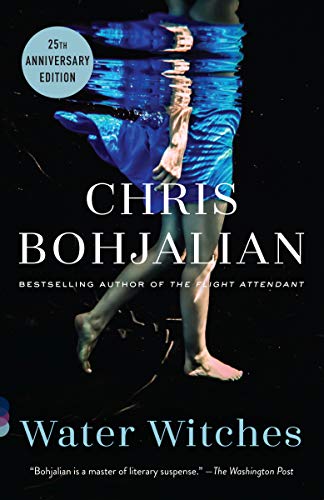
I just got done reading a horror story. Or, maybe it’s not supposed to be a horror story, but it sure gave me nightmares. Water Witches by Chris Bohjalian (1995, Simon and Schuster) is the story of a Vermont attorney and lobbyist who learns the hard way that what he does to make money is not in his family’s best interests.
Scottie Winston represents industry, which in Vermont is tourism, logging, and maybe the occasional paper mill, stone-cutting operation and sugar bush. In this story, Scottie’s client is an aging ski resort that wants to expand, needs to expand in order to compete with the glitter and glamour of Colorado and California winter sports. The resort wants new trails, a new gondola, and most particularly new water rights in order to manufacture snow — since the New England climate of the late 20th century is not providing this basic service to skiers. However, if the climate isn’t dropping snow on the ski runs, it’s also not dropping snow — or much of any precipitation — on anyplace else either. The water rights are slated to come from the Chittendon River. But the river is the lowest anyone has seen in memory. And while ‘droughts come and go’, it’s starting to look like this one might be sticky, an unwanted new normal, and the river is starting to look endangered.
The rest of central Vermont is in danger as well. Wells are drying up. Forests are burning down. Jobs are vanishing. People are dying. And Scottie’s family is at the center of this storm.
By machinations that nothing but creative license can explain, Scottie, a slick flatlander attorney with decidedly neoliberal leanings, somehow married into the Avery clan. These women are dousers, talented and sought after and uncanny. They are locals with deep roots in their town. They are nonconformist in the oddly backwoods conservative way of many old-time Vermont families. They wear boots and overalls. They are bog-standard Earth Mothers. And they are all women, biology notwithstanding.
Scottie’s sister-in-law, Patience, is world-renowned and brilliant and rather a paradoxical kook. She does not hide her derisive opinions about Scottie’s outsider status, his chosen career path, or his unfortunate possession of Y-chromosomes. But she values ritual and tradition sufficiently to want to be given away by a man when she decides to marry for a third time — to Scottie’s principle opponent in the Vermont legislature (and one of his good friends). Patience is also teaching Scottie’s daughter to douse — and Miranda Winston might be the most powerful Avery woman yet.
So small town and small state hijinks ensue. There are church functions, protest rallies, Peacesicles and properly doused evaporators. There is real loss and fear under the cloudless skies. Gardens wither away. Corn is dead by the Fourth of July. The drilling of new wells overburdens fixed incomes. One old man’s dreams go up in flames. And a little girl has nightmares about the dying trees.
Into the midst of this drama sashay three mountain lions, the catamounts that are beyond rare in Vermont. They are assumed locally extinct despite occasional, but always unverifiable, sightings. So in spite of these premature rumors of the catamount’s ultimate demise, while Scottie and Miranda enjoy a summer evening ski lift ride, they look down and see a wildcat mother and her two cubs. Unmistakably alive. Huge, fierce and beautiful. And apparently in residence on the same land that Scottie’s client ski resort wants to clear for its new runs.
Well, this would cause anybody to revisit their life choices. Scottie is already troubled by the drought, already concerned that climate change might be having impacts on his life, and already worried about his daughter who seems to viscerally feel the pain of the animals and the wood and the waters. Mountain lions are one perturbation too many. And soon this pragmatic lawyer decides that some things are untouchable. There are more author machinations to work out all Scottie’s problems, but the end of the book is both unexpected and completely predictable. And exactly right.
So that was all good… but…
The horror comes from my situation as a Vermonter. I live in the same area, probably not far from the ballpark where Scottie played softball. I know women like the Averys, like the aging twin sisters who lose their well, like the reporters who give Scottie indigestion and the earnest legislators who don’t seem to have a good grasp on the concept of boundaries. I have eaten, maybe not Peacesicles, but Sisters of Anarchy ice cream and have watched the glorious weirdness that is a Vermont holiday parade. And like Scottie, I live in scary times.
The fickle ski seasons and development pressures are barely the beginning. There are slopes being cleared, not by human saws, but by emerald ash borers and red pine scale. Sap runs are down year after year. Orchards are failing and hay meadows are brown. There are a few success stories. Catamounts are, in fact, still roaming the hills and in greater numbers than in the late 20th century. But once prosaic creatures like butterflies and lightning bugs and the iconic loons of our woodland waterways are almost unknown these days.
What’s more, I know this isn’t temporary. This isn’t a here-today-gone-tomorrow blip in the climate. Drought is a permanent state in my state. Wells will continue to run dry. River systems will struggle. Species will go extinct. Families will lose their lands, their livelihoods, their dreams. The waters of Lake Champlain will drop to levels so low that agricultural and human waste make up a not insignificant percentage of lake liquids. And, while there are not the huge fires like those that surrounded my old home in Albuquerque, every day something around here will burn and there will be loss. Moreover, unlike Scottie, my cloudless skies are not blue, but dingy white or greyish yellow from forest fires as far away as British Columbia — and sometimes so thick with ash and smoke that we have to close up our houses and break out the COVID masks in order to breathe safely. We have ballgames cancelled because of poor air quality.
This is a nightmare world. And it is directly attributable to decisions made in boardrooms of the 20th century. Decisions not unlike choosing tourism jobs and new ski runs over mountain lions and sustainable ecosystems. Decisions that are still being made today even as we choke on smoke from hundreds of miles away and wonder how long the well is going to hold out. If I met Scottie today, I’d probably punch him. Or maybe not. Because I would see my own fear mirrored in his eyes. And I’d understand that, but for a very few decisions, Scottie’s story could be my own.
But the worst of this story, the thing that absolutely unnerved me, is that this was written 25 years ago. And nothing has changed in those boardrooms despite nightmares becoming daily normalcy.
So I closed the book feeling satisfied as a reader. But as a Vermonter? I wanted to cry. And I am very frightened for this weird and wonderful world. Because author machinations are not going to step in and save this story.
©Elizabeth Anker 2023

 By My Solitary Hearth