


I’m working my way through Rhyd Wildermuth. This was not a planned exercise, but I find his writing so compelling and original that I just keep picking up one book or essay after another. The most recent is All That Is Sacred Is Profaned: A Pagan Guide to Marxism, which is almost exactly as advertised — a clear and concise explanation of Marxism told in the language of grounded spirituality.
Wildermuth uses engaging metaphor and illustrative stories to give materiality and weight to political and economic concepts. History is made tangible. Real relationship and dependence are centered in his narrative. It makes sense.
Though there are a couple passages that felt a bit contrived — or maybe un-sensed — there are few better descriptions of Marxism. However, there is one curious weakness in this book: it doesn’t actually talk all that much about what Paganism (or paganism) might bring to the discussion of economics and social organization. Wildermuth talks of re-enchantment but doesn’t talk much of how pagan lifeways and ethics are uniquely capable of undermining capitalism and other symptoms of modernity. He seems to want to bring magic to Marx, not show that a pagan worldview is what Marx was unwittingly trying to create.
Consider the definition of “paganism”: these are the lifeways of the land. These are people who live embedded in their body-scaled, material place. Paganism is not a belief system; it is a practice. It is a being. It is how we live and why, physically, we live that way. Pagans are part of the world, not apart from it, and they view this whole as sacred.
Wildermuth’s clever title is never completely explained, but here is what I think it means. For capitalism to work, in fact for most forms of economics to work, the all that is sacred, the holy in the world, the spiritual and numinous, all must be turned into lifeless matter. All must be made into resources — whether raw materials or labor. All must be shorn of integrity and made into things that can be used by capitalists — who reserve personhood, interiority, agency and value for themselves. They can and must exploit things, not beings, in order to churn those things into private wealth. So all that was sacred is desecrated by capitalists. All that is living is rendered inert and empty. All that is the body of this hallowed Earth is made into feedstock for capital.
Paganism is incapable of reproducing capitalism. People who are of the land, people who are in acknowledged relationship with other beings, people who worship that state of holy interbeing, can never take from the land, from the system that supports all things, for personal gain. Because this is arrogant and rude. Because this is destructive and foolish. Because it is wrong. People who see the world as holy can’t take the life from that world, neither physically nor metaphorically. (Which amount to the same thing in practice.)
I might have thought Wildermuth would have stressed this. Pagans are more Marxist than Marx. Marx was concerned with solely human relationship and equity. Pagans don’t recognize human exceptionalism. We know there is no such thing. There is no distinction between human life and all the rest of the planet. There are no Others, no Away that will absorb all the damage of self-absorption. All is connected and interdependent. There is no shipping violence and harm elsewhere, no lesser bodies to do all the work and carry all the pain. There is no hierarchy of worth — everything is sacred. There is not even separability. There are no real boundaries between one being and another; it is all one interrelated, glorious whole.
Paganism is the exact antithesis to capitalism — or, more precisely, paganism is the antithesis to the foundational assumption of human specialness and supremacy that makes capitalism possible. Humans are not special in the pagan world view. Humans are one being among many, all equally necessary and good. In that way, paganism is radically egalitarian — all beings are valued because they are. It is also radically real, rooted in actual embodied life with no mystifying screen of human ideation. It is actual give and take and give again in joyful material reciprocity. Paganism is just; it does not need justification. Paganism is so starkly substantial, capitalism, standing in paganism’s shadow, is revealed as a cracked and crevice-ridden abstraction, the whining want of infantile minds.
A Pagan economics is ecological. Capitalism is mere fantasy. Paganism is being. Capitalism is taking. Pagans are alive to a sensical world. Capitalists have to kill the world to own it. Marx came close to understanding all this but tripped over the hurdles of his times and prejudices. So unfortunately, humans are still special in Marxism; the world is still inert; value is earned, not intrinsic; and work is the measure. Marxism is still a human project, not a world project. It is still oriented around human want, not around balance of many needs. With this core of anthropocentrism (and further hierarchy of humans within that center), it is un-ecological, though much less so than capitalism.
Still, Marxism is a good starting place for those humans who have not yet discovered embodied wisdom. It is a step toward paganism. It does not, in itself, re-sacralize the world, but you can see that place from Marxism. You can orient yourself toward the sacred. And when you are ready, you can root yourself in the holy land and live in the real, wonderful world of the pagans.
Because, the Pagan path is the way out of this mess.
Halcyon Days
Here is an idea that seems to have forgotten its roots entirely. In our times, “halcyon days” refers to a golden past, a time when everything was wonderful. Sometimes it just means “youth” with overtones of innocence and insouciance. But this name has nothing to do with nostalgia. In fact, it’s an allusion to a very sad tale from Greek myth, a classical just-so story explaining fair weather around the solstice.
In the story of Ceyx and Alcyone, both are transformed by their undying love into kingfishers. Alcyone is the daughter of the winds. Every year, her father calms the winds over the Mediterranean while Alcyone sits on her nest. But this isn’t a happy tale. She is a bird because she committed suicide after losing her dear husband to shipwreck.

This rather dark story with the marginally happy ending does describe Mediterranean weather around the solstice. Midwinter is a time of slack. The changes in temperature and pressure that drove autumn storms have subsided, and they don’t pick up again until the days are noticeably lengthened. The occasional winter storm finds its way from the North over the mountains, but most days the weather is monotonously still, sunny, and cool. Good for nesting birds, but not much else. No wind means no sailing, for one thing.
If they thought the becalmed sea was a “golden” time, the story they chose sure doesn’t reflect that belief. There isn’t anything happy about Alcyone except that she gets to be undisturbed — as a bird, not as a woman. So I don’t really understand how we slather her name on our rose-colored memories.
But then, we also name those who go seeking adventure and working great feats in the service of mankind “heroes” — after the goddess of matrimony, child-birth and home-life, Hera. So we clearly have translation issues…
In any case, the ten or twelve or fourteen days around the solstice are named the Halcyon Days. The Old Farmer’s Almanac says that golden period of slack begins today. It seems perfectly in accord with the day and the weather to curl up with a good book and nest for the next two weeks or so.
A story for the Halcyon Days…
I wrote this over twenty years ago. It goes with my Midwinter story collection… There were publishing aspirations once upon a time, but I think I’d rather just share them. Though if someone wants to illustrate them… Anyway, here is my story of Ceyx and Alcyone.
Ceyx and Alcyone
Ceyx was the son of Lucifer, the Morning Star, and he was king in Thessaly. He was married to Alcyone, daughter of Aeolus, King of the Winds. They loved each other above all else and could not bear seperation. But on a time Ceyx was obliged to travel over the seas to consult the oracle. Alcyone was distraught, daughter of the winds that she was. She knew the destructive power that the winds could unleash upon the waves. She begged Ceyx to send others in his place, or at least take her with him on the voyage.
Ceyx, then, was also moved to tears, for he returned her great love in equal measure. But Ceyx could not entrust his duty as king to his noblemen. Nor would he willingly cause Alcyone to face the perils of the high seas. So he boarded ship alone and set sail. Alcyone watched from the beach with a leaden heart as her love drifted out of the harbor. She remained there, cold on the sands, long after the ship was beyond mortal sight.

That very night Alcyone’s fears were proven true. A raging storm broke over the ship. The red lightening set fire to the masts; the wind tore the sails and set the waves pounding; the rain came down in rivers, overwhelming Ceyx’s ship. Every man aboard was mad with terror, every man but one. Ceyx was at peace, calmly facing his own death, knowing that he had saved his beloved Alcyone from such a fate. He uttered her name as a final prayer as the waves crashed down and smashed his ship into oblivion.
Alcyone waited with as much patience as she could summon for Ceyx to return. As the days passed she sighed often and prayed unceasingly, to Hera most of all, patroness of all devoted wives. Hera heard her prayers, but the great Lady also beheld the destruction of Ceyx and knew Alcyone’s prayers were futile. Nothing would bring him back from the realm of Hera’s dark brother. So she thought to gently bring grave tidings to Alcyone in a dream.
Hera sent Hermes to Hypnos with the request that he wash Alcyone in sweet sleep and then send his children to relate the tale. Hypnos’s son, Morpheus, could assume the shapes of men in dreams. He was sent by his father to Alcyone in the shape of Ceyx, robed in seaweeds and dripping salt water on the floor.
“My dear wife,” said the shadow of Alcyone’s dearest. “My dear wife, await my return no more. I am gone forever under the seas. Await me no more, but shed salt tears in my memory. Never will I return. There is no hope. Now is the time to grieve. Farewell, my love.”
Alcyone, in her sleep, moaned and reached out her arms to embrace her husband, but he was gone. She woke with tears already coursing down her fair cheeks, knowing that her dream spoke the truth. Her dear Ceyx was dead. She no longer cared for life, so much did she long to be near him once more.
Before the dawn, she rose and made for the same strand where she had watched Ceyx sail away. Dully she gazed on the grey waters as the sky turned from slate to gold. As the sun rose, the waters were made into rippling light. All but one small patch far out on the harbor.
Alcyone watched this blot of darkness, and it seemed that it was drifting toward her. When it was still far out she realized it was a dead body, its face hanging down into the sparkling waters. With wide eyes she gazed transfixed as it came closer and closer, till finally it came to rest on the sand. A great wave, pushed on a sudden strong wind, turned the body, and there she beheld the face of her dead love.
She cried out in anguish. But the great wave carried both her and her husband’s body away from the beach. And suddenly she found that she was above the waters, riding on the winds. She looked to her hands and saw bright feathers. She looked to the terrible body and saw that it was gone. Instead, she found her lover’s eyes set in the body of a noble kingfisher. They flew to a perch of seaweed, tossed by the waves, and great was the joy that they shared at being reunited. Never would they part again.
For because of their pure devotion, the Gods took pity on Ceyx and Alcyone and turned the both of them into kingfishers. They live together happily on the seas to this day. And each year at Midwinter there are seven days when the winds are restrained by Alcyone’s father and the seas are smooth as glass. For on those days, Alcyone sits on her brood, and her father will not disturb her watery nest until her children take wing.
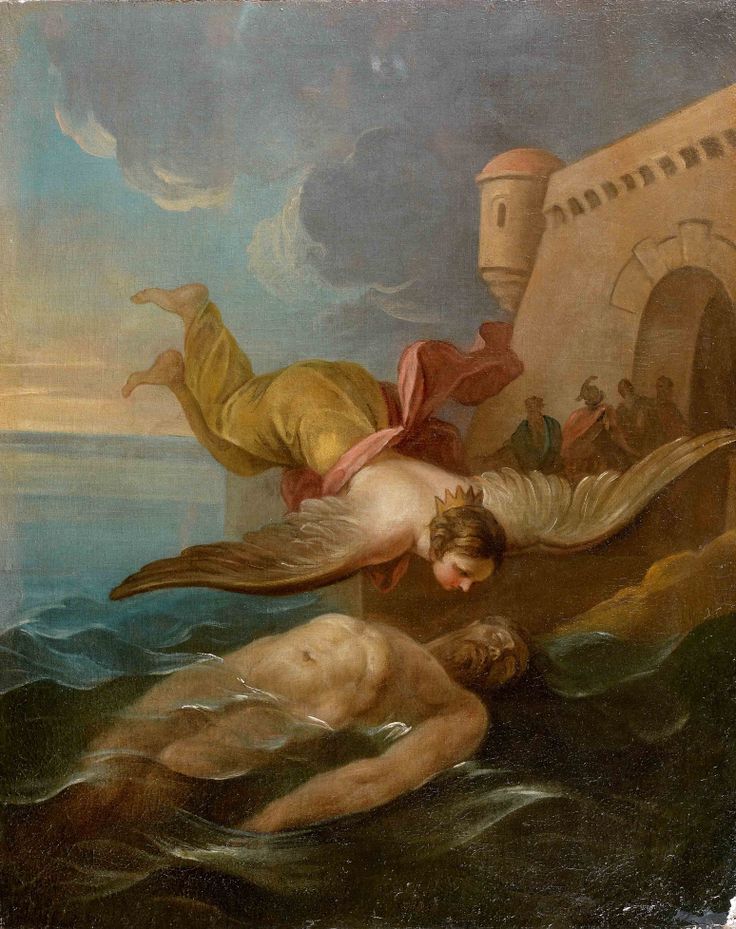
©Elizabeth Anker 2023

 By My Solitary Hearth
As you know, I enjoy your writing. Your piece today reminds me of this sonnet by William Wordsworth:
The world is too much with us; late and soon,
Getting and spending, we lay waste our powers;—
Little we see in Nature that is ours;
We have given our hearts away, a sordid boon!
This Sea that bares her bosom to the moon;
The winds that will be howling at all hours,
And are up-gathered now like sleeping flowers;
For this, for everything, we are out of tune;
It moves us not. Great God! I’d rather be
A Pagan suckled in a creed outworn;
So might I, standing on this pleasant lea,
Have glimpses that would make me less forlorn;
Have sight of Proteus rising from the sea;
Or hear old Triton blow his wreathèd horn.
LikeLiked by 1 person
I am with you on this one, Eliza, at least until the very end. I don’t know that Marxism provides a better vantage point than capitalism from which one might see the need to “re-sacralize the world.” Marx seemed to have his feet pretty well planted in the same soil that bred all the ills we must now contend with. And then there’s the small farm advocates like Wendell Berry or Chris Smaje: they operate from capitalist premises (the small farms they tout are privately owned) but their writing veers more in the direction of paganism, as you are defining it here, than anything I ran across in Marx. For them, as for you, it is more about scale, and Marx wanted to seize all the big industrial things capitalism created and put them to what he hoped, in the hands of the right people, would be humane purposes. He did not care for capitalism but he was on board with Progress as conventionally understood. Turns out that matters a great deal, for reasons a pagan and a small, freehold capitalist are both equipped to appreciate.
I am curious to see how Wildermuth finds paganism in Marx and appreciate your calling it to our attention. I just bought, on your suggestion, his book on paganism, but have not read it yet. Sounds like an interesting writer coming at things from a unique perspective – the thing I always appreciated about David Graeber … and, if you’ll tolerate some flattery, about you!
Brian
occupythehearth.org
LikeLike
I suppose it is true that Marx wanted Big Things and Progress, and maybe it was always Engels who was empathetic and human scale. But a socially oriented perspective and one that at least recognizes that the work done to maintain this enterprise is not benefitting the workers (nor much of anything else) seems to me to be better able to see reality than capitalism. What bothers me most about Marxism and socialism more generally is that it always comes from a place of privilege and carries that need for top-down leadership, hierarchy and status right into the “workers” revolution.
Glad you picked up Wildermuth. His is an interesting view of the world!
And flattery is always tolerated, though it does make for pink cheeks.
Cheers!
LikeLiked by 1 person
Thanks for posting this piece about Rhyd Wildermuth. I wasn’t familiar with him and the other good folks at “Beautiful Resistance” but look forward to reading more of his/their good stuff. The story of Ceyx and Alcyone is indeed a good metaphor for the human condition in the 21st Century. The human species does seem to be hell bent on committing suicide over the pain of living in a world of wounds. Let’s just hope that the goddesses can be merciful and return us to what we have always been, enchanted animals.
I particularly liked your summary of All that is Sacred is Profaned, “A Pagan economics is ecological. Capitalism is mere fantasy. Paganism is being. Capitalism is taking. Pagans are alive to a sensical world. Capitalists have to kill the world to own it.” While I do agree with Marx on the primacy of a “home” economics, I wish that Wildermuth would have focused more on the other two components of the triad of evil, the patriarchy and violence of the State. Perhaps he did in his other writings? Capitalism is a relatively recent part of the human experience and is more akin to a symptom, rather than the root cause – the virulent disease of patriarchy. Here I’m thinking of Silvia Federici’s Re-Enchanting the World.
I was also intrigued by your critique of All That is Sacred is Profaned. “However, there is one curious weakness in this book: it doesn’t actually talk all that much about what Paganism (or paganism) might bring to the discussion of economics and social organization.” For that discussion of Pagan economics and social organization (power as collective action), I would highly recommend one of my favorite books, Pierre Clastres’ Society Against the State.
LikeLiked by 1 person