

The Wolf Moon goes dark today at 7:36am (what happened to this month!), so the crescent Snow Moon might be visible tonight at sunset, though it would be faint and you’d need a very flat western horizon to see it. In traditional lunisolar calendars, the Moon is not new until you can see that crescent. There were functionaries who would look for its first appearance and declare that the beginning of the month. Today, there are computer programs that calculate when it would be visible if someone were looking. The Moon also does not become new until moonset, because days, and therefore months, start in the evening in lunisolar calendars.
I dispense with all that because I haven’t the time or the energy, but also because I live in the mountains, by definition an obstructed horizon in all directions. I hardly see the crescent before it’s several days old. (Also hardly see moonrise… or sunrise… and etc.) For me, the day after the dark moon is the new moon, and I don’t actually care all that much to make it any more precise than that. Tomorrow, is the new Snow Moon for me. But the Chinese calendar sticks to the ancient traditions of calculation. (It mostly is the ancient traditions of calculation…) So, moonset on January 29th welcomes in Chinese New Year — the Year of the Wood Snake.

The solar year, the time it takes for the Earth to orbit the sun, is slightly more than 365 days long. The traditional Chinese calendar is lunisolar — it incorporates the moon’s cycle into the solar year. A Chinese calendar month is 29 or 30 days long, about the length of time it takes for the moon to orbit the earth (which actually takes 27.3 days, but from our perspective appears to be 29.5 days from new moon to new moon because of fiddly geometry-of-light reasons). A normal Chinese lunisolar year lasts from 353 to 355 days, and to keep the calendar in sync with the sun and the seasons, the Chinese add an extra leap month about one year out of three.
Most years, Chinese New Year falls on the second new moon after the winter solstice, which is around December 21. The exact calculation of the New Year is a bit tiresome and we’re just going to leave it alone. A shorthand is to remember that Chinese New Year usually occurs with the New Snow Moon. Chinese New Year is fixed to the period between 21 January and 21 February. This fixed window of time is one of the restrictions that make determining the date tiresome — there was a Board of Mathematics responsible for the calculations — but it keeps the lunar year from drifting away from the seasonal year as the Islamic calendar has.
New Year celebrations around the world are a time for prognostication. Hence Groundhog Day and First Footing and any number of the divinatory customs associated with Midwinter and Samhaine. In China there is a tradition of determining the tenor of the upcoming harvest from the number of days between the solstice and the lunar new year. If there are 50 days, food supplies will be sufficient. Every day under fifty is a deficit; every day over fifty is a surplus. The arithmetic usually works out to a gloomy prognosis because there are only 52 days between 21 December and 21 February, the latest date allowed to the New Year.
Chinese New Year is also called the Spring Festival, and the new lunar year is sometimes set to the new moon closest to the beginning of spring which is on or around 4 February in the Chinese seasonal calendar. This is obviously difficult, not least because the onset of spring varies. There is also the regular problem of early and late New Years when two new moons can be evenly spaced on either side of 4 February. The problem of which to choose is also a task for the Board of Mathematics. So this method of determining the new year is seldom used, though it gives the celebration its more common name in China.
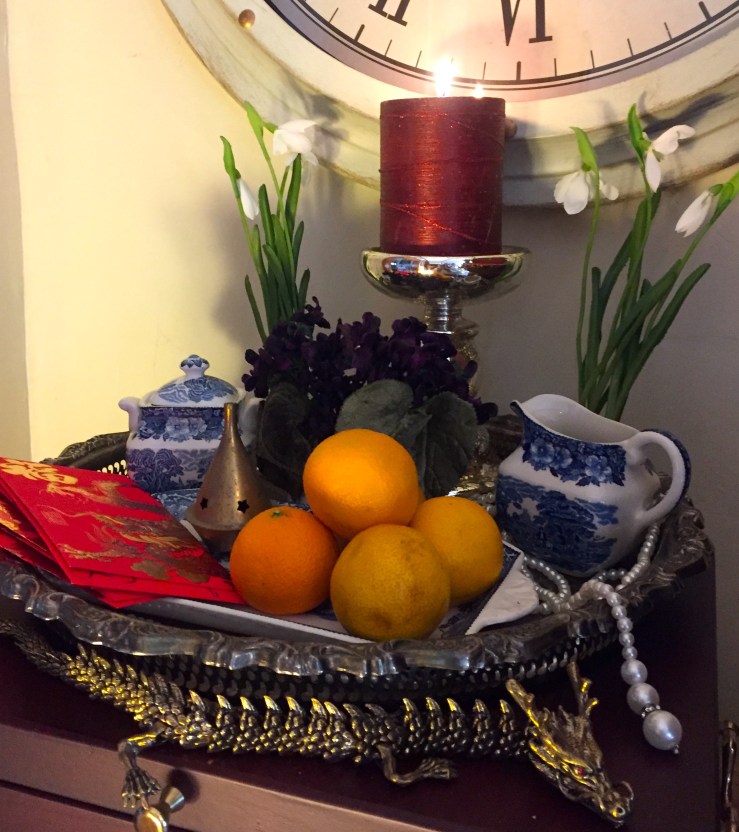
The first month in the Chinese calendar is called the Holiday Moon, and there are ritual celebrations throughout the month. The Chinese New Year Festival itself lasts for the first fifteen days — from dark moon to full. There are both religious and secular rituals. On the first day people welcome the gods of heaven and earth. There is no work done — or allowed — and no travel. Using sharp tools is considered inauspicious, so cooking is done the day before. Fireworks are lit in the evening, and in traditional communities wells are closed for the first two days of the year to symbolically allow Fire to transform the old into the new. The second day is for prayer to both gods and ancestors. The next two days are for men to pay respect to the fathers of their wives. On the fifth day, there is no travel; people welcome the god of wealth into their homes. The next week is given over to community and family gatherings as well as temple visits. The celebration culminates in the Lantern Festival with its colorful lights, dragon and lion dances and vast piles of rice dumplings.
It is traditional to set out platters of oranges — the symbol of happiness — and candied fruit to start the new year sweetly. Wishes for health and good fortune are written on red scrolls and hung around the home. As this is a celebration of the awakening spring as well as the new year, flowers and floral decorations abound. When visiting others, it is customary to bring a bag of oranges or tangerines as a gift, and any candies eaten off the tray of happiness are replaced with red envelopes containing coins for children. These coins are incidental; it’s the envelope that is important. Red is the color of good fortune and abundance. The coins merely accentuate the symbolism.
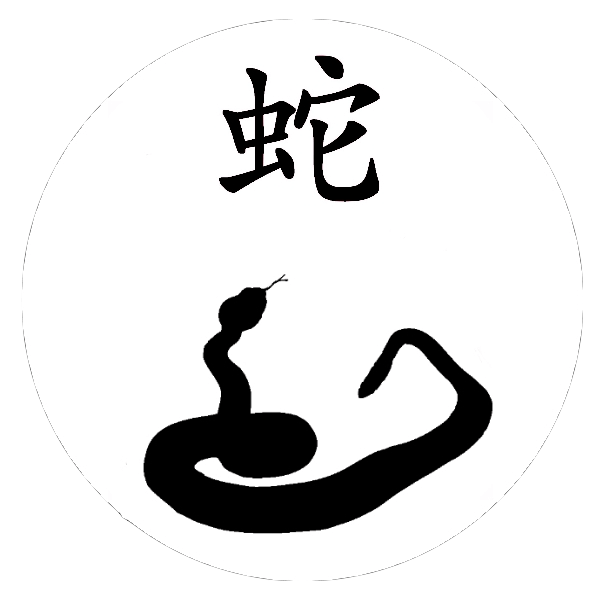
The cycle of years in the Chinese system follows the cycle of the twelve Earthly Branches, each of which is associated with a sign of the zodiac and an animal that represents the branch. These symbols are also applied to the hours of the day and the months in the year. The Snake month is the fourth in the year and falls around May or June. The hour of the snake is 9-11am (which, yes, is two hours… but whatever… it’s their calendar).
Years are named for the appropriate animal symbol in the cycle, and those born in a given year are thought to have the characteristics of that animal. This is the year of the Snake, not one of the more auspicious years to be born. For this reason, sometimes this is called the Year of the Little Dragons, to address feelings of inadequacy. Snakes are supposed to be highly intelligent, though they are also said to lack a strong moral compass. They are cold and quiet, ruthless and devious, using any means to accomplish what they believe is necessary.
I don’t know if this applies to people born under this sign, but it certainly seems like 2025 is warming up to be a year without scruples. On the other hand, there doesn’t seem to be an abundance of intelligence to go around. So make of that what you will…
The Earthly Branch is further refined by adding an elemental qualifier. This is the year of the Wood Snake. In the system of Chinese elements, Wood stands for growth and new beginnings. It is symbolized by the color blue and is associated with the east, with springtime, and with the wind. It is also fuel for Fire, the transformative element.
Maybe this Snake year will be a time when ruthlessness leads to transformation and thereafter a new spring… Next year, 2026, is the year of the Fire Horse. Horses are energetic and free and good-natured, if not the sharpest. Everybody loves a Horse. So…
Hey, I’m reaching here… let me have my harmless delusions… Anyway…
Happy New Year to all who are celebrating today!
©Elizabeth Anker 2025

 By My Solitary Hearth
This has been a fascinating read!
LikeLike