

The Sap Moon is full at 2:54am (EDT) early tomorrow morning. This Sap Moon is also a Blood Moon, or at least people will call it that these days. That appellation is a recent attempt to glamorize a full lunar eclipse which also happens very early tomorrow morning.
The moon enters the penumbral phase at 12:55am, becoming just a tad dimmer than a full moon should be. By 1:47am, the moon is about half in shadow, and at 2:26am totality — the red phase — begins. The peak eclipse is also the peak full moon and hits at 2:58am. Then the eclipse reverses itself, with totality ending at 3:31am and the whole thing over at 5:05am.
This eclipse is visible throughout the entire western hemisphere though the final penumbral stage is cut off by moonrise in Brazil. Here is an animated map. Here in New England, we may have clouds to contend with, but the skies will probably not be completely covered. So we might be in for a real treat. The red moonlight makes the clouds smolder. Which does make me wonder: why don’t we call this the Ember Moon?
Because reasons?…
Calling this the blood moon may seem like some dark ancient prophecy, and it does indeed have ties to prognostication. Bob Berman at The Old Farmer’s Almanac tells us that this name is media hype generated around the 2014-2015 string of consecutive full lunar eclipses. Some of the end times wing nuts decided that this unusual series of night sky events was a sign of the coming rapture. They based their claims on a few references in Hebrew-Christian texts, one of which is John’s Revelations (which is not at all the drug-induced hallucinations of a half-starved, hunted, and incredibly isolated late 1st century mystic who may or may not have been named John…). The Revelations quote is “And I beheld when he had opened the sixth seal, and, lo, there was a great earthquake; and the sun became black as sackcloth of hair, and the moon became as blood.” Which of course, begs many questions, not least what happened to seals one through five? (And have they been opened yet?)
In any case, the world did not end. Our culture did not even end, though it does seem like 2015 might be a reasonable marker of the beginning of the end — if you discount all the other reasonable markers that have shown unequivocally for decades that we’re living in an inexorable train wreck. However, 2015 is when the shale oil boom that had propped up the ailing conventional oil economy began to slide into bust. But I digress…
The world did not end and we are not going to see a rapture any time soon, however the bloody name stuck; and now every beautiful lunar eclipse is slapped with this gory epithet. It’s not even accurate. The full lunar eclipse does turn red, but it’s far more orange and gold than blood. If your blood is that color, I think you have worse problems than the end times.
What we are seeing is our atmosphere and — and this is far more interesting — bent light. That we can see the moon in eclipse is proof that light does not travel in a straight line — or more accurately that lines in a curved universe can’t be straight. Isn’t that fascinating!
In a lunar eclipse the moon is in Earth’s shadow (remember this?). Most of the sunlight that the moon normally reflects back at us is blocked in an eclipse, but there are sufficient light waves that are curved around our planet to hit the moon and make it glow dimly. The Earth’s atmosphere then plays its hand by scattering all the blue wavelengths (why the sky is blue, by the way, for when your 5-year-old next asks), leaving us with the warm end of the spectrum — the yellows, oranges and reds. I suspect there’s fantastic infrared radiation in there that we can’t see because those long wavelengths curl more readily around our planet.
This is what a full lunar eclipse looks like to our eyes.
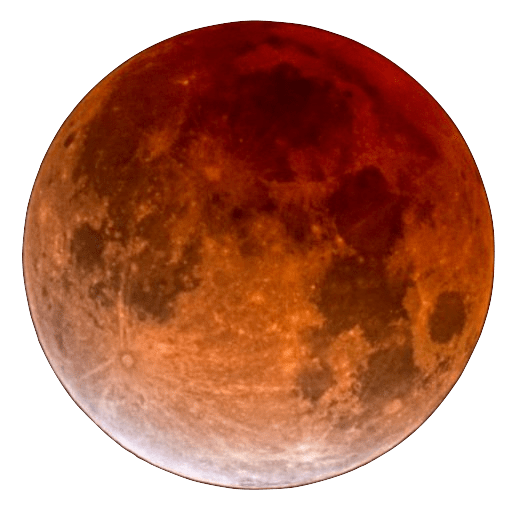
To me, this is far more a ball of rust than a clot of blood. For all that the moon has nothing to do with this light show except serving as a mirror, rust is actually close to what you are seeing as you gaze at the moon. Blood and rust both get their red color from oxidized iron, and the moon is an enormous glob of iron-rich silicate rock. What the moon does not have is an atmosphere rich in oxygen. So the moon is not actually rusty red; it is dull steel grey.
Because the geometry of eclipsing works best around the equinoxes, it is not unusual to have a Blood Moon for the full Sap Moon. However, the next one visible from my part of the world will fall in a late Snow Moon on March 3, 2026.
I don’t think the world will end then either…
But you never know.
©Elizabeth Anker 2025

 By My Solitary Hearth