


St Joseph, Patron of Fatherhood
To me Christianity seems to be rather quiet on Joseph, the husband of Mary and the step-father of their deity. That may be because I’ve never lived in an Italian neighborhood where Joe is the patron saint of roughly half the male population (though I did get a faint whiff of this from my Uncle Joey who played trumpet and ran a nightclub in Chicago). There are many people and places — and even hospitals — named after Joseph, though some in the Anglo world are named for the later Joseph of Arimathea, the man who assumed responsibility for Christ’s crucified body. But St Joseph has few prominent churches, no monastic orders or major centers (to my knowledge), and a far less conspicuous cult following than the other principal people of the New Testament.
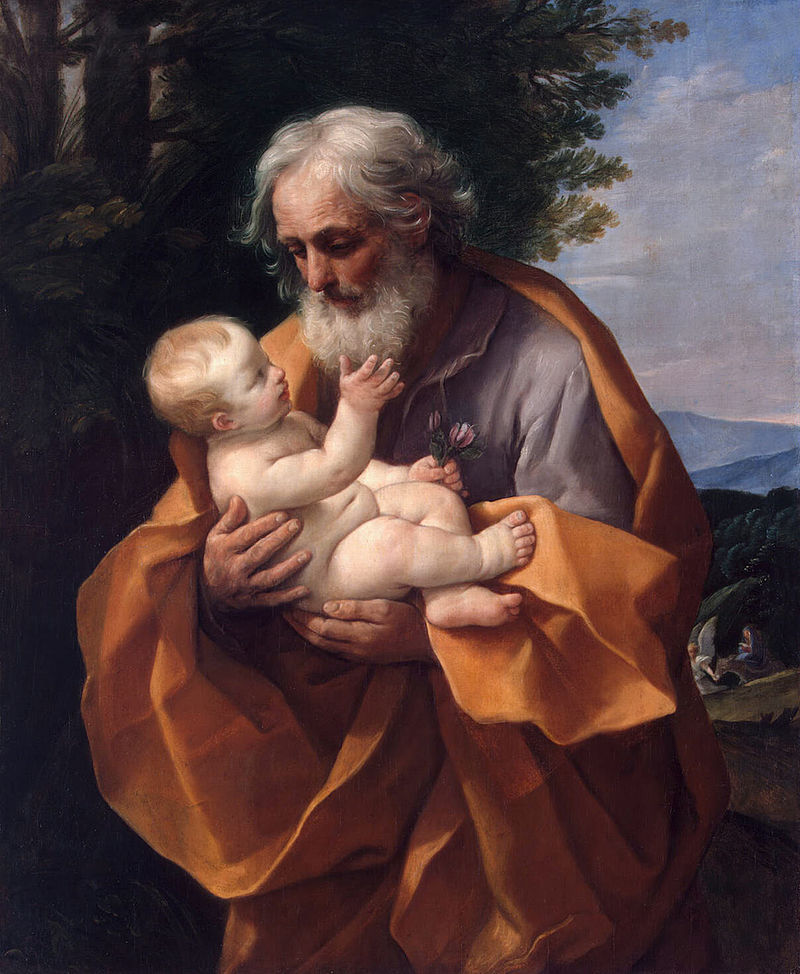
Furthermore, Joseph has no voice in the New Testament. We don’t know how he felt about the role he’d been dealt (though we might reasonably infer…). He disappears from the story shortly after presenting Jesus to the Temple. He is not, for example, present for any of the miracles; nor is he a disciple. From this absence, it seems that many artists have concluded that Joseph was an old man before Christ was born and therefore reached the end of his life long before Christ reached adulthood. In pronounced contrast with Mary’s fresh youth, Joseph is almost always portrayed in his dotage with white hair and wizened flesh.
I think perhaps this silence is because St Joseph was the sort of craftsman who quietly does the necessary work and keeps his opinions to himself. We all know that guy. He is competent. He is calm. He is dependable and generally affable. He is not rich but seems to embody a higher form of quality. He has kind eyes, though he rarely displays stronger emotions. He works with his hands and pours all his love into the wonderful things he produces. He seldom speaks, and when he does he uses few words and a soft voice. We must lean in to listen and learn. That guy is also always old, having lived beyond the need for noisy acclaim. He always looks like St Joseph.
This is the St Joseph that I picture in those few stories that include him. He is the archetypical Craftsman. He hovers protectively in the shadows, ready to do what must be done, even if that means enduring ridicule. He skillfully builds shelter for his young wife and infant step-son. He teaches the Son of God how to be a Man.
St Joseph is honored as patron saint of many places, including Canada and Mexico. He watches over families, fathers, expectant mothers, travelers, immigrants, house sellers and buyers, carpenters, craft-makers, and engineers, among others. He represents the common working class, though a separate Feast of St Joseph the Worker was created in 1955 by Pope Pius XII in response to the rise of Communism. This feast day was set on May 1st to compete with the secular celebration of laborers.

(Note in this painting that while Joseph has a faint halo, Jesus does not
— though he does seem to have lingering attendant angels.)
March 19th is St Joseph’s Feast Day (though complications arise if the 19th falls between Palm Sunday and Easter). In some predominantly Catholic countries, this day doubles as Father’s Day. This day is a Solemnity of a Saint, and as such is one of a very few days in Lent when the vestments and altar cloths are changed from somber purple to white or gold, the hymns are more joyful, and the Creed is said. In short, it is a break from Lent, though it is a quiet break with little raucous celebration — except in a few places. It is largely a day of solemn processions, of erecting elaborate altars of blessed food and then donating it all to the hungry, and of showing special attention to fathers. It is a day of honoring the stalwart strength of the men who gently guide our hands into adulthood.
©Elizabeth Anker 2025

 By My Solitary Hearth
Thank you for highlighting Joseph! Where would Mary have been without his care.
LikeLike
Poor Joseph, having your fiancé, a 14-year-old virgin, knocked up by her Heavenly Father, is enough to make any man’s life a little awkward. Social issues of the other man aside, is it any wonder that Joe has been consigned to the theological dust bin of history? Everyone knows that it always depends on who your father is.
LikeLike