

The goldenrods began blooming last week, the garlic is ready to dig, and the calendula are getting unruly. This is when central Vermont starts to see these sorts of signs of the approaching autumn. The very tops of the maples start to glow in yellows and reds. Many mornings begin in fog, and many evenings end in clear, deep blue skies. And there is a lessening of the heat… normally…
But not this year… Though the forecast keeps telling us that highs will drop down into the upper 70s (°F) sometime in the next ten days, by the time we get to those days, the cooler temperatures have evaporated from the forecast. Moreover, we have high humidity this year… which is unusual this far north. The jet stream usually clears that funk out… So, the highs in the upper 80s feel more like mid 90s. But worst of all, airflow has been sluggish but coming largely from the northwest… where there is fire. Canada’s smoke has been regularly blanketing much of the upper Midwest and the Northeast. On Saturday, the air quality index shot to 176, meaning it was “unhealthy for sensitive groups”… or just plain unhealthy… You can’t see clearly across the valley right now. You can’t inhale without a creating a burning tickle in your throat. And if you have allergies at all, your eyes are going to feel full of grit within minutes of stepping outside. On Sunday evening, my son reported that a trip from his apartment to the trash bins a few dozen meters from the back door of his building caused his eyes to start watering and triggered a cough that lasted quite a while after he went back indoors.
Yesterday brought a little relief in the morning. The morning fog was grey rather than brown. But by evening, the yellow haze had settled over my town again. This morning, the sun is rising in ocher skies. But I need to open the house to let the heat out before we begin the day’s heat (high of 89°F predicted for today). So, I’m hoping that the general flow of warm air out of the house and into the cooler dawn air will block the flow of smoke into my house. I’m not sure this is working completely… I can already feel it in my throat.
However, if you live far enough from smoke, this is the moment to get in some predawn skywatching. Early tomorrow morning, the Delta Aquarid meteor shower will be its most active, around ten per hour, which means if you watch for ten minutes you’ll likely be able to wish on a falling star. Predawn is no longer excruciatingly early at this time of year. In all likelihood, you will be up and getting ready for work long before sunrise, and if you rise at 4am or so, the skies are still fully dark. Give yourself a treat and go stand outside for a few minutes and savor the night. And it’s a double treat for those of us wilting under this summer’s sun — because the hour before dawn is always the coolest. Beautiful night skies and relief from either relentless heat or equally relentless air conditioning.
If you keep getting up early to watch the skies, look for the ending of the Dog Days, heralded by the rising of Sirius, the Dog Star, in the dawn skies. For my latitude this will not happen until around August 15th, but those further south may see the Dog Star in the night sky once more as early as next week. (Here is a chart that shows the heliacal rising of Sirius at a given latitude in 2025.)
Because of many factors — precession, calendrical shifts, and so on — the Dog Star reappeared to Roman eyes after its daytime sojourn right around the beginning of August. For Rome the Dog Days ended this calendrical week. Those who had fled the urban heat dome in July returned with the Dog Star and the watery public festivals that preceded its rising. The lethargy of summer was shaken off and people settled back into routines.
The last echo of this return to work is the European school schedule. We like to think that the academic year begins in early autumn to make room for the agricultural year, but that doesn’t quite make sense, does it. First of all, until recently very few farm kids went to school. But it’s the timing that rings a false note because this is when the intense work of harvest begins, not ends. In the south, the orchards demand hours every day right through September. In the north and in places that grown maize, the grain harvest is at peak intensity in August.
No, the summer vacation is more a relic of urban peoples than rural, and largely the wealthy who had time and lands to spare. This is when the patricians would vacate Rome for their summer villas. Later in history, this is when the royals abandoned the urban castle and shifted the whole edifice of nobility off to cooler climes. It was also the peak time for war, and second sons were shipped off in droves to stake a lord’s claim to something or other.
When the heat slackened, they drifted back to the city and the pace of urban life sped up once more. For the children of the Enlightenment and Victorian wealthy in the earlier days of public education, the return to town, and their parent’s return to the hectic schedule of being rich, at the end of the Dog Days brought the inevitable carriage ride off to school — as much to get the kids out of the way as to train them for adulthood. But it seems to have been true of true academics even as far back as the Greeks to start the course of training after the heat of summer relents. As these were neither children with busy parents nor laborers with duties, it is likely the school year (such as it was) was tied to the urge to leave the city when the heat became too much. When the Dog Star left the daytime skies, it was deemed safe to return to the city, and schooling began once more.
But only for the elites. The real agriculturalists did not get a summer vacation. The plebs and urban laborers similarly did not get days off, though the relentless need of the wealthy was taken off somewhere else for a time, easing the burden on the urban working class in the Dog Days — at least those who weren’t forced to follow the needy wealthy off to their summer retreats. (Because patricians don’t fend.)
This pattern is not much changed in nearly three millennia. When the Dog Star dogs the sun, wealthy urbanites take off for summer leisure (as opposed to autumn, winter and spring leisure within the city). The pace of life even in places like Manhattan slows a bit in summer, becomes more erratic and more human-scaled. Those who could no sooner afford a week or two in Aruba than take off for the moon remain behind and keep the necessary work humming along, but just enough, never more. You are liable to find locked doors posted with summer hours. Construction sites are hilarious — especially in this age of personal screens — with one guy wielding a tool and the rest standing in what shade they can contrive. In Albuquerque there is a running joke: takes twenty paychecks to dig a hole in July, just one in October.
But the work in the kitchen never completely relents. The work of feeding and cleaning and caring for bodies is never done. The wealthy don’t do this work, and so they don’t see it. They believe that summer vacations are the norm, even as they spend money on the labor of others every day wherever they are — and complain loudly when they encounter closed businesses and locked doors. The hospitality industry must always be waiting on their every whim — and so the plebeian workload is viciously increased in congenial summer climates.
Vermont was historically once such place. In many communities, wealthy urban flatlanders still own more property than Vermonters, with non-resident ownership sometimes as much as triple the local homesteaders (those being the base divisions in property taxes). But since biophysical breakdown has rendered Washington County in central Vermont as one of the nine top counties for federally declared disasters in the country, and especially since COVID, we are becoming lax in our service. There are fewer tourists now because everyone is feeling the effects of collapse, but those that still make the annual trek to their summer mountain retreat are all the more entitled — because they are the least troubled by reality — and therefore they all the more voluble at finding closed signs.
Most of these complaints are levied at the poor working bodies who don’t have the good fortune to earn their fortunes independently. The waitresses and shop clerks, receptionists and bank tellers. So… mostly women. Woe betide those powerless workers who have to serve a Boston Brahmin who’s just encountered a locked door. We must always hold our doors open to the tourist dollars of the needy elite.
Especially when the weather is fine…
So there’s a reason to bless the brown skies, I suppose…

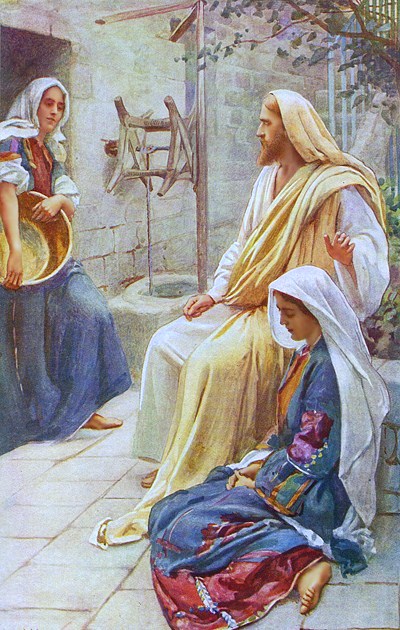
by Harold Copping (1927)
July 29th is the feast day of St Martha. Martha was the sister of Mary of Bethany and Lazarus. In the Gospel of Luke, Jesus visits the house of the two sisters. Mary sits and listens to the teachings of Jesus, but Martha “was encumbered by many things”. Rather than sitting, she made sure their guest was fed, had clean linen and a comfortable bed, and very likely took care of whoever else was traveling with Jesus as well. For this she was gently rebuked by Jesus and generally maligned by many early Christians.
However, over time Martha has come to represent maturity, responsibility, care and strength. She is a saint in the Orthodox Church and the Roman Catholic Church, and she is recognized by both the Lutherans and the Anglicans. And while she is remembered and honored, her sister has been conflated with Mary Magdalene and largely forgotten as her own person.
St Martha is the patron saint of all working women, but especially all those who work Below Stairs, doing the cooking, cleaning, and care work for the household. In light of that, the etymology of Martha’s name is interesting. It is derived from the Greek, Marta, which means “mistress”. Martha was very likely not a serving woman in the original stories. She was the head of the household, the mistress of the home; and as such, it was her responsibility to offer hospitality. One wonders how the story would have gone if she had shirked off the work of welcome. I imagine she probably would have been castigated, instead, for not preparing a kind reception. Because women can never win…
I wrote a story several years ago based on the British custom of calling all personal maids “Martha”. Marthas have incredible access to those in their care, and yet they are explicitly and intentionally unseen. I’m not the first person to consider the darker ramifications of that… a revolt of the Marthas would be devastatingly effective.

The Marthas
The old lady swept her walk every morning in the dawn light and tended her garden at dusk. She was unknown and unnoticed in the neighborhood. Kept to herself. Smiled at small children and dogs on leashes passing by her gate but did not encourage conversation. She was unremarkable in every way, forgotten as soon as she closed her door on the world.
Very little mail was delivered to the brown house on the hill. No packages on the front steps, just the morning paper which disappeared quietly into the house each morning. No evidence of pets in the yard. No clutter. No regular visitors. The garage remained shut but for a weekly foray, presumably for groceries. The trash cans went out on schedule, but the cans were almost empty.
It was quiet in the brown house. Now and then, there would come music. Of such variety that no preference could be determined. But there were no loud conversations on cell phones. No grinding appliances or growling engines. The car was electric. She used a broom. Her lawn mower had a rotary blade. Few had even heard her speak.
She went for a walk at some point every morning. She ambled aimlessly around the block and often disappeared into the park. She carried an umbrella no matter the skies. She wore billowy, bulky clothes on her light frame even in the summer heat. She favored hats and sensible shoes. She revealed little flesh. But this is the way of old women.
The old lady had few friends. No bridge clubs or book clubs. No dinner parties or gossip over coffee. If anyone was watching, she could be seen in her window now and then hunched over her computer, typing rapidly. Sometimes she just sat, sipping her tea and frowning down at the screen, perhaps a silent observer to some digital meeting. Then, she would shut the machine with a decisive snap and vanish into the depths of the house. But nobody ever was watching. And if they saw, they soon forgot.
The former CEO of Amazon was found dead in his Central Park West home. Authorities are investigating possible food poisoning. A large black feather, possibly of corvid origin, was found on the body…
They appropriated an abandoned city parks garden shed. She supposed it was apt. They were gardeners of a sort. And the gardening funds were gone before she was even born. Which was emblematic of the problem in many ways.
They carried nothing that could be traced. Granny Webster didn’t even have a cell phone. It was inconvenient, but necessary. As communications director, she had to be clever. Whatever had been recorded on bits of newsprint and scraps of notebook paper she scrupulously used as kindling in the bread oven fire.
The shed was invariably cold and damp and filled with opportunities to get tetanus. They left it as they found it save that Granny put a pair of upturned plastic buckets near a rotting potting bench and laid out ragged donation blankets on a pile of pallets. It looked like a rather well-to-do camp for the homeless. She suspected it might have been used as such from time to time. That too was emblematic.
She had misgivings. Qualms even. As she typed the daily directives into her home-making blog, she had to focus on The Code not the meaning. She used to be strictly non-violent. She still was at heart. She felt that if there was a hell, she would be there. Probably with most of the targets. She didn’t believe in hell, but she believed that what goes around comes around in the end. Still, she kept with it. Because nothing else was working. Things were so desperate. And this, however bloody, saved lives. Maybe saved the world. At least it might save the part of it that her kids would inhabit.
She’d had many internal arguments about ends and means before she finally stopped thinking about what they did.
They never came to the shed together. Granny would visit in the morning with her umbrella of newsprint, her Attache Case. (Granny had a warped sense of humor colored by noir mysteries and old television.) Then later in the day, as her kids played nearby, she would wander down the trail. She’d “discovered” the shed so many times now it came natural. — Why, what do we have here! — Test the handle, find it turns, poke a tentative head in, body follows reluctantly. The wrinkled nose and cautious steps were still genuine. She’d interrupted rat conventions more than once.
She would set about tidying up the shed. Shake out the blankets and fold them neatly. Place the buckets by the bench. Gather up any trash, much of which was from Granny’s umbrella. Then close the door with a rueful shake of the head. She dumped the real trash in the closest bin.
The Kentucky Senator was found unconscious in his office after apparently suffering a massive stroke. It’s reported that he died in transport to the hospital. No foul play is suspected, but authorities report finding a crow feather in the Senator’s hand…
Martha was not her name. She didn’t even like that name. But being a Martha was her true calling. Martha was a believer. She wore her hoodie and broomstick skirts with pride.
She shuffled into the public library every day and found a vacant computer cubby. Never the same library branch. Never the same machine. Never the same time. Often she would take a short nap before getting down to business. She thought it added to the role. And she usually needed the sleep anyway.
She set out her snacks — granola bars, trail mix, and pilfered chocolate — then pulled up the card catalog and grabbed the tiny pencils and paper scraps set out for note-taking. She had various research projects. Once she learned all about the care and use of foxglove. In truth, her projects were often botanical in nature, though there was also a good deal of cooking and crafting. This was only mildly suspicious for someone who didn’t have a home. Aspirations explained quite a lot.
While researching book titles, she invariably opened up the machine’s browser and pulled up Raven Maven’s website. For the uninitiated, this blog was yet another white woman’s self-important blathering about house stuff. Martha knew how to read it now. All the Marthas did. That was the chief job of a Martha. Well, that and the assassination. But it did no good to think in those terms. Better to call it cultivating. Or cleaning.
There were Marthas in every city. Probably every neighborhood. Shuffling, shiftless women. Invisible except when in a convenience store. They bathed in public restrooms and ate from Dumpsters. (Surprisingly well if one knew which bins to open.) Many of them had children they never saw, or saw but rarely. Most had jobs. Martha had a job as a cleaning woman for a rich old bat who had exacting standards about hand towels but rather lax standards on employment law. She treated Martha well enough, but payment was always in arrears and usually short. Hence the pilfered chocolate.
Marthas were often cleaning women. Access and invisibility were the chief job qualifications after all.
Martha did not know any other Marthas in her city. She thought that might be intentional. Can’t squeal on someone you’ve never met. She didn’t know Raven Maven’s true name either. Martha knew that someone named Granny Webster gave a lot of advice through the Maven filter, but she didn’t know explicitly that Granny was connected to Martha’s task. Martha had been recruited, so to speak, by an intriguing flier at the bus stop nearest her regular underpass camp. She’d visited a questionable Facebook page that afternoon and was visited by a questionable old woman from Brooklyn later that month. Martha training. Mostly about The Code.
The Code shifted. That too was part of The Code. Martha had to read the Maven blather every day or take several days trying to figure out the new key words. Martha had the feeling that the Maven liked to be difficult. Martha didn’t think she’d like the Maven. Probably would want to punch her undoubtedly adorable little white-girl button nose. But maybe that was all part of the act. Maybe the Maven was really a chain-smoking truck driver from Texas. Maybe she was a grocery store check-out dish-rag from some blighted part of Chicago. Maybe she was a billionaire’s miserable trophy wife.
What she was probably not was a he.
She believed that the Marthas and their ilk were a sisterhood. There might be the odd feminist male here and there. Maybe. Martha wasn’t sure. But on the whole she felt that men just weren’t very good at being invisible. In any case, male solidarity might have balked at many of the objectives.
The owner of the Boston Globe and the Boston Red Sox was found dead in his home early this morning. Cause of death is believed to be accidental drug interaction, though we are told there was a crow feather stuck on his pillow…
It’s working. I still don’t think it’s right. But it’s working. The center never can hold. One or two picked threads and it rips wide open.
I worried about power vacuums at first. But nobody seems to be plugging the holes. Maybe all the seconds really don’t want to be in charge. Maybe nobody actually believes in what they’re doing these days and are glad of the excuse to let it break apart. Maybe it was only all held together by the force of a few twisted personalities. Maybe we’re just that scary that nobody wants a crow-feathered target on their forehead. Maybe a lot of wives and mothers are stepping up. I don’t know why or how. All I know is it is working.
I have blood on these old hands now. If I were a moralizing sort, I might worry about that. But morals went out the window years ago. And they only ever raised morals when they needed subterfuge anyway. Nobody believed in those commandments. Or they didn’t follow them if they did.
But in the balance, I think it’s the only way forward. Something has to break. A runaway train only stops when it crashes into something solid. We are become the mountain.
I don’t believe this is justice. I don’t buy that vigilante nonsense. This is no eye for an eye. If there is an accounting, this is one dead man for many billions of living beings. And yet I think this is murder, pure and simple. As gentle a murder as we can contrive. Quiet. Clean. Almost as invisible as the hand that delivers it. But murder nonetheless.
Still… the account books don’t lie.
Wall Street has all but foundered. Washington is adrift. And where they go others follow. It was all so tenuous anyway. So many financial facades and empty words. China was a paper castle. India was a mire. Germany had its industry but no markets. England was nothing at all but bluster and odd hats.
And when the box stores have no convenience left to sell, people remember the harder, more durable ways. They may grumble, make plenty of mistakes. But there are co-ops forming in this very neighborhood, where once there were HOA rules about how much grass should be grown in front of your house. And nobody even blinks at my lawn mower anymore.
Most of the complaints are not about the work though. The hardest part of all this is the loss of routine, the loss of normal. In many cases, the loss of family. Can’t be a 9-to-5 wage earner in a cushy work-free job, can’t be a family separated by a continent. But we couldn’t before we gave this monster a shove off the cliff either. We just stole from other families, other normals to keep the monster fed.
I guess the Marthas, this whole ugly project, we’re just removing the feeding tube. Once or twice perhaps literally. One for the many. I hate that. But I hate what they were doing to this world even more. And it turns out that so many others feel the same. It’s like Lysistrata but not about sex. Sex is nothing. We’re taking back our lives.
My wish for the future is that when the blood is washed away there will be lives worth living again. And never again will we allow such monstrosity to feed on us.
©Elizabeth Anker 2025

 By My Solitary Hearth
It is interesting to read of the origin of the ‘Marthas’ – whom I have only encountered in novels. Had to look up ‘Boston Brahmin’ – what an apt name!
LikeLike