

The Perseid meteor shower begins its peak about now. This floating pile of space gunk is left over from Comet Swift-Tuttle and is quite thick still, making for hundreds of collisions with our atmosphere as we pass through it. You can expect fifty or so meteor sightings an hour, about one a minute, from the 11th through the 13th. The best time to watch is in the early morning, but you can see them all night, especially on the 12th. And if you’re looking early in the morning on the 12th, Venus and Jupiter, both very bright, are in conjunction. Dazzling planets with a background of falling stars. Quite the free light show!
The Dog Days have ended, but the weather gods haven’t got the memo… It’s 90° with no air flow, rather high humidity, but no rain nor even much cloud cover, though there is still thick smoke. Everything, including me, is wilting. On Friday, we’ll see the last day with more than 14 hours of sunlight, so the maples, who take their winter preparation cues from day length, will be turning colors soon. But it does not feel like time for fall. It’s been another summer that slipped away in perpetual disaster, though this one was personal.
But it is coming up on autumn. Right on cue, the Hatch chiles showed up this week. So this weekend was busy. Saturday was spent mostly on the delivery and installation of the new range. Which is delightful and does, in fact, fit in that awkward space. It is also a vast improvement in cooking. Energy efficient and generally better at containing heat, it took no time to get to 400°F in the oven or to heat up the range elements; it stayed at that temperature; and it did not heat up the kitchen. I can cook indoors without cooking myself — even in 90° heat. With no air conditioning, I might add…
I had to do the usual bread and yogurt before the chile roasting. I had forgotten how pleasant it is to have heating elements that hold temperature. I hardly had to pay attention to the warming milk. Then I baked a couple loaves of ciabatta. This oven uses convection heating. The difference in bread quality is astonishing even inside the ciabatta pan. But the wonderful thing was the chiles. This range has two broiler settings, low and high. Setting it on low allowed me to use the broiler and shave off about 10 minutes for each batch of chiles. Which doesn’t sound like much, but with a dozen batches, that’s two hours. It also isn’t as hot as cranking up the oven temperature and roasting them from the bottom. So this round used less energy and put less waste heat into the kitchen. It wasn’t no heat, but it was tolerable.
So I have twelve gallon bags of chile in my freezer now, somewhere north of 150 pods roasted. That ought to keep me happy through the winter.
I have to say that chile roasting after baking ciabatta makes the house smell like heaven.
Which is a nice contrast to the ashy hell outside these days…
Here’s a bit on the process of chile roasting from a few years ago. In this post, I say don’t use the broiler… I have proved that this is possible if you have an excellent late-model oven… Not that you should go out and buy one just for that reason… But if your current range is on the edge of dying, it’s probably a good idea to replace it now before tariffs jack up the price by two or three times what you’ll be paying today… which is quite ridiculous enough already… And who knows how long ranges will be available… If nobody can afford to buy them, they aren’t going to be sold… If not sold, they aren’t going to be manufactured… And so on… This is how we fall off the Seneca cliff…
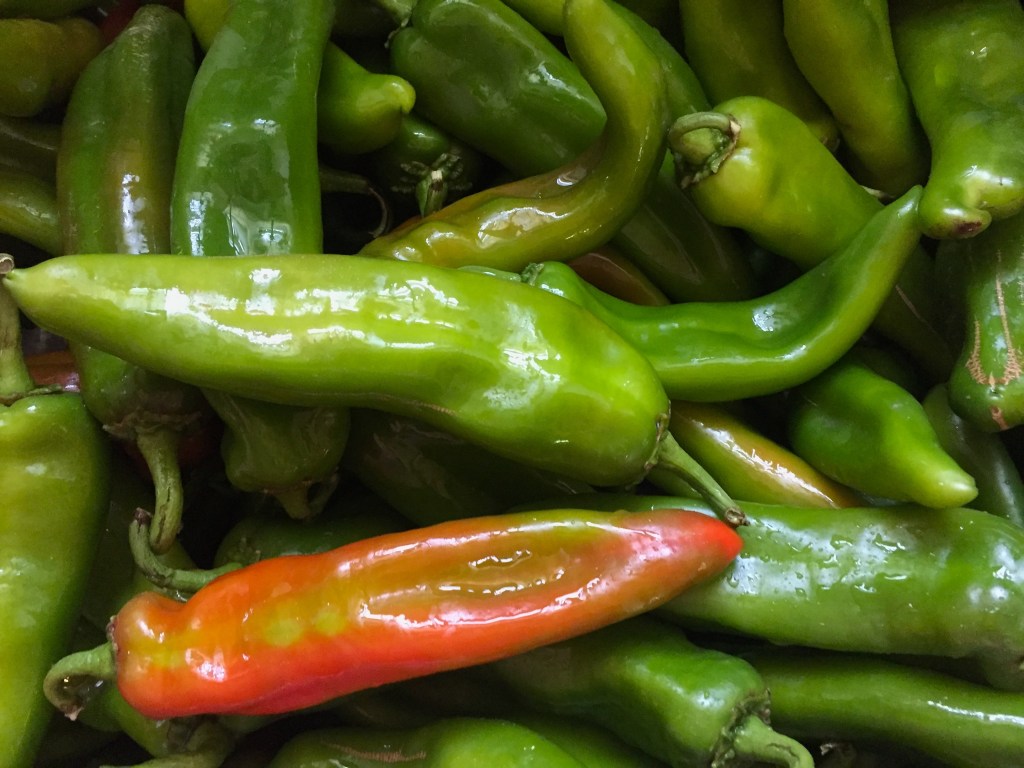
I ordered chiles in April as, I thought, a back-up to the bumper crop of Big Jims I would be growing in the front yard hügelkultur mound. Turns out it was a very small bumper, somewhat less than a Matchbox car, so it is a very good thing I was cautious or I’d be eating only canned chile this year. Not that I’m opposed to the newly proliferating cans of Hatch chiles in grocery stores everywhere, even my Vermont co-op. (I put that down to Breaking Bad… or perhaps signs that I’m not the only New Mexican in climate change diaspora…) But there is a big difference between the machine processed stuff and chile that is fresh roasted — in texture, in flavor, and in heat.
For one thing, the canned stuff usually needs some acidic preservative that alters the flavor and the heat — because acid neutralizes the chile heat (that’s why when you have a burning mouth, milk or lemonade work better than water to calm things down). For another, I can control what varieties go into the home-preserved chile. I tend to grow Big Jim and NuMex, with a slightly higher proportion of the less fiery but more flavorful Big Jims. When I buy fresh chiles, I order a mix from Hatch Chile that is about the same as what I grow. For some reason, there is no canned variety that mimics my preferred blend, though I think it is probably what most New Mexicans taste in their minds when they think “green chile”. It is almost identical to the blend that Albuquerque’s Garcia’s Restaurant chain uses, and it’s very close to the frozen “Hatch Autumn Roast” from Bueno Foods. For many New Mexicans those are benchmark flavors.
For the uninitiated, Hatch is the name of a southern New Mexico town, nestled into a bend in the Rio Grande south of Elephant Butte reservoir (hence the now mostly dry part of the river…). This is the place that grows most of the planet’s green chile, the overgrown-poblano-like pods that have heat and flavor unlike any other pepper. Big Jim chiles are moderately hot, but can carry a wallop depending on July’s heat. The hotter the weather, the more oil is produced, ergo the hotter the chile. NuMex chiles are hotter but, I think, do not have as complex a flavor as Big Jim, which can taste smoky, nutty and somewhat pungent like garlic or onion, again depending on the weather while ripening. The colder and cloudier it is, the less flavor in the pods.
There are several other varieties of chile grown in Hatch. Nearby, New Mexico State University has made an industry out of breeding cultivars. Both Big Jim and NuMex came out of the NMSU breeding program many decades ago. Recent inventions tend to be focused on heat though. And while I need that capsaicin kick, I like being able to taste the other flavors (or, you know, anything at all…), so I don’t go in for the ghost pepper assault that appeals to those (mostly non-New Mexicans) who chirrup on about Scoville heat units. I’m not into testosterone contests, nor do I think pain is a flavor…

Anyway, 25 pounds of fresh chile showed up on Wednesday and needed to be addressed with all due haste, or it would quickly rot into a grey miasma of noisome slime, which, in addition to being horrifying in the kitchen, is a monumental waste of money… among other things. So, on literally the hottest day of the year, I was roasting chiles.
(Addendum: This year, I discovered that I can fit the whole box of chiles into the chest freezer. Chilling the chiles in this way for about an hour twice a day and storing them in the basement, kept them fresh for several days. I only lost about three pods, and that was because I was being picky. Not because they were rotting…)
In New Mexico, the roasting is managed for you. Grocery stores, farm markets, and random street corners all sprout knots of grinning denim-swathed men in splendid hats who pour 30 pound bags of fresh chile into a rotating mesh drum over an open gas flame that likely doubles as an arc welder in the spring construction season. A few turns of the barrel and the chiles are redolently charred. They go back in the burlap bag, much reduced in volume. You take the steaming pile home and dump it in cold water to make peeling easier — and to cool the pile’s interior to something less than the surface temperature of the sun. Then you start the long process of peeling, chopping and packing the chile into freezer containers. The only complication in this whole business is trying to keep the chile oil out of your throat. Because once that happens, you’ll be coughing for the rest of the day.

New England is not noted for its chile culture. So I have to be the guys with the flame thrower. I’ve used a charcoal grill, but this made quite a bit more mess than I am willing to endure, and I lost a large number of precious chiles. Now, I use the oven set to 450°F. I have to do many batches of pods laid out on cookie sheets, so it takes many hours. I try to imagine spiritual elevation and inspiration coming over me with all the sweat, but my imagination falls rather short. Like my temper… So I suggest you complement the whole process with the latter chapters of Ellen Melloy’s Eating Stone and a well-chilled bottle of “Girls-are-Meaner” from Wines of the San Juan.
Also, if you don’t have a sitting space in your kitchen, I sort of recommend making a temporary one. Fifteen minutes isn’t long enough to go do much of anything else, but it’s way too long to stand!
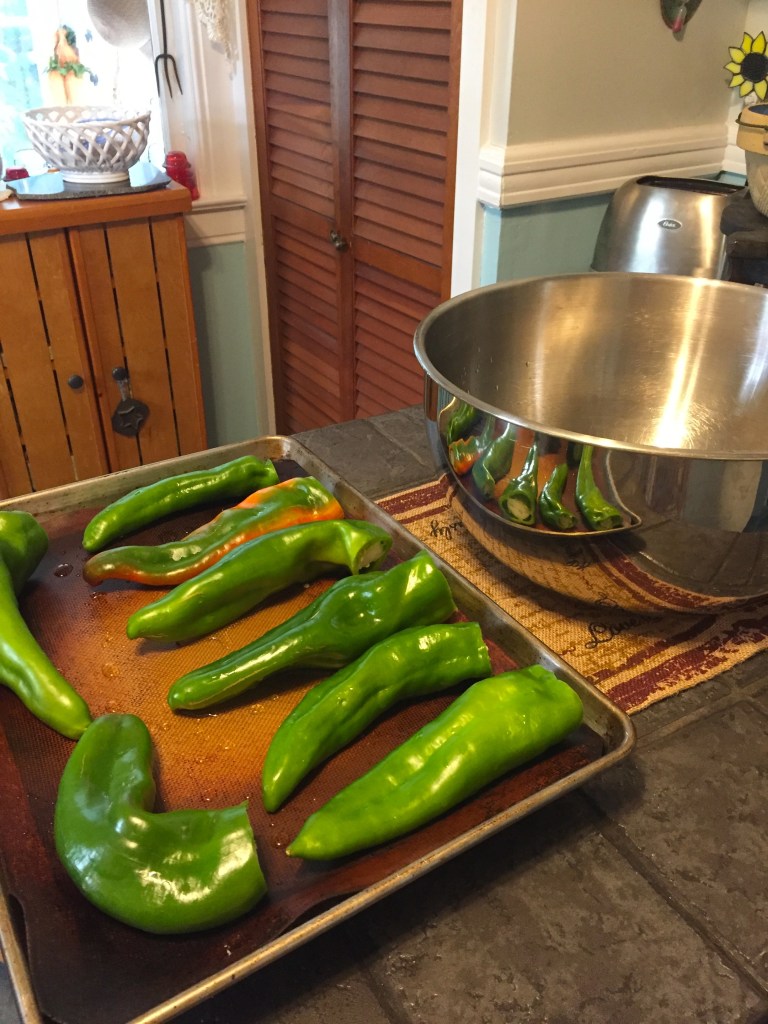
The process is simple. Wash the pods and remove the stem. Don’t clean out the whole seed cavity, as that fleshy stuff that holds the seeds is also where all the capsaicin is. But the stems turn sort of gross after all this abuse from heat and cold, so I cut them off. Lay the clean pods on a cookie sheet. I highly recommend using a silicon pad or parchment paper because after a few batches, there is a charred mess. Cook them at as high a temperature as your oven will maintain for many hours without meltdown.
Don’t use the broiler. I know this seems like it would be closer to the flame thrower, but the few times I’ve tried it the chiles turned black on the outside but didn’t cook much at all on the inside. You need that arc welder and the tumbler to get the insides done before the outsides turn to charcoal.

Cook on one side for 15 minutes. Turn over the pods, then cook on the other side for another 15 minutes. As soon as they come out of the oven, dump them in cold water. This both cools them and causes the skin to separate from the flesh.
At this point, you can peel them and chop them and then pack the chopped chile into freezer containers. But last year I discovered by accident — another round of chiles that showed up at an inopportune time — that dropping them whole and unpeeled into freezer bags works just as well. Better for me actually because I can thaw the pods and then stuff them with my home-made ricotta to make rellenos — which you can’t do if the chiles are, you know, pulverized.
I bag up 12 pods in a gallon bag. This is an amount that I can use within a week of thawing, no problem. But I cook with a lot of chile, so you might want to store them in smaller amounts.
And that’s it.
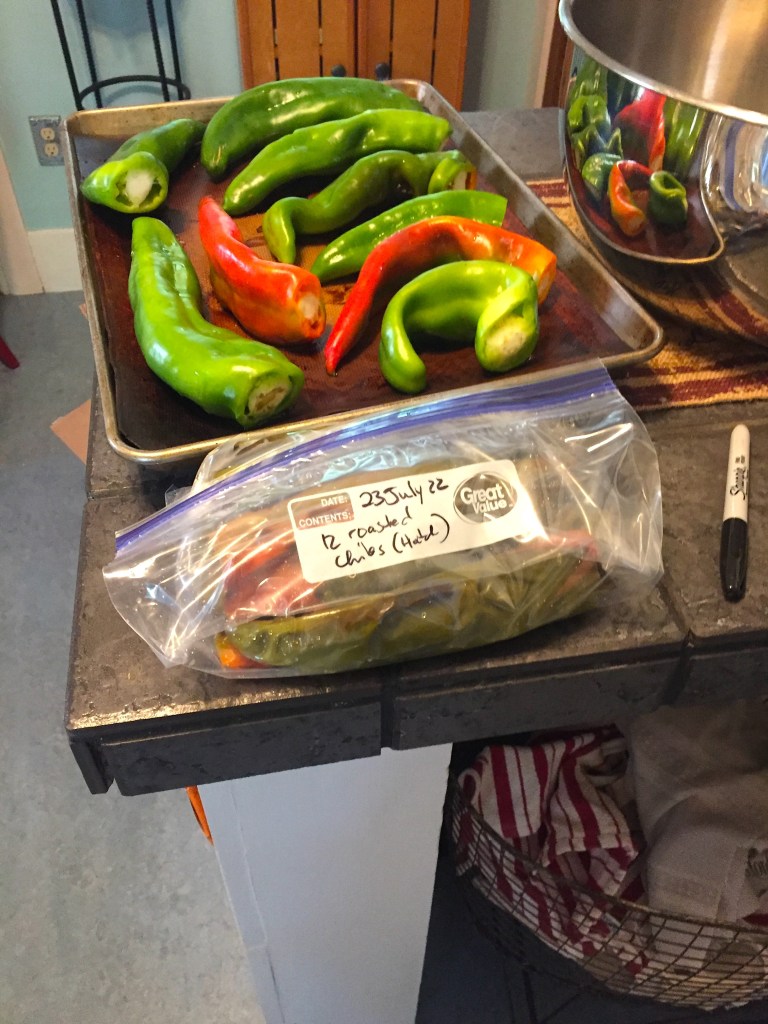
I have 12 bags of chile pods in my freezer now. This ought to last me a year, supplemented with that canned Hatch stuff. And since the oven was on and the kitchen was already roasting, I decided to use up the last of last autumn’s frozen corn and the last of this year’s strawberries in baking. I’ve got two loaves of cranberry double corn bread and four dozen ginger strawberry muffins in the freezer also. Oh, and four pints of the first of the season’s blueberries that I got at the farmers’ market. All in all it was a productive, if sweaty, day. And I finished Eating Stone. And the wine… So I feel it all balanced out in the end…
Maybe this heat will inspire my own chile plants to get on with it already… After all, it’s August. We’re going to be dealing with first frost anxiety before you know it…
©Elizabeth Anker 2025

 By My Solitary Hearth