

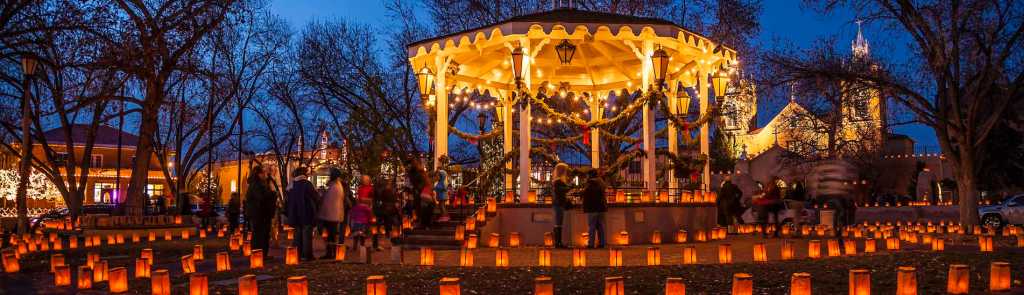
Las Posadas begins today. In this Latin American Christmas novena, the community acts out the Holy Family’s search for a place to sleep upon coming to Bethlehem for the Roman tax census. Starting nine days before Christmas Eve, a Mary and Joseph, with an entourage of angels and shepherds and others, walk door-to-door begging for shelter. The group is turned away at every stop until the last hacienda on the 24th where the whole community gathers. Though there is no rest for the travelers until Christmas Eve, every home puts out lights — bonfires and luminaria (pictured above) — and gives out refreshments — usually biscochitos, a short-bread cookie flavored with cinnamon and anise, and hot chocolate.
In some communities, Las Posadas is used as a fundraiser, collecting money or food or clothing for some worthy cause. It also serves as an object lesson in sacred hospitality. Always open your doors to strangers and share what you have with neighbors, lest you turn your back on deity when you douse the porch light. But the main focus is simply to bind the community together in this collective ritual remembrance of the Mother of God in her time of great need.
But Las Posadas transcends religion. Latino Protestants are just as likely to put on a processional as their Catholic neighbors. Latin Americans from other European cultures (for example, the sizable German population in Mexico) also host Las Posadas. Most importantly, the indigenous peoples also enact this ritual.
In Aztec tradition, the Mother of the Gods, Tonantzin, was celebrated on December 12th (now recognized as the feast day of the Virgin of Guadalupe). The Aztec sun god, Huitzilopochtli, was born around the winter solstice. So when the colonizing Catholics introduced the story of the Nativity, the resonances were so powerful that the myths were seamlessly fused into one. In cultures around the world, there are rituals centered on enacting hospitality, but in Aztec culture (as well as most others in the Americas), hospitality was profuse, deeply political and baroquely elaborate, featuring often ostentatious gifting and festivity for the whole community. A nine-day celebration of the Mother seeking shelter in the depths of winter was exactly the sort of community-binding performative hospitality that the Natives had been enacting for centuries, perhaps millennia in different forms. They embraced it with enthusiasm. In fact, the tradition seems to have been invented in Mexico… under the auspices of the Church, yes, but quite possibly celebrating a different Mother, depending on private beliefs…
Or just building and celebrating community…
And this has endured for centuries in Latin American communities everywhere. Especially in El Norte… New Mexico.
New Mexico is a place where traditions are still living and enacted — and understood. The reasons we do the things we do are well known and the source of endless discussion and debate. Nothing is simply the done thing. There must be both a lineage and a valid motive for continuation. Tradition is more than what we do; it is who we are. It is how we are…
This is not to say that new traditions never blossom in the desert. One of my favorite traditions is the Twinkle Light Parade in early December. Obviously, this tradition is no older than electric twinkle lights. But no matter the weather, every Burqueño always turns out to watch a procession of low-riders, bike clubs, dance students, musicians, and random things like this all decked out with hundreds of light strands. My bookstore fielded a float, featuring everybody’s favorite Grandpa sitting in front of a burning fireplace reading beloved holiday stories to a bunch of kids, with enormous cut-outs of the characters dancing around the edges. (It was my craft-teacher-in-residence’s most spectacular creation.)
We also assemble a holiday tree for the Old Town plaza that used to be made up of about fifty twelve foot trees attached to a central pillar. (During COVID the city went plastic, but it’s still an impressive tree.) We put luminaria on every level surface, much to the chagrin of the fire department. (I only had the fire department at my house once, and that was because our neighbors across the street had a carbon monoxide leak. While the guys were dealing with that, one of my luminaria went up in flames right next to the fire truck… It was a bit embarrassing. But it ended in cider and biscochitos in my backyard with most of the neighborhood and the first responders, so that was all good.)
We hang ristras and live greens on every doorway and post (which contributes to the excitement when luminaria go wrong…). We decorate random trees along the side of the road and file through the Botanic Gardens for lights, mariachi music and hot chocolate laced with chile powder. We eat tamales and posole on Christmas Eve and put both red and green chile on everything, because it’s Christmasy, you know. We have live nativity scenes with actual burros, sheep and camels (yes, plural all around). We stay up all night on the solstice and leave the tree lit all night long on Christmas Eve. We have 12th Night parties and don’t pay much attention to New Year’s Eve, though there is a strong tradition of eating a grape for every chime at midnight to bring luck in the coming year. And people will set off exploding things, though this also can happen on any night between Hallowe’en and 12th Night. Gifts and sweets, parties and feasts can and do happen any time between St Nick’s Day and Epiphany, and very little work gets done between Thanksgiving and about the middle of January.
This is who New Mexicans are… Especially that last bit.
And from the 16th through the 24th of December, we all host Las Posadas processions. Matters not whether we are of the proper faith or culture. Everybody participates. Bonfires are lit and luminaria are set out to light the way. Cider is pressed and mountains of biscochitos are baked to feed the hungry pilgrims. A likely couple is dressed as Mary and Joseph and everyone else puts on angel robes (though some do look rather more like fairies…). Sometimes a docile burro is requisitioned. And usually someone wastes quite a lot of time printing up the lyrics to carols, though you can’t read them in the darkness and everyone knows the lyrics anyway. (Or improvises tolerably well.) This is such an entrenched tradition that Albuquerque’s Youth Symphony Orchestra makes nearly all of its annual budget in one fundraiser — selling luminaria for the processions. (For five years running, my driveway looked like this the weekend before Thanksgiving.) This is what we do. This is who we are. And this doing is how we are who we are.
There is still shopping and over-eating. But that is and always has been part of the midwinter festivities and has less to do with modern commercialism than upholding ancient hospitality customs. For one thing, most New Mexicans are rather poor and can’t afford ostentatious spending, but there is also less urge. There are so many other facets to the celebration that presents are ancillary. Gifting is also spread out over the whole season, so there is no big build-up to one massive extravagance of gift-opening on Christmas morning. And gifts tend to be small and meaningful, leaning toward food and hand-made housewares and clothing and jewelry. (As a New Mexican, if you don’t know at least four jewelers and a handful of weavers and potters, you need to get out more…)
Kids get toys, of course, but only one or two will show up from Santa Claus. (In a place where families are largely intact, adults still end up gathering quite a number of gifts for nieces, nephews, grandchildren, great-grandchildren and that neighbor kid who never leaves.) Crucially, gifts do not come from the mall, which in Albuquerque, to my recollection, was a rather joyless and barren place that had a hard time keeping its anchor stores in business. Gifts are found in random places, bought from the crafters that line the plazas, ordered from local artisans, or made. Christmas is a local affair. (Of course, most of life is local in New Mexico… we’re too idiosyncratic for mass marketing.)
So that was my life. Those are my experiences and expectations. Now, I live in New England. For all the Currier & Ives postcards and sleigh rides through the countryside, I don’t think New England understands the point of holidays. This is not a land of deeply felt traditions. In fact, Christmas, especially taking time off from work to celebrate the holiday, was outlawed in Massachusetts and New Hampshire for a couple hundred years. But even in Vermont, where we love our local quirk, there hasn’t been much of an effort to craft a coherent set of ritual traditions. Mostly it’s just about buying stuff, which is the least joyful aspect of Midwinter.
I feel at odds here. Where is the meaning? What is it all for? Why am I doing this? What is the local equivalent of Las Posadas? What do we eat here? What do we do? Who are we? What makes us a culture?
And where is the Twinkle Light Parade? Or the New England equivalent of a community party featuring light, frivolity and fun in the long Midwinter darkness.
Don’t get me wrong. There are plenty of things that make up Vermonters, but Yuletide doesn’t seem to be one of them. Christmas is not a native tradition here. It is an imposition and comes with no instructions. This may be because this was a Protestant culture that did not celebrate the holidays, and now it is the third least religious state in the union — behind its neighbors, Massachusetts and New Hampshire. Say what you will about Catholicism, but it endures (perhaps because most of its traditions are actually pagan). The self-directed versions of Christianity do not seem to be as durable. The Protestant faith certainly doesn’t include traditions, ways to mark the time, reasons to gather and celebrate. In such an individualist faith system, there are no reasons to be a culture, a community, a society. And Christmas is not a thing that makes sense in isolation. It is a gathering.
So I often feel like I am creating my own holiday rituals… which just doesn’t mean as much in the absence of community. I stubbornly eat tamales and posole and light candles on Christmas Eve. I drink warm cider, not eggnog (which is… what exactly???). I put out my tin luminaria (but only on the covered porch because they’d get buried in the snow). I burn piñon and cedar incense to mimic the hearth-scents of Christmases Past. I listen to New Mexico music and bake biscochitos (though I am an apostate and do not use lard). And my tree is covered in Kokopellis, Coyotes, Hopi Clowns and Pueblo Storytellers. The material culture is still there; the symbolism is still there… but the ritual and especially the gathering have yet to materialize.
I don’t know if it will. I refuse to assimilate into the zombie shopper holiday mode and give up my notions of celebration, but nobody here understands the importance of Las Posadas. So how do I meet these people where they are and still be me? I know there are other New Mexican refugees here. Maybe we need a support group.
Or maybe I just need to be in charge of celebrations…
Tea Parties
In 1773, as Marys and Josephs were setting out on their Midwinter perambulations all over Latin America, the folks in English colonies had decided to make a statement on tariffs and taxation. The Tea Act, passed earlier that year in May, had favored the East India Company with the exclusive rights to sell Chinese tea duty free, effectively giving that corporation a monopoly on the market for the preferred morning beverage in the colonies. Unsurprisingly, this ticked off local importers who wanted to cash in on the tea cash cow.
Throughout the summer and autumn there was increasing grumbling about “taxation without representation”, among other irritations. Then, on December 16th, members of the Sons of Liberty in Boston dressed up as Native Americans and boarded the Dartmouth, a ship carrying a substantial cargo of East India Company tea which they promptly seized and tossed overboard.
Nine days later, on Christmas Eve (the final stop for Las Posadas), colonists in Philadelphia forced a merchantman carrying another load of East India Company tea to turn around and head back to Great Britain.
Several years later, open war was declared.
Such interesting parallels in all this… Consider that today our leadership is doing everything it can to tax Chinese imports and grant monopoly status to a few favored corporations… Consider the difference in culture and community strength between the peoples who were going door to door in a festival of ambulatory begging and the peoples who were playing pirate dressed like Indians so they could be free to sell tax-free tea… among other things… Plenty of other things to consider in this, but maybe those two are enough to be going on with today.
©Elizabeth Anker 2025

 By My Solitary Hearth