

Today is National Cheese Lovers Day. I don’t know if that means much to most of you. I love cheese, so I feel it’s a day to celebrate this amazing invention. But that’s not what I want to talk about today…
We’ve entered a new lunation. The Cold Moon went dark on Sunday (2:52pm, my time). So the third moon in my lunar year, the Wolf Moon, was new yesterday. The Wolf is new between 28 December and 25 January; it’s full between 11 January and 8 February. In the time of the Wolf Moon, the nights are still long, but usually the lengthening of daylight is perceptible. This subtle shift was once marked by an odd English Candlemas custom. On the morning of 2 February, the steward of a large estate would give a candle to the manor lord, symbolizing the declining need for artificial light during the morning chores.
I still need the lights on to get ready for work in the morning, but then I believe my morning chores start substantially earlier than all but the bakers and scullions of an old English estate. Also… the sun is, in fact, up before I leave for work. It rises over the horizon at about 7:20am this week. But with all the snow and dense cloud, we see the sun for maybe a couple hours a week and hardly ever in the morning. In fact, we’ve seen the stars more than the sun. It has frequently been the case that the clouds, which had been darkening skies and dropping snow all day, will clear off after sunset — so, lacking cloud-cover insulation, the temperatures are free to plummet below 0°F.
This is the coldest time of year in the North. It is when stores of food are running low and hunger is stalking every home. This inhospitable month is also the breeding season for wolves. They are calling to each other in the lovesick long nights of deep winter. I was born under the Wolf Moon. I hear the calls of coy-wolves in the night and feel the warmth of belonging.
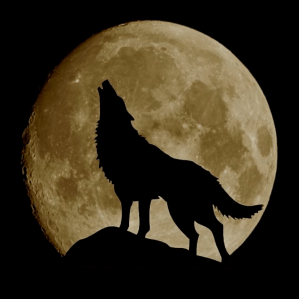
Why do I call this the Wolf Moon? Well, it’s not just me. This is one of only a few traditional full moon names found in both European-derived cultures and in many of the cultures of Indigenous North America. I suppose northern humans have always seen the wolf at the door at this time of year because it is cold, dark, and nothing is growing. There is no food except what small game you can hunt. And there are equally hungry hunters who might be hunting you in the long darkness. I’m not sure I believe that wolves regularly attacked human settlements, but it’s probably a healthy caution if you’re going out in the woods at night. At any rate, the hungry canids may well be carrying off your livestock, your own food stores — because a penned animal is very easy prey, like food on a stick to a hungry wolf. Hard to turn that down when your belly is grumbling and breeding season is getting underway.
Because another reason this time of year is associated with wolves has to do with their breeding cycle. Wolves have but one breeding season — late winter. Our ancestors heard wolves howling at the moon at this time of year not because those wolves were coming for them — though that made a good metaphor for the hunger that was stalking humans and wolves alike — but because those wolves were singing love songs to potential mates. I tend to think our ancestors knew about wolf breeding cycles. They were keenly observant of their world. And, as evidenced through widespread adoption of the wolf as clan totem, many of them felt deep kinship with wolves and would thus have been extra aware of these fascinating beasts.
These days, anthropology gives us new evidence of our close relationship with wolves. It is very likely that wolves and hominids learned from each other. Of course, we worked together to hunt, though it may be more that humans scavenged off wolf kills under the protection of pack benevolence. But it also seems like canines may have taught our species the benefits of cooperation and care, the rules of pack life, the advantage of orienting ourselves around the family and the home. We say that we domesticated the dog, but it may be more accurate to say that wolves domesticated humans.
I sometimes think dogs are the shepherds the wolf clan set on the infantile human species and that these shepherds diligently watch over us still — protecting us even from ourselves. Perhaps especially from ourselves…
The season of Midwinter gave way to the season of Imbolg on Plough Monday last week. Plough Monday can fall anywhere between the 7th and the 13th, and this 6-day period of time often feels like a big shift in weather. The first week of January is almost always Midwinter cold. The middle of January, however, frequently sees a thaw and can feel like a false spring at higher latitudes. We’ve had a cold winter here in central Vermont. It did indeed warm up a bit last week, but warm meant highs in the 20’s (°F) as opposed to near zero. So there’s not been a thaw. And there’s not going to be a thaw this week either. The forecasted high for my next day off is -3°F. That’s about -20°C. And that may be next Saturday’s high…
However, the days are lengthening, though the cold may be deepening this week. There is still snow and will likely be for months. There is often wind this time of year. Yesterday was sort of miserably blustery. The temperature was 22°F. It felt like 12° with the 15mph breeze blowing from the west. So it’s not spring, but spring is coming.
And there are birds on the feeder. Goldfinches and wrens never seem to leave these days, but they do go quiet in the deep winter. Now, they are back with gusto. The wren that likes my back porch is staking his claim on the whole yard each morning with loud liquid trilling. House finches and purple finches are covering the suet and seed log in the afternoon. The usual crowd of juncoes, nuthatches, downy woodpeckers and chickadees are getting boisterous and maybe a little annoyed that the summer people are already here and getting in the way. Indeed, the cardinals are already starting on summer planning, with the bright red males ostentatiously parading around the garden, chasing everyone out of “their” territory.
Most of the furred beasties are still asleep or hiding. But there are skunk tracks in the snow most mornings, and the raccoons are nightly visitors to the compost bin. Sadly… I had to cover the pail by the back door with a heavy metal mesh basket because someone chewed off the filter in the lid and spread squash mess all over the snow. I’m sure they’ll figure the basket out soon… So I need a new pail, this time with a locking lid.
In any case, other beings are starting to wake up despite the weather, and this past weekend I put away the last of Midwinter and started to get out Imbolg. This is the season of enkindling. It is not warm. The ground is still white. But with the lengthening days, spring is starting to stir. Or at least to think about waking up.
I love Imbolg. It is peaceful and calming, a quiet welcome to the sun and the spirit of growth. The wolves are breeding now. Soon the skunks and porcupines in my jungle will follow suit. This is not always a pleasant experience, as they both tend to be a bit more aggressive in breeding season, sending up a powerful stink now and then, but it is joyful. A new generation. New life carrying on. And sometime soon, it will be time to sow the nightshades in paper pots for the new gardening season.
After the scary December electric bill, I decided I did not want to mess with heaters and grow lights, fighting the dark cold in the basement. In fact, I wasn’t going to sow any seeds indoors this year because it is just not that successful even with all the energy pumped into the project. What few sprouts that manage to germinate are spindly and weak and rarely thrive in the growing season. But I hit upon a plan. I set up a plastic table that is about 2ft tall in the guest bedroom, the warmest room in the house. This room also has both east- and south-facing windows. No electricity needed even for the light-hungry nightshades. If there isn’t enough room on the table, I have an old tub in the guest bathroom that has questionable plumbing. I’ve never used it for bathing. But it might do in a pinch for housing seedlings. I’m thinking that might be the best place to start the brassicas because they don’t like as much sun and prefer temperatures around 65°F, easily achievable in the cast iron tub.
But that’s not going to happen in the Wolf Moon, I think. I never sow anything before Imbolg, and this year I might hold off until the Hunger Moon which is new in the middle of February, a much better time to start seedlings. For now, I’m just going to enjoy the quiet energy of Imbolg.
The Imbolg holidays are Saint Brigid’s Eve (31 January), Imbolg or the Feast of Saint Brigid (1 February) and Candlemas (the Feast of the Purification of the Virgin, Groundhog Day, 2 February).
My grandmother was born on January 31st, so I feel a special connection to this Celtic women’s rite. In Irish and Scottish families, it is traditional to weave crosses from rushes on Saint Brigid’s Eve and welcome the saint, the embodiment of fire, into the home by opening the doors to the night air. Often there is a bit of ritual involved, with the oldest daughter of the house gathering the rushes and then knocking on the door begging admittance with her load. Then the women gather to weave the crosses and gossip. It’s traditional to make one cross for each family member and a substantial number of the livestock as well. These are hung as wards for the coming year over cradles, in the barn and byre, and in the kitchen.
Not having a ready supply of rushes, I usually weave a cross out of moistened lavender stems. Or I make one in the summer and then let it dry wrapped in tissue paper in the attic until I need it.
Imbolg is usually a day of quiet contemplation followed by a meal featuring the traditional dairy products my ancestors depended upon at this time of year — especially cheese! I particularly love potato-leek soup made with rich yogurt and warm bread slathered with fresh made farmer cheese. This year the Wolf Moon is full on Imbolg. Apparently, the last time this happened was in the year 1551.
Candlemas is, I confess, usually an afterthought. I have no particular attachment to divination, being of an intentionally “what will come, will come” nature. I do note the weather, but I do that every day. I usually watch Bill Murray learn life lessons from a large rodent in the delightful movie Groundhog Day.
I recently discovered that a significant number of the 19th century stonecutters who immigrated to my town came from Scotland. I knew there was a Robert Burns statue near the old school, but I never thought much of it until this year there was a newspaper article about the Scottish traditions that once flourished in that neighborhood. Until the 1950s, Hogmanay was celebrated on New Year’s Eve. Burns’ Night, on the 25th, was a day for boisterous poetry and singing. Then on the 30th, they gathered for Up Helly Aa, which translates roughly into “the holiday is over”. This was the Scottish end to Yuletide. It is a night for hard drinking before St Bride brings the sun and the season of lambing.
This year Up Helly Aa will be graced by a conjunction of the nearly full moon and a very bright Jupiter. If you’ve seen the night sky at all recently, you’ve seen Jupiter shining magnificently from twilight to dawn. Jupiter was at opposition on the 10th, meaning it is as close as it gets to Earth. This year’s opposition is brighter than it’s been for a couple years, and it will be the brightest star in the sky for the next few weeks. Most planets and stars are washed out by the light of the full moon, but Jupiter at opposition will be shining fiercely. You may also see Castor and Pollux, the twin stars of Gemini, nearby.
This Friday, the 23rd, there will also be a conjunction of the crescent moon and Saturn. Lovely, of course, but not as show-stopping as Jupiter.
This year, the waning Wolf Moon shines on the early morning of St Valentine’s Day and, appropriately, Lupercalia, the ancient Roman fertility festival dedicated to the wolf-mother of Romulus and Remus. And then it goes dark on Tuesday, February 17th, ushering in the Lunar New Year, the year of the Fire Horse, and Mardi Gras. This year’s celebration of both festivals together ought to be stupendous. The last time this happened, in 2002, there were parades all through Albuquerque with dragons and beads and lots of noise. I think it might be a bit more subdued here in New England. But maybe I can do something about that…
Because the next day is Ash Wednesday and the New Hunger Moon. And I suspect it will be a long, hungry time before it is truly spring. However, Imbolg will be ending soon. The days will be well over 10 hours long. The Maiden will be stirring. And, while it will still be cold, it will no longer be getting colder.
Winter will be steadily losing its grip. And it will be time to plant those nightshades and lean toward the coming growth.
©Elizabeth Anker 2026

 By My Solitary Hearth