

The Wolf Moon goes dark today at 7:01am, so the crescent Snow Moon — or, this year, the Hunger Moon, since it is so late — might be visible tonight at sunset, though it would be faint and you’d need a very flat western horizon to see it. In traditional lunisolar calendars, the Moon is not new until you can see that crescent. There were functionaries who would look for its first appearance and declare that the beginning of the month. Today, there are computer programs that calculate when it would be visible if someone were looking. The Moon also does not become new until moonset, because days, and therefore months, start in the evening in lunisolar calendars.
The Hunger Moon brings us Mardi Gras and Chinese New Year. The Chinese New Year is the beginning of a month of festivals. Mardi Gras is the last gasp before Lent begins on Ash Wednesday, the last days before the spring fast. It is Carnival time. (Carnival, by the way, means something like “goodbye to meat”… puts an interesting spin on things, no?) Up north, Carnival is celebrated mostly with pancakes and ball games.
Pancakes are a delicious way to use up all the dairy and fats that you won’t be able to eat in Lent. They are also easy food to eat on the run — which is what the ball games are. Running. Mostly. These are not tame matches on a marked pitch with rules and referees. There may not even be an actual ball, just a roundish object that can be tossed and carried. There are many variants, from classic futbol with almost rules, to hurling with rather fewer rules, to chucking around a silvered chunk of wood with no rules at all. It is not unusual for the ball course to cover an entire village or neighborhood, nor is it abnormal for the game to last for more than a day, with players rotating in and out. Mostly to go eat pancakes and drink beer. In many towns with the spring Ba’ games, there are boards on the windows of homes and shops today because it is also not unusual for these games to get rowdy. Most players will go home with some injuries, and there have been some few fatalities in the hundreds of years that this tradition has carried on. Mostly there’s just a lot of mud and a bit of blood. And then it’s off to the pub for more pancakes and beer.
Carnival is also a time for parades and fairs and mischief. The Latin Quarter New Orleans Mardi Gras parade is the gold standard, though it’s hard to pull off that much exposed flesh in most of the north this time of year. Many parades up north, instead, feature giants. Costume puppets up to 15 feet tall that can take two or more people to wield go marching down the market street today, the Saturday before Lent. The Sunday before Lent, is Pancake Sunday in Brittany, though the pancakes are crepes down there. Shrove Monday is named Collop Monday, a collop being a rough hunk of meat that is either roasted and eaten before Wednesday or is salted to last until after Lent. Shrove Monday is also known as Peasen Monday, and it is traditional to eat pea soup, for much the same reasons that people eat black-eyed peas on New Year’s Day.
Shrove Monday usually sees the beginning of mischief. It is Nicky Nan Night in Cornwall, among other places. This is a sort of trick-or-treating for pancakes. If you give the little blighters a pancake, they are supposed to take their pranks elsewhere. I suspect this rule breaks down from time to time. At some point on Shrove Monday or Tuesday, it will also be barring out time. Kids will lock the school door, barring out their teachers and yelling “Bear, bear, give us a holly” which means roughly “We’re not unlocking the door until you give us an extra holiday”. Which, of course, the teachers grant them. (Because it’s not just the little blighters that get the holiday… I do wonder sometimes why the teachers even bother trying to get in… “Oh dear, it’s locked… Well, off to the pub!”)
On Tuesday, in Catholic countries, and even some Protestant places, the Pancake Bell rings around midday. People go confess their sins — or, get shriven, hence Shrove Tuesday — then they gather for a pancake supper. When the bell rings, shops are obliged to close for the day and not reopen until Thursday. This is when most barring out happens. Then the kids go door to door, caroling for pancakes and sweets. In Scotland, Shrove Tuesday is a popular time for divination. It is Bannock Night, where little trinkets that each carry significance for the future are baked into an oatcake. Whatever you bite down on marks the coming year.
And then it’s Ash Wednesday. However strict (or not) your Lenten fast may be, this beginning of Lent is usually observed with a full fast and total abstinence. Parishioners go to Mass, carrying a bit of palm from last year’s Palm Sunday. This is burned and then used to mark the forehead, reminding us of our temporality. Today all utensils and pots for preparing and eating meat are washed and put away.
Chinese New Year
I dispense with all that because I haven’t the time or the energy, but also because I live in the mountains, by definition an obstructed horizon in all directions. I hardly see the crescent before it’s several days old. (Also hardly see moonrise… or sunrise… and etc.) For me, the day after the dark moon is the new moon, and I don’t actually care all that much to make it any more precise than that. Tomorrow, is the new Snow Moon for me.
But the Chinese calendar sticks to the ancient traditions of calculation. (It mostly is the ancient traditions of calculation…) So, moonset on February 17th welcomes in Chinese New Year — the Year of the Fire Horse.
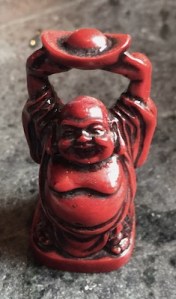
The solar year, the time it takes for the Earth to orbit the sun, is slightly more than 365 days long. The traditional Chinese calendar is lunisolar — meaning it incorporates the moon’s cycle into the solar year. A Chinese calendar month is 29 or 30 days long, about the length of time it takes for the moon to orbit the earth (which actually takes 27.3 days, but from our perspective appears to be 29.5 days from new moon to new moon because of fiddly geometry-of-moving-bodies reasons). A normal Chinese lunisolar year lasts from 353 to 355 days, and to keep the calendar in sync with the sun and the seasons, the Chinese add an extra leap month in about one year out of three.
Most years, Chinese New Year falls on the second new moon after the winter solstice, which is around December 21. The exact calculation of the New Year is a bit tiresome and we’re just going to leave it alone. A shorthand is to remember that Chinese New Year usually occurs with the New Snow Moon. Chinese New Year is fixed to the period between 21 January and 21 February (so this New Year is about as far from the solstice that it can be). This fixed window of time is one of the restrictions that make determining the date tiresome — there was a Board of Mathematics responsible for the calculations — but it keeps the lunar year from drifting away from the seasonal year as the Islamic calendar has.
New Year celebrations around the world are a time for prognostication. Hence Groundhog Day and First Footing and any number of the divinatory customs associated with Midwinter. In China there is a tradition of determining the tenor of the upcoming harvest from the number of days between the solstice and the lunar new year. If there are 50 days, food supplies will be sufficient. Every day under fifty is a deficit; every day over fifty is a surplus. The arithmetic usually works out to a gloomy prognosis because there are only 52 days between 21 December and 21 February, the latest date allowed to the New Year. So even as late as New Year is this year, it will still be a poor harvest.
Chinese New Year is also called the Spring Festival, and the new lunar year is sometimes set to the new moon closest to the beginning of spring which is on or around 4 February in the Chinese seasonal calendar. This is obviously difficult, not least because the onset of spring varies. There is also the regular problem of early and late New Years when two new moons can be evenly spaced on either side of 4 February. The problem of which to choose is also a task for the Board of Mathematics. So this method of determining the new year is seldom used, though it gives the celebration its more common name in China.
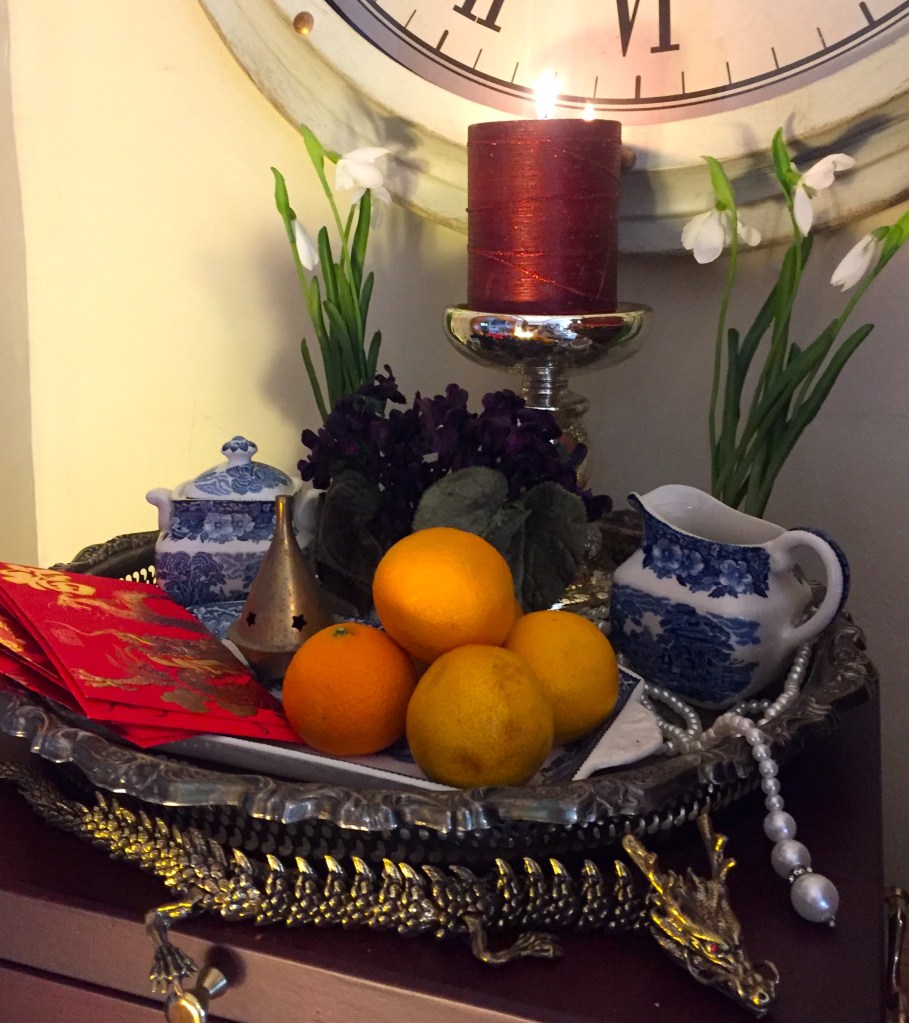
The first month in the Chinese calendar is called the Holiday Moon, and there are ritual celebrations throughout the month. The Chinese New Year Festival itself lasts for the first fifteen days — from dark moon to full. There are both religious and secular rituals. On the first day people welcome the gods of heaven and earth. There is no work done — or allowed — and no travel. Using sharp tools is considered inauspicious, so cooking is done the day before. Fireworks are lit in the evening, and in traditional communities wells are closed for the first two days of the year to symbolically allow Fire to transform the old into the new. The second day is for prayer to both gods and ancestors. The next two days are for men to pay respect to the fathers of their wives. On the fifth day, there is no travel; people welcome the god of wealth into their homes. The next week is given over to community and family gatherings as well as temple visits. The celebration culminates in the Lantern Festival with its colorful lights, dragon and lion dances and vast piles of rice dumplings.
It is traditional to set out platters of oranges — the symbol of happiness — and candied fruit to start the new year sweetly. Wishes for health and good fortune are written on red scrolls and hung around the home. As this is a celebration of the awakening spring as well as the new year, flowers and floral decorations abound. When visiting others, it is customary to bring a bag of oranges or tangerines as a gift, and any candies eaten off the tray of happiness are replaced with red envelopes containing coins for children. These coins are incidental; it’s the envelope that is important. Red is the color of good fortune and abundance. The coins merely accentuate the symbolism.
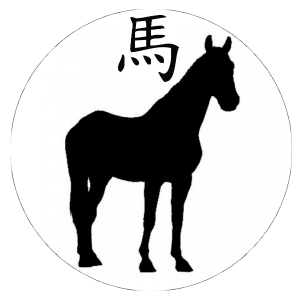
The cycle of years in the Chinese system follows the cycle of the twelve Earthly Branches, each of which is associated with a sign of the zodiac and an animal that represents the branch. These symbols are also applied to the hours of the day and the months in the year. The horse month is the fifth in the year and usually encompasses Midsummer. The hour of the horse is 11am-1pm, midday, the sun at its peak.
Years are named for the appropriate animal symbol in the cycle, and those born in a given year are thought to have the characteristics of that animal. This is the year of the Horse. Those born under this sign are thought to be energetic and affable, clever and physically fit, adventurous and dependable, ready for anything — except being told what to do. Horses do not love reins. They also tend toward impatience and will act impetuously, stupidly sometimes, just to get things moving. More than anything, Horses are themselves, always. Horses are earnest and honest and enemies of falsehood. The ultimate slur for a Horse is to be called inauthentic.
The Earthly Branch is further refined by adding an elemental qualifier. This is the year of the Fire Horse. In the system of Chinese elements, Fire stands for ripening energies, fermentation and transformation. Fire is the yang portion of the Yinyang character. Fire is associated with the hot sun of Summer, the South, and the planet Mars. It is symbolized by the extremely fortunate color red. In Traditional Chinese Medicine, Fire is the attribute of the Heart, and therefore virtue and compassion. However, Fire can be restless and impulsive, even hateful, when out of balance.
The year of the Fire Horse is sure to be dynamic… Those born under this sign are charismatic and bold, change-makers. However, there is danger in that burning restlessness. Attempts to rein in a Fire Horse can lead to explosions.
Explosions can be cathartic, clearing away stagnation and obstruction. The danger is that they clear out everything else too… so…
Still… maybe we should send a whole lot of people born in 1966 to Minneapolis…
Happy New Year to all who are celebrating today!
Mardi Gras
In a sort of embarrassment of holiday riches, today is also Mardi Gras, Fat Tuesday, the last Carnival hurrah before Lent, the spring fast.
Now, I don’t much celebrate Fat Tuesday. I like the pancakes, but that’s about it. I don’t drink much, certainly not when I have to be at work in the morning. I’ve no use for purple plastic beads. There aren’t any parades round these parts. (Because who wants to be outside in February…) I’ve had King Cake. Not going to repeat that. I do love zydeco, and I was a devout follower of Dr John (no apologies…). So, tonight there will be Chinese New Year for me — maybe with pancakes.
And that’s okay!
Some traditions just won’t resonate. That is to be expected. I’m tossing out all these ideas to give you ideas, not to dictate a rigid ritual calendar. You may love King Cake and feather boas and glitter. If so, then this is your night. Dust off those Clifton Chenier and Professor Longhair albums and dance all night. Or line up all your friends, deck yourselves in outrageous costumes (big and loud and super-twinkly!), and parade around the neighborhood. Provided the weather works.
That’s really the main problem with Carnival in Vermont. The weather doesn’t work. Today might be the day before the spring fast begins, but it’s still very much winter. Mardi Gras can fall any Tuesday between February 3rd and March 9th, and this is never a time when Vermonters want to be doing things outdoors. Even skiing is starting to lose its luster, though this year it’s been given an Olympian boost. Still, we’re all tired of shoveling snow, and the plowed up mounds are taller than buildings and looking decidedly grey with grime. Who wants to climb over all that to get to the parade route? But even an indoor party will fail to draw people out on a cold Tuesday night when we all have to be at work the next day. And… well… did I mention the cold!
So why do I talk about Mardi Gras at all? Why not follow my own advice and follow the local traditions?
Well, first, I’m not talking to myself. And some of you are bound to find something useful in Mardi Gras and other observances that don’t work for me.
More importantly it’s that Mardi Gras is part of my heritage, and those traditions of your genetic ancestors are important. Mardi Gras is not an old tradition in my family. We’re mostly northerners. But my mother’s parents up and moved to Biloxi, Mississippi, in the 1970s. So Mardi Gras was grafted on to their Shrovetide rituals — the ball games and closing up shop early and eating piles of pancakes all afternoon. This is what my people did at this time of year. It meant something to them.
It helps me to feel my way through time to try to understand what meaning they derived from these rituals and symbols. It doesn’t always fit when and where and who I am. Sometimes it’s like Mardi Gras — a fun party that just can’t be adapted to place. Other things are best left in the past. But all of it led to me.
And if you’re reading this, in English, online, then probably a good deal of it led to you also.
I am fortunate. The calendar of my genetic ancestors does resonate and can be followed where I live now. This was not always true. Spring is a very different thing in New Mexico. It comes early. It is chiefly marked by ferocious wind. There are no flowers except those that you have planted and carefully tended through the dry days, though there is an increase in the rodent and rabbit populations, so the tulips will all be eaten… And it ends abruptly, usually by mid-April. Suddenly there is no more weather. It’s just oven hot and too bright and so dry you shrivel a little every time you walk outside. This does not relent until the monsoon starts sometime around the Fourth of July.
So what is Spring in all this weather? What is Summer? What does May Day mean where there are no hawthorns? What is Midsummer when it’s been 95° since Easter and you can almost taste the petrichor on the southern winds bringing the end of the heat in a couple weeks? And don’t even get me started on White Christmas… (Yes, there is snow in New Mexico. Yes, it may fall in December. No, there is nothing white about New Mexico Christmas…)
Trying to follow the Wheel of the Year in New Mexico made me viscerally understand that traditions are not universal. Your calendar must be adapted to your place — or you’re just fighting your place and probably creating a good deal of waste in the process.
But I am in Vermont now. New England. Which has a climate that is not particularly different from Old England. So the ritual calendar of my northern ancestors fits this place. Though there still is not much hawthorn… (And no, you don’t want to plant that stuff unless you have acres to spare…)
In any case, many of the traditions of my ancestors have local variants. We are 400 years into the colonizing project. European, especially English, culture has been grafted on to New England. In fact, New England folklore that is not specifically indigenous (ie pre-colonization), points back to those Old England roots anyway. There doesn’t seem to be much new material, except for the folklore of snow and ice (because snow is just not the same phenomenon in England as it is here). Maple sugar is another thing that has been added to old European lore. Truthfully, much of what has been added to the tales brought across the Atlantic is related to plants, because that is how this place differs. There is no hawthorn, but there are so many indigenous plants to mark the time. And then there’s that groundhog, though the day is just an adaptation.
So the traditions of my genetic ancestors are aligned with the traditions of where I am living now because we come from the same stock. But there are older traditions here, and those are perfectly honed to fit the time and place. So why not follow them?
Because that’s not my place…
While I have learned much from Native Americans of both North and South, their culture is not mine. I will adapt or just use the more practical ideas (mostly related to gardening and physical herbal medicine), but I don’t take from the core of their spirituality. Less frequently, I will tell the tales, but even then I don’t tell their stories — I translate the ideas. In any case, I don’t appropriate indigenous traditions. I figure people who look like me have taken enough already. I’m not Native in any sense, and I don’t want to take what isn’t mine, though I will learn from those ideas and try to find parallels in the lore of my own people.
(In an interesting aside, history does show that people who look like me quite often preferred to live with the Natives, preferring Native traditions to the colonizer’s — all those capture stories… and only a few of them ever voluntarily returned. In fact, Anglos called Vermonters the Black French — because in these mountains most of the immigrants of whatever European stock — though mostly French — became assimilated into the local culture, though they seem to have been rather bad at learning the languages.)
But I don’t have to steal from the locals. The interesting thing is that the more I’ve learned about my own Irish culture, the more I’ve become convinced that truly indigenous cultures the world over share far more similarities than differences. Pagans are pagans wherever they happen to be. After all, we are all the same species with the same needs and the same tendencies. Names may be different, but the stories are broadly the same, given the different local ecosystems. Irish folklore has more to do with cows than Native American folklore does, for example, but the stories told about those cows are eerily similar to the stories told of deer and other magical food-providing beings here on Turtle Island.
And Mardi Gras? Does that have a parallel? Actually, it sort of does. Not the parts about beads, nor confession, nor abstinence looking toward the death of a savior deity. But Spring is a harsh season up north. The central theme of Mardi Gras is to throw a party before tightening your belt another notch — because food is not going to be happening for many more weeks. That theme is almost universal in temperate climates! (Witness Chinese New Year!)
In farming communities, winter stores are running low and mostly consist of wrinkled potatoes and potentially lethal moldy grain. There is some milk. There might be eggs… soon… But there isn’t much else to eat. What you plant, when you finally get to do that, will not be food for weeks, if not months.
In foraging communities, there isn’t much in the plant world, though the maple sap will be running… soon… The winter game are thinning out, and most of the hibernating animals haven’t yet shown their faces. There might be fish, if you can drill down through the ice, but you’ll only catch the year-round bony bottom feeders, not the nutritious migrators like shad which won’t be running until the water is warm. And the pemican you made last fall is getting really chewy…
So of course there are many stories and traditions that help humans weather this time of the year — on both sides of the Atlantic. This is the sort of thing traditions were made for! To explain the rough parts of life and to try to smooth them out as best we can.
Lent is older than Christianity. It is a tradition of the land. Mardi Gras may not be that old, but it is a natural response to facing dearth. Get your groove on and dance down the street, laughing at fate.
And then you throw pancakes into the mix…
Annular Eclipse
If you’re down in the Antarctic research stations, the Dark Moon brings you a somewhat rare annular eclipse. At Concordia Station, totality occurs at 8:01am local time and travels in a thin, curving band across Antartica.
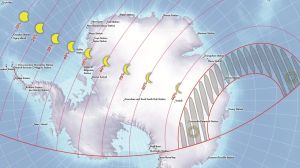
In an annular eclipse, the Moon is not in the right position to totally cover the Sun, instead leaving a ring of fire around the dark disk of the Moon. This happens when the Moon passes between Earth and Sun at a distant point in its orbit from the Earth (close to perigee), and it isn’t common, happening only once every 1-2 years. What’s more, the geometry has to be so precise that totality is never widely visible. As is happening this year, the path of totality in an annular eclipse travels a short and narrow band and, because most of the Earth is water, tends to be over the oceans.
For others in the southern hemisphere, in parts of South America and Africa, there will be a partial eclipse. I think these are neat because the shadows cast under the light of a partial eclipse are all crescents. Similarly, if you punch a small hole in a sheet of paper and allow the light to shine through the hole onto some solid surface, you will not see a disk shaped like the hole — it will be the shape of the Sun. So the deeper the partial eclipse, the thinner the crescent.
Interestingly, while annular eclipses are not common now, because the Earth is slowly drifting away from the Sun, there will come a day when full solar eclipses will no longer be possible. Then most “total” eclipses will be annular.
So… enjoy those total eclipses. Those are the truly rare events in the universe. And one is coming up this August!
©Elizabeth Anker 2026

 By My Solitary Hearth