


St Joseph, Patron of Fatherhood
To me Christianity seems to be rather quiet on Joseph, the husband of Mary and the step-father of their deity. That may be because I’ve never lived in an Italian neighborhood where Joe is the patron saint of roughly half the male population (though I did get a faint whiff of this from my Uncle Joey who played trumpet and ran a nightclub in Chicago). There are many people and places — and even hospitals — named after Joseph, though some in the Anglo world are named for the later Joseph of Arimathea, the man who assumed responsibility for Christ’s crucified body. But St Joseph has few prominent churches, no monastic orders or major centers (to my knowledge), and a far less conspicuous cult following than the other principal people of the New Testament.
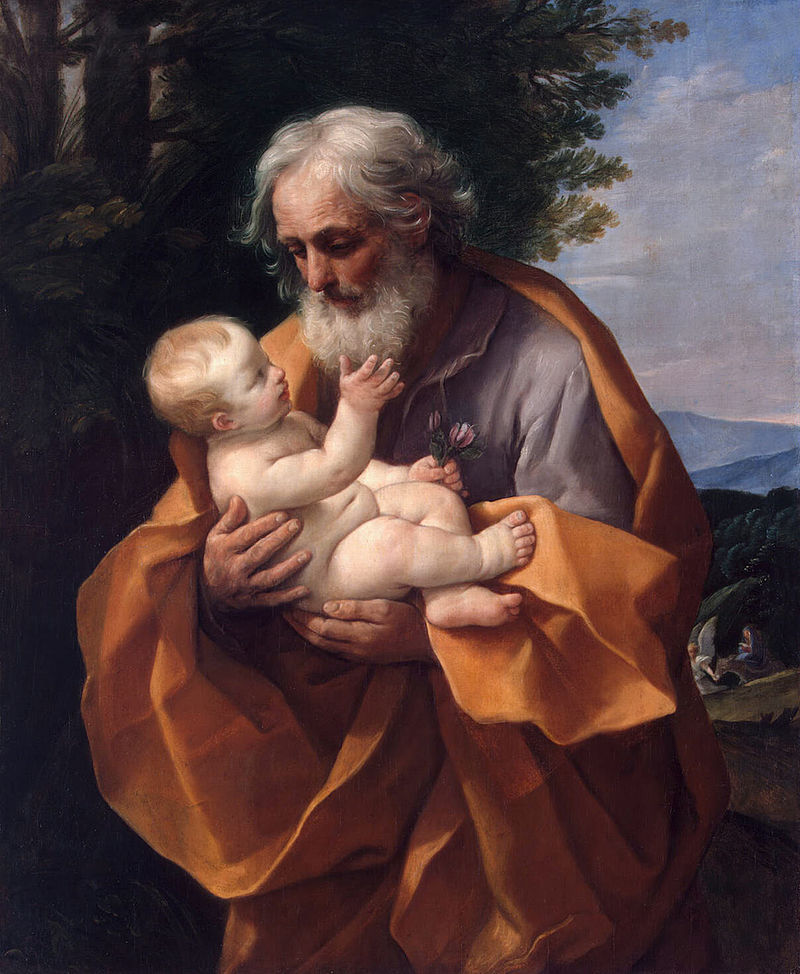
Furthermore, Joseph has no voice in the New Testament. We don’t know how he felt about the role he’d been dealt (though we might reasonably infer…). He disappears from the story shortly after presenting Jesus to the Temple. He is not, for example, present for any of the miracles; nor is he a disciple. From this absence, it seems that many artists have concluded that Joseph was an old man before Christ was born and therefore reached the end of his life long before Christ reached adulthood. In pronounced contrast with Mary’s fresh youth, Joseph is almost always portrayed in his dotage with white hair and wizened flesh.
I think perhaps this silence is because St Joseph was the sort of craftsman who quietly does the necessary work and keeps his opinions to himself. We all know that guy. He is competent. He is calm. He is dependable and generally affable. He is not rich but seems to embody a higher form of quality. He has kind eyes, though he rarely displays stronger emotions. He works with his hands and pours all his love into the wonderful things he produces. He seldom speaks, and when he does he uses few words and a soft voice. We must lean in to listen and learn. That guy is also always old, having lived beyond the need for noisy acclaim. He always looks like St Joseph.
This is the St Joseph that I picture in those few stories that include him. He is the archetypical Craftsman. He hovers protectively in the shadows, ready to do what must be done, even if that means enduring ridicule. He skillfully builds shelter for his young wife and infant step-son. He teaches the Son of God how to be a Man.
St Joseph is honored as patron saint of many places, including Canada and Mexico. He watches over families, fathers, expectant mothers, travelers, immigrants, house sellers and buyers, carpenters, craft-makers, and engineers, among others. He represents the common working class, though a separate Feast of St Joseph the Worker was created in 1955 by Pope Pius XII in response to the rise of Communism. This feast day was set on May 1st to compete with the secular celebration of laborers.

(Note in this painting that while Joseph has a faint halo, Jesus does not
— though he does seem to have lingering attendant angels.)
March 19th is St Joseph’s Feast Day (though complications arise if the 19th falls between Palm Sunday and Easter). In some predominantly Catholic countries, this day doubles as Father’s Day. This day is a Solemnity of a Saint, and as such is one of a very few days in Lent when the vestments and altar cloths are changed from somber purple to white or gold, the hymns are more joyful, and the Creed is said. In short, it is a break from Lent, though it is a quiet break with little raucous celebration — except in a few places. It is largely a day of solemn processions, of erecting elaborate altars of blessed food and then donating it all to the hungry, and of showing special attention to fathers. It is a day of honoring the stalwart strength of the men who gently guide our hands into adulthood.
The New Sap Moon
The fifth moon of my lunar year is the Sap Moon, which is new today. The fifth moon is new between 24 February and 24 March, full between 10 March and 7 April. This is a period of rapid change. The Sap Moon rarely sees the same weather from year to year. When it’s early in the solar calendar, this month is dominated by mud and melt, if not snow and blizzards. When late, there may be daffodils blooming. When it is close to the equinox, we may have blooming snowdrops, though nearly all the other bulbs and spring ephemerals are green shoots not more than a couple inches tall. But it’s just as likely that the full Sap Moon will be shining down on two feet of snow in my part of the world.
However, I don’t want the cold to go away entirely yet. We need those cold nights paired with warm days to get the sap flowing or this won’t be much of a Sap Moon. Which is just wrong. Maple sugar is one of the few spring traditions in New England. Sugaring season is spring here.
The collection and concentration of sap was already an industry before Europeans arrived with their metal tools and cooking implements. Sugar was trade currency, a condensed, easily transportable form of delectable energy that could be stored for months. Sugar season began when the first crow appeared and lasted until the frogs began to sing. Each family matron had her own sugar bush and directed the entire village in gathering and boiling the sap in this time of year when not much else was available from garden or forage.

The colonists brought pots that could boil off the liquid more efficiently than the previous method of putting heated stones in a hollowed log filled with sap. They also introduced the spile, a somewhat gentler way of reaching the sap. This was originally just a wooden tube with one spiked end. It quickly evolved to a metal tap that could be reused from year to year, and it hasn’t changed much since then — though these days, the taps are connected to tubing that empties into a central collection bin.
The locals also showed the new-comers one of the delights of this season — sapsicles. Branches that are broken in winter storms don’t tend to heal until the growth season gets underway. So during sugar season any broken wood is liable to leak sap. After a few rounds of night freezing and day thawing, these drips form frozen slivers of sugar water that look much like icicles — candy, free for the taking, a spring favorite for kids in this part of the world for thousands of years.
Sugaring is an industry in my part of the world. Vermont accounts for over half of the syrup produced in the US. This isn’t the romantic, old-timey, hanging-bucket you see pictured on all the syrup bottles. We take sugar seriously up here. The sugar season begins long before the first sap is collected. Shortly after the new year — or even the solstice in the last few years — maple trees around Vermont become webbed in bright tubing. The trees are tapped (meaning a small hole is drilled down to the inner bark) and a spile is inserted. The spile is connected to rubber hose that joins many trees together in a collection network. The sap runs through the tubing to a large collection tub, and the tubs are taken to the sugar shack to be emptied into the boiler hopper multiple times in a season.
The main tasks early in the season are checking the lines and making sure flow is unimpeded. This year that involved digging down through one to two feet of snow to get to the lines. I should say that lines are always suspended well above ground to minimize breakdown of the tubing and to try to keep the rodents from gnawing holes in the lines. Snow was so deep this year that a line of tubing suspended two feet off the ground was buried under an additional two feet or more of snow. February saw many stories in the local papers about trenching to check the maple lines, adding significantly to the work involved this year.
Now, if you’re making your own syrup from a few trees — especially if your “sugar bush” consists of solitary trees spread over a large area — then those old-timey buckets are better. Buckets are cheaper to buy initially and to maintain. There is less material and energy use, though you have to expend more energy. Still, the whole production is more human scale. The tapping process for buckets is the same, but the spile should have a hook on it to hold the bucket. Be prepared to empty your buckets often, sometimes several times a day in peak season, and you’ll need to have clean storage containers to hold the sap until you have enough to boil down, “enough” being entirely up to you. It will take hours, perhaps a full day, to boil the sap into syrup no matter the sap volume. Get the most out of those hours by boiling it all at once.
As I said, Native Americans have been tapping and boiling maple sap for at least hundreds if not thousands of years. There is an ancient tale of Nanabozho, the Anishinaabe trickster, and maple syrup. Long ago, sap flowed from the maple trees as pure syrup, free sweetness for the taking. Nanabozho decided this was way too easy, that the people did not appreciate the free gift. He thought hard work would make the people more grateful. So he diluted the sap with water, leaving merely a trace of sweetness. The people then had to boil off the water to get to the sugar — quite a lot of water. It takes about 40 gallons of sap to make 1 gallon of syrup. Nanabozho truly made us work for that sweetness.
But Native Americans made maple sugar, not just syrup, so they really cooked out all the water. They stored large blocks of the sugar in special birch-bark boxes. Sugar is easier to cook with, easier to transport and store, and I suspect it lasts longer than syrup — provided the ants can be kept out.
There are other trees that can be tapped for sweet sap, but maple is the most concentrated. For example it takes somewhere around 110 to 200 gallons of sweet birch sap to make a gallon of syrup. That said, if you’re up for the work and have access to a large number of river birch trees (also called copper birch), the taste is divine. It’s a softer sweetness with a minty overlay; it can only be described as winter air. You’re not likely to ever find it for sale. However, there are birch beers that will give you an impression of the syrup’s flavor.
Since tapping a tree is literally taking its life-blood, choose your sugar bush trees wisely. Tap mature trees, those with a diameter of at least a foot measured at a height of five feet above the ground. I’ve seen some old trees covered in buckets, but most people will drill no more than three holes per tree per year. In the centuries-old sugar bush surrounding my last home, the maple trees bore evidence of tapping all around the trunk as high as I could reach. When using the tube-collection method, there is normally just one insertion in the tree; and it’s commonly recommended that you drill at least 6” away from previous holes. Moving the spile is another early task in sugar season.
Sugar boiling season is not set in time. It can begin as early as January or as late as the end of March. It’s the weather that is important. The trees need to experience warm days — a few degrees above freezing — so sap will flow. But nights must be cold. This daily variation in temperature creates pressure differentials which makes flow volumes that are high enough to keep the tap hole from drying and healing over. However, once the tree starts photosynthesizing, the sap turns bitter. This bitterness is the tree’s defense from sap-suckers of all kinds, including us. So when the buds open, it’s definitely time to turn off the tap. It’s also said that when the spring peepers start singing, tapping season is over. Many sugar producers will finish the season with the so-named “frog run”, the last sap collected before spring begins in earnest.
Collecting sap, even by bucket, is a somewhat solitary endeavor. With the tube networks, it’s not even that much of an endeavor. The truck drives up to the collection tub, empties the sap into a tank, and heads out to the sugar house where it gets dumped into bigger tanks until it goes into the evaporator. Still, the dozen-tree bush across the street from my last home could fill up a 1200 gallon storage tank in less than a week. (It often sounded like it was raining out there because there was so much flow.) So it can be a good deal of work for one. And collecting buckets is even more time intensive, obviously, because there is isn’t a tank collecting the sap. You have to empty your bucket at least once a day in high flow season. If you have many buckets distributed over a wide area (the typical “bush” these days), the project starts to trend to one better managed by a community — unless you have nothing else to do in sugar season. (If that’s true, tell me your secret…)
However you manage the collecting, once the boiling stage starts, then this truly becomes a community project. For reasons I’m not too clear on but which seem to have actual bases in reality — and syrup quality — you can’t stop the boiling process once you start it. So if you are boiling down those forty gallons for your own gallon of syrup, you’re in for about 24 hours of standing over the pot, adding more sap as needed, stirring up the bottom to keep it from scorching, and keeping the cooking temperature at the right level for syrup production. If you are cooking with wood fuel, like many sugar shacks, that means near continuous regulating of the firebox.
This is obviously tiring work for one person. But it’s a whole lot of fun for a small group. Brian Donahue’s Weston, MA community farm, Land’s Sake, figured out early on that maple sugaring is a wonderful way to give children hand’s-on experience with the production of their food. To this day, Land’s Sake still offers classes, partnering with local schools, church groups and various kid groups — from Brownies to Little League teams. Their maple season classes are already running, but they have drop-in spaces available still. If you live near Weston and haven’t done this yet, I highly recommend signing up this year.
Donahue is a visionary, but setting kids to tend the boiler is not particularly novel. New Englanders have been granting their children these teachable moments for at least as long as the colonists have been recording syrup production methods. It’s likely that the locals here before Europeans made the same use of their children. There is certainly a festival air about sugar season — and this predates the colonists. The whole community worked together to tend the fire, to keep the sap boiler full, and to package up the sugar bricks. Others brought a continual stream of food and refreshments. There were games and dances and story-tellers for those who weren’t on active duty but who didn’t want to go home. It was a party. And in places like Land’s Sake it still is.
Here in Vermont, maple syrup may be an industry — evaporators are huge and computer regulated, collection and delivery are automated, and bottling is done by machine — but there is still room for community. All across the state, families head out to the bush in February to drill tap holes and hook up the tube lines. There are kids who get off school for the critical crunch time when the boiler is fired up and the tanks are overflowing. And of course, the moment the doors are thrown open on the sugar shack shop, it’s all hands on deck until the last jug is sold. There is a celebratory atmosphere in these shops, with local musicians, craft bazaars, and the ubiquitous cider donuts all jammed into the shack — and overflowing into the parking lot when the weather is congenial enough.
Much like the old husking bees and planting day celebrations, sugaring is work that is turned into a carnival — all the more appreciated for coming at the last days of winter weather when everyone is desperate to get out of the house and see friends. It is community building at its finest. And, unlike the bewildered goldfish and enormous stuffies lugged home from other agricultural fairs, the take-home prize in sugaring is your own gallon of the best syrup in the world.
If you have untapped potential out there, go find a few buckets and a few friends and make a sugar bush. You will enjoy the party for decades!
The sugar season got off to a late start with deep snow inhibiting tapping and deep cold inhibiting flow. But sugaring is underway now, just in time for Maple Open House Weekend in Vermont. I will be heading up to Morse Farm for Sugar on Snow, a modern variant of a tradition in my part of the world that stretches as far back in our local story as we can see.
The generosity of the maple is truly astounding. Maple is a grand old mother tree who keeps giving and giving and giving. Maples can be coppiced and pollarded and will repeatedly produce new growth around the cuts for decades, perhaps even hundreds of years. Maple wood can be formed into all manner of tools and household uses. It is not particularly rot-resistant, but it is very hard and will last for a long time if kept dry. My 19th century house has rock maple woodwork, and I can confirm that it is stony. Nothing penetrates it. In the woods, maple trees will remain standing for decades after their branches and bark have been shed. Most of the dead trunks in my jungle are maple, and all manner of creatures make these old trunks their home. They are riddled with woodpecker holes. Owls and bats and swallows and many other wee beasties live in these excavated apartment complexes. I’m fairly sure the skunks are living in the base of one of the oldest trees.
Still, there has to be a limit to the generosity. I can’t quite accept that the maples are happy and healthy with humans sucking them dry in the seasons when they are already too stressed to produce much sap. It can’t feel good for the trees. But then it doesn’t even seem smart for the farmers. If your sugar bush isn’t producing this year, best find some other form of income so that it will produce again next year. Taking more than the tree would shed naturally seems like you’d be shortening the tree’s life, taking away from the future for you and everybody else who depends on that tree.
I don’t doubt that the matrons who directed their villages in sugar collecting all those thousands of years limited the stress on their trees. Maybe they didn’t have the tools — like plastic tubing and enormous metal boilers — and so that constrained them. But I rather think they just wouldn’t have condoned taking more than the bush could provide. If a patch of trees wasn’t producing, they just moved. As in many things, our patterns of “owning” property inhibit a farmer’s ability to let stressed areas lie fallow. Today’s farmer can’t just relocate operations to a healthier part of the woods, and with all the expense of evaporators and tubing and transport, they also can’t afford to turn off the income taps. It’s yet another wicked problem that will likely result in increased harm for the future. (As nearly everything involved in profit-mining does…)
From the Book Cellar
— My go-to reference on Native American storytelling is always Joseph Bruchac. The story of Nanabozho is based on his “Manabozho and the Maple Trees” found in Native American Stories Told by Joseph Bruchac (Excerpts from Keepers of the Earth, Michael J. Caduto and Joseph Bruchac, eds. 1991, Fulcrum Publishing).
— For information on Land’s Sake and an excellent tale of taking on suburban sprawl, read Brian Donahue’s Reclaiming the Commons: Community Farms and Forests in a New England Town (2001: Yale University Press). Donahue, a historian and Environmental Studies professor at Brandeis University, also has many other wonderful books on the role of agriculture in community, particularly in New England.
— One of the best introductions to making your own maple syrup comes from Martha Adams Rubin in her Countryside, Garden & Table: A New England Seasonal Diary (1993: Fulcrum Publishing).
Here are three more books on making and cooking with maple syrup:
— Backyard Sugaring: A Complete How-To Guide (3rd edition) by Rink Mann (1991: Countryman Press).
— Maple Sugar from Sap to Syrup by Tim Herd (2010: Storey Publishing).
— Maple Syrup Cookbook by Ken Haedrich (2001: Storey Publishing).
There are quite a number of wonderful picture books on maple sugaring. All of them feature amazing art and storytelling. A few are award winners!
— Sugaring Time by Kathryn Lasky, photographs by Christopher G. Knight (my version is from Aladdin Paperbacks and dated 1998; original copyright is 1983).
— Sugaring by Jessie Haas, illustrations by Jos. A. Smith (1996: Greenwillow Books).
— At Grandpa's Sugar Bush by Margaret Carney, illustrations by Janet Wilson (1997: Kids Can Press).
— Maple Moon by Connie Brummel Crook, illustrations by Scott Cameron (1997: Fitzhenry & Whiteside).
— Pancakes for Supper by Anne Isaacs, illustrations by Mark Teague (2006: Scholastic).
— The Sugaring-Off Party by Jonathan London, illustrations by Gilles Pelletier (1995: Fitzhenry & Whiteside).
— Sugarbush Spring by Martha Wilson Chall, illustrations by Jim Daly (2000: Lothrop, Lee & Shepard Books).

And last but not least, there is Jane Yolen’s tender depiction of her daughter and now-deceased husband learning about nature in the cold nights of earliest spring. There is no maple syrup, but there are maple trees — and owls! Owl Moon by Jane Yolen, illustrations by John Schoenherr (1987: Philomel Books).
©Elizabeth Anker 2026

 By My Solitary Hearth