

Well, it was a disastrous week in the garden. No, not the weather. The rain harried the daisies and left the potatoes prostrate, but that happens every year to no effect except dishevelment. The rain hasn’t even bothered the herb bed too much, though none of those plants like humidity and wet feet. No, the disaster was of a local and earth-bound nature… though it too happens every year.

The garden was eaten. I am blaming the groundhog because once again the destruction was methodical and thorough, every leaf on every plant eaten. And once again it was leaves, not fruits or seeds. I suppose it could be deer, only the damage is most pronounced at ground level, not deer level. Also deer eat everything in a given area, not all of just a few kinds of plants spread out all over the whole garden. Deer also share the squirrel tendency to tear down plants, nibble on some parts, decide they’re just not in the mood to eat that stuff, and then leave the rest of the plant to die… and then they go on to another plant of the exact same species and repeat the destruction right on down the row. Because deer are stupid beyond belief. (Squirrels are just evil…)
Groundhogs are slow. They are fat and cautious. They are creatures of dogged habit. But they are insanely smart. They waste no time or energy or plant material, going right through all of what they love and ignoring everything else completely. How do they know that they hate tomatoes when they only live a few years and maybe have never personally encountered a tomato plant? No idea. But they do know. Must be some sort of groundhog ancestral wisdom passed down through the generations. ‘Go straight for the beans, eat all the leaves, pass on the smelly stuff.’
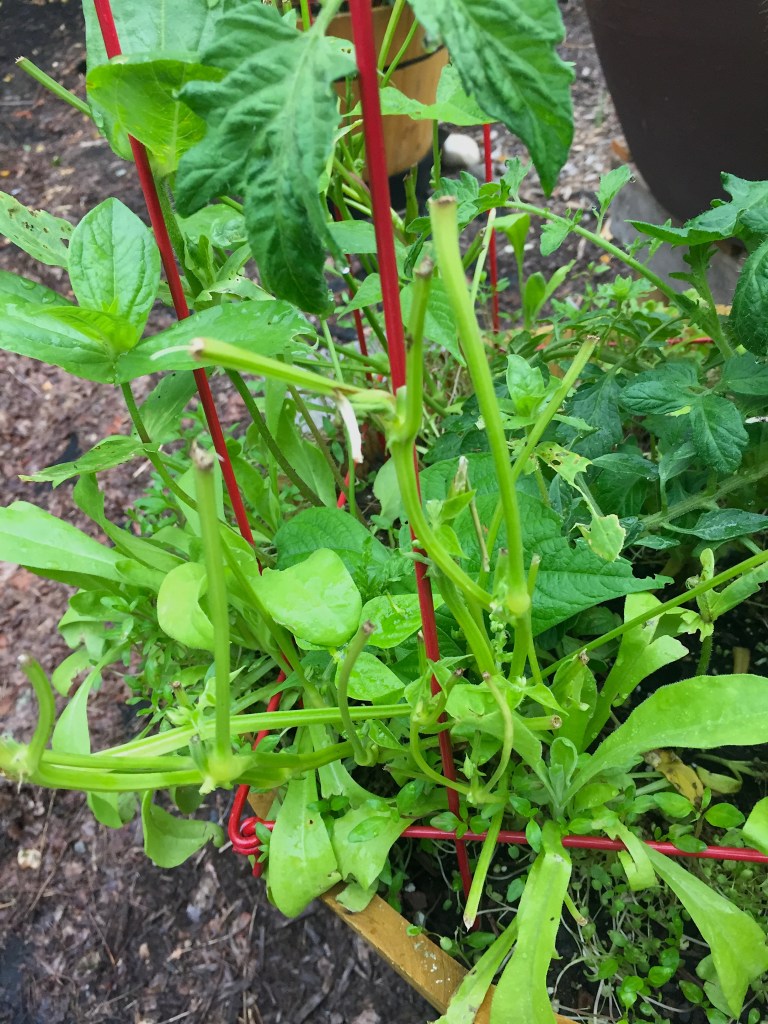
Moreover, you will never outwit a groundhog. You can’t trap them, deter them, or frighten them off with the sort of noise and sparkly things that work on birds and deer. They don’t like the smelly things, but they also know the difference between the smelly onion and the bean sprouts growing among the alliums. I have not yet tried chile on the leaves, but that’s more because there aren’t leaves to spray with chile. I am losing this contest. Besides, common wisdom is that no amount of repellant and caging will keep a groundhog away from the garden once she’s discovered the bean plants. They’re not afraid of you or any of your four-legged minions. They know your routines and will be out in the garden the minute you carry your tools indoors. You can’t flush them out of their burrows; they just calmly waddle out another exit and wait for you to get tired of holding the hose. Apparently, you can’t use flamethrowers down the tunnels either, but I’ve not tried that. Yet. I might be getting close to that level of desperation.
It’s sort of funny actually. Or it would be if I wasn’t trying to grow the food I need to eat in the winter. But then again, beans are sort of superfluous summer food right now, until I figure out how to dry them in this humid climate. I’ve already made many resolutions to just stop growing the beans, darn it, because it’s just not working here in New England. Except that I know it does for other people. What are Boston baked beans if not evidence that other people have figured out the bean-drying problem? And kept the groundhog out of the garden.
Thoreau talks about the groundhog ravaging his own bean field. He pooh-poohs the whole endeavor, saying that the groundhog has as much right to eat the beans as the human does. Which is only sort of true. The groundhog didn’t clear the ground, nurture the soil into good health, plant the seeds, tend the plants and keep the weeds away. The groundhog didn’t carefully preserve the seeds from last year’s harvest. The groundhog doesn’t know the meaning of harvest. The groundhog doesn’t need to eat beans when there is a whole forest of native groundhog food surrounding the bean field. The groundhog doesn’t need to eat at all in the winter, sleeping through the dark months that humans survive mainly by eating beans… and grains… which groundhogs don’t like. The groundhog didn’t put anything into Thoreau’s bean field and therefore doesn’t really have as much right as Thoreau to benefit from that work. I suspect Thoreau knew this… but in the face of the indomitable groundhog he made up excuses that made him feel better about losing to a fat rodent.
It’s odd that no other garden writers between Thoreau and Michael Pollan talk much about the groundhog. It feels like an intentional lacuna, excising all the lost battles from the rosy published descriptions of summer harvest and, well, roses… I just don’t believe that nobody else in New England has had encounters with the groundhog. Failed encounters, that is. I also am beginning to doubt that beans are ever harvested here, Three Sisters gardening notwithstanding. Maybe all those brown beans have always come in burlap bags, since the cold old days of ruffed collars and tall black hats, shipped here from heavenly places where beans will dry in the sun and groundhogs do not roam. Like maybe Arizona…
Well, I don’t give up that easily. My mother is Irish, after all. Come to think of it, we might be kin to groundhogs in many ways… ahem…
So I’m putting together an arsenal of tools and techniques that will hopefully allow me to harvest a winter’s worth of my beloved black turtle beans and maybe the odd meal of tender filet beans sautéed with maple-glazed spiced walnuts. (Okay, let’s not get all maudlin here…)
Step 1: Plant the potatoes in the hugelkultur mound. The groundhog does not like the potatoes. The groundhog doesn’t seem to even like walking near the potatoes. The few bean plants that have survived the groundhog are the ones closest to the potato patch. So encircle the garden in potatoes. That might work for a few weeks. Before the beans are actually planted…
Step 2: Buy an industrial bolt of translucent row cover fabric. A few hundred meters will probably suffice. Or maybe not that much… but enough to cover all the beds that will be planted in beans from the ground to at least four feet high. I don’t want to block moisture and I don’t want hot air to be trapped under the cover, so I don’t want the cover to have a roof (so, not so much of a cover, then…). I want to make gigantic tubes around the beds that are open to the sky but solid at ground level. The netting sold as garden protection isn’t good enough. All it does is trap hapless birds. It also seems to be particular effrontery to squirrels. Even when they don’t want anything inside the green mesh, they will gnaw it all to shreds just to see all your careful work in tatters. (Squirrels… evil… ) However, this worked.
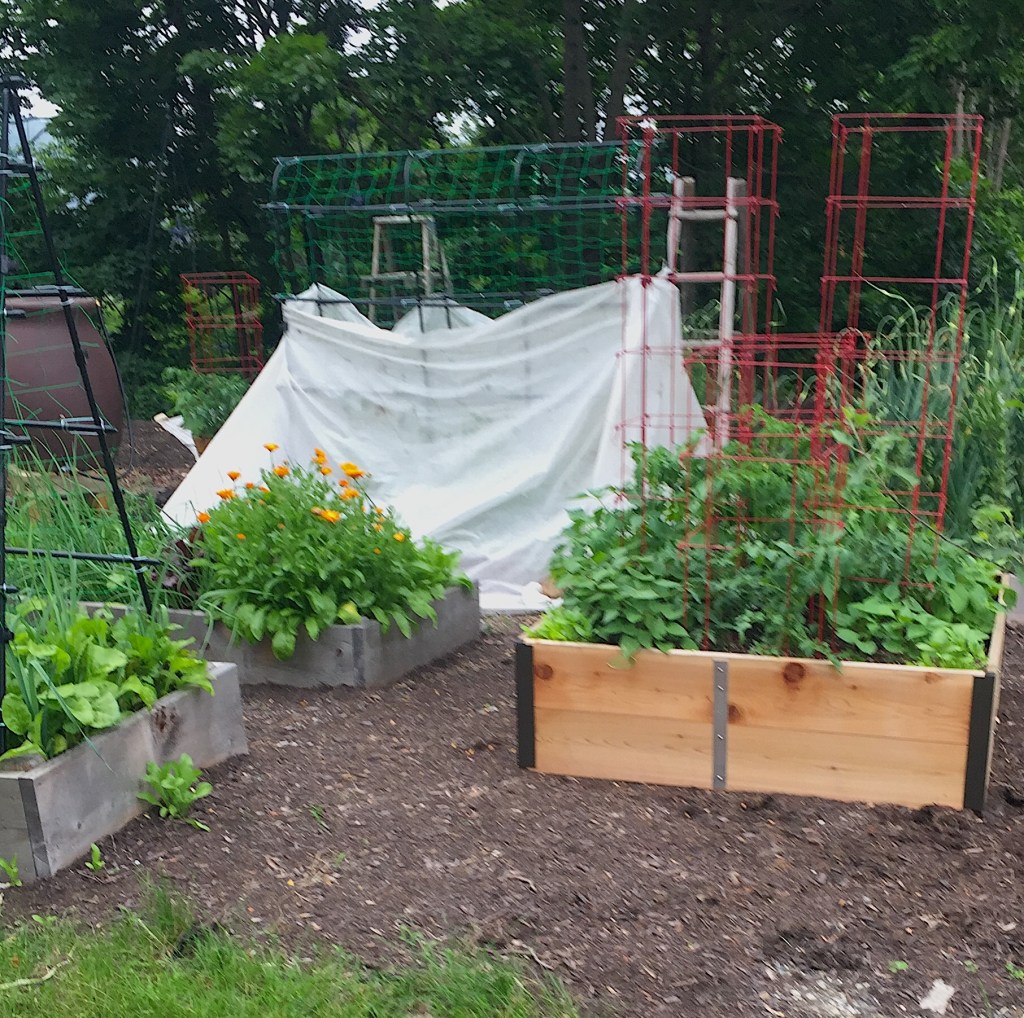
For a blessedly rodent free month the peas, beans, sweet potatoes and a few rows of lettuce grew inside this open-roof tent of solid fabric. It was lush and healthy. The only reason I took it down was because the weeds were also lush and healthy. After I weeded the bed, I should have put the fabric back up. I knew I should have put the fabric back up. I did not put the fabric back up. I told myself that everything was large enough and mature enough, redolent with foul phyto-chemicals, that all would be well and all would be well and all manner of things would be well. Or at least all would be bitterly poisonous by now. This is how that worked out.

So next year, I shall garden in tubes.
Step 3: Don’t plant bush beans. As much as I love French filet beans, it’s just not worth enticing a groundhog into the garden for her favorite meal. The beans that I plant have to be suspended high above the ground(hog), and the plants must be large enough to endure ground(hog) level exfoliation without dying. All those Three Sisters gardens do not have titchy little bush beans planted under the corn and squash. Of course, not; that would be silly. Beans aren’t shrinking violets, to hide under the pumpkin leaves. In those interplanted patches of complementary garden plants, pole beans are majestically vining up the corn, rising above all the perils at ground(hog) level. In any case, there are pole bean varieties that taste just as yummy as the delicate French beans I love, as long as I stay on top of the bean harvest. And when I don’t — because I won’t… don’t judge — the pole bean pods will yield up actual beans for drying.
And this is where the plan gets a bit nebulous…
Out in New Mexico, the growing season was so long and most days were so sunny and warm that even in monsoon season, I could dry beans on the plants. In fact, I had to be careful to not let them get too dry, completely desiccating and destroying the bean flesh. I can’t do that here. In New England drying beans are hardly mature before frost sets in. And while August can be hot and windy and dry, there are still strings of humid days that rot everything left on the vine. So I need to create New Mexico in New England. I need a dry and well-ventilated space that is large enough to accommodate my drying racks and unused enough that those racks don’t get in the way for the week or longer that it takes to dry shelled beans. And I do not have such a space in this damp and not very spacious house.
The best I could do is to suspend the racks from the attic ceiling, but the ceiling is so low the racks would be nearly trailing on the (rather disgusting) floor. Also, while there is heat, there is no airflow up there and no less humidity than the rest of the house. Not much less than outdoors, to be honest.
I could put the beans in the oven or the veg dehydrator, but this uses electricity and, I suspect, might be too slow to process the harvest before most of it rots. These tools only hold a square foot or two of beans at a time. Still, I’ve heard other people claim success with such things. So that’s a possibility for the interim.
But I think the goal now is to decommission the garage and turn it into more useful space. I went off in some detail why I think the garage is more trouble than it’s worth. In much the same way as filet beans are, now I consider it… It’s working against nature, and not working enough with me to even justify its existence with whiny human reasoning. Once I set about resolving its relationship to water, there’s going to be a large open space with rafters and not much in the way of house rodents (being perched on fifteen feet of solid rock). Add a large fan and it becomes a perfect drying barn.
I might also go a few steps further, because I also need root storage (as one does). The basement is good, but it’s not great. It was cool and humid enough to keep the carrots and beets happy, but those were used up not long after the solstice. So I don’t know what would happen if they spent a whole winter down there. The few potatoes I managed to grow and the greater volume I bought in bulk for storage sprouted roots in March. Most were useless even for planting by the time the ground thawed.
But the worst thing about keeping the root cellar in the basement is this means I can’t do things to dry out or warm the basement. It has to stay cold and damp and smelly and therefore not very congenial to anything but stored veg. I can’t put a big wood-fired cook stove down there in the logical place for a big wood-fired cook stove, on the base of the chimney where a big wood stove of some variety used to exist, down low in the house, so the heat from baking warms the whole house. I can’t put a loom or a spinning wheel down there even though there is plenty of space for both down there… space that exists nowhere else in the house. I can’t even dry my clothes down there, and more than half my wardrobe does not go in the electric dryer. It takes days on the drying racks, after which time they come upstairs smelling like moldy basement. This does not make me too popular at work…
So take half the cold garage and make it cold storage. The thick concrete is as good as an ice block at maintaining the necessary cold into the warming spring months. If a small space could be partitioned out and insulated, all I’d need was a space heater to keep the veg from actually freezing. Unlike in the house, I could install a heat pump over on that side of the road because the garage has its own 100amp electrical circuit and almost nothing drawing on that power. That electrical capacity can easily both charge my car and keep the interior above freezing. In fact, I could have two heaters — what luxury! — one for the cold storage room and one that could seasonally warm up the rest of the space enough to start seeds in the spring and dry beans and onions in the fall. Being of a redundancy-fanatic nature, I could even put a small wood stove in the larger space. So when the electricity fails I can still maintain the temperature to do what needs to be done.
I read a headline the other day that said ‘What to Grow in the Future’. I got excited because I thought it was a garden advice column. Or maybe a description of infrastructures and technologies that would be beneficial to cultivate in times of disintegration. I thought it would be something like the long, rambling lists and stratagems that fill my garden journals. It was not. It was on degrowth… which is a helpful belief system to cultivate in times of disintegration, to be sure. But it’s not very tangible. It doesn’t give one ideas for actual things that one can actually do — or not do. It was not a practically helpful read, though it was interesting and emotionally uplifting.
However, what I learned from that is that I want to read what other people are doing to weather this mess. Actual things. Like figuring out what to grow in order to feed ourselves — both in the growing season and in the winter when nature is not providing local food. Like creating plans and then the physical means and spaces to process and store that food. I want to hear actual details of actual acts. I want to hear how other people dry beans in humid climates. And I really want to know how other New England folks are dealing with groundhogs. I want to fill that two hundred year old gaping hole in the garden writing record.
So this is what happened… Welcome to my serial maundering on What to Grow.
But seriously, this is my offering of experience and experiments. Now, you all need to reciprocate… because I need help with this damned implacable rodent!
©Elizabeth Anker 2023

 By My Solitary Hearth
After an outstanding spring harvest (of lettuce, beets, mustard greens and snap peas), my garden is now in a sorry state. Something, (squirrels, chipmunks, voles? definitely not groundhog) ate all but a few of my pole bean seedlings. Something is working on my sweet potatoes. I don’t know what but I can see their green tops shaking. Probably doesn’t help that I’ve encouraged my garden to be a ‘habitat’ for others as well as myself. My mom has a groundhog. I told her she should buy some food from the farmers market to feed it so it doesn’t eat her garden. Speaking of farmers markets, I marvel at how they can produce so much food with all these hungry critters. I suspect there are a lot of unlucky groundhogs (despite their ingeniousness).
LikeLiked by 1 person
I used to use fencing & thorny raspberry canes on my farm. I had groundhogs, but they didn’t bother with the garden. Which is good because I suspect you really can’t get rid of them. They don’t like dogs or dog smell, so that’s another good deterrent. But I work too much to have a dog here.
LikeLiked by 1 person
Hi Eliza,
45 years ago we had a female labrador retriever running loose on the farm who killed every woodchuck within ¼ mile of home. Lately we have had success using electric netting to thwart woodchucks, rabbits and racoons. This is the product we use and, for us, it has been 100% successful: https://www.premier1supplies.com/garden_wildlife/fencing.php?fence_id=34
We have always used electric fence to contain our Angus cattle and our sheep as well as to keep our chickens safe from foxes, mink, and fishers. We do not use a solar powered energizer, but use a plug in model under cover from the weather and run a single insulated wire out to the garden to power the fence…..has worked well for many years now. The poly-net fence is easy to erect and to take down at season end. We have never had trouble with a woodchuck attempting to dig under the fence despite the fact that one lives under a shed 20 ft. from the garden.
I hope this helps!
Mike
LikeLiked by 2 people
Yes, thank you! I think I might try that. My garden is right next to the garage & I could put the electronics in there.
LikeLike
Eliza, groundhogs (like rabbits) are quite edible! I’m not a hunter or a gardener, and I’m happy to see them in the yard, nibbling on the unkempt growth, and presumably working out their own salvation. If only they’d develop a taste for Japanese stiltgrass…
LikeLiked by 1 person
I’m a vegetarian, but I have had that thought more than once. I’ve also let it be known that anyone who does hunt is welcome to come try their hands at groundhog… I actually like watching the in the yard. They mostly eat the stuff I don’t want in my small patches of grass, though they also love clover and will annihilate that.
LikeLike
I share my mini-farmstead with deer, rabbits, and pocket gophers. I have a 4000 sq ft garden and over the last 13 years, I have outfitted it as a fortress. And still, they find their way in. My garden is surrounded by a 10 feet tall deer fence (plastic mesh) which has held up remarkably well to UV, howling winter winds, and 5 feet of snow each winter. In year three of my permaculture garden, the pocket gophers ate every last garlic bulb I had planted in the previous autumn. I didn’t know about gophers and had to dig out my 9 raised beds and install hardware cloth. Then the following year, I discovered that rabbits had chewed holes in the plastic mesh to enjoy a morning buffet of salad greens, carrots, etc. An expensive roll of chicken wire was wrapped around the bottom of the deer fence years of heavy snow pushed it down and this year they found a way in. Gophers are persistent, tunneling next to the raised beds and creating mounds of soil in my paths. It’s a never-ending back and forth and I am thankful to live in an area where I can supplement my food supply with organically grown produce.
LikeLiked by 1 person
And we think we’re the clever beasties!!! I am glad we don’t have gophers. Nor have I had to deal with voles on this property. But there are deer. They’ve been quiet this year, knock on wood… But last year they tromped all through the winter squash patch. They didn’t eat much, just destroyed all the plants.
LikeLike
Oh no! And here I was worrying about your garden surviving all the rain. I don’t have a groundhog but I do have rabbits and squirrels and now, apparently, sparrows that eat everything. It is a constant trial and error and I frequently lose. But I try to take a page from the squirrels and persist until I figure something out. I find there is very little about protecting veg from urban invaders in gardening advice, and when I have asked expert gardeners they just look at me and say useless things like, wow you have really aggressive squirrels.
Fencing has helped immensely against rabbits, is it possible you can fence off your garden from the groundhog? And by fencing, I mean tall metal garden stakes and hardware cloth, nothing fancy or permanent or super expensive.
I suspect groundhogs and other critters have always been a foe to gardeners, but I also suspect folks used to spend a lot more time in their gardens, not having to go to wage labor jobs 40 hours a week, or they were/are able to pay other people. And so the presence of people in the garden for a large chunk of the day, no doubt deterred critters from being able to inflict so much damage. That’s my theory anyway!
As for drying beans, before our drought summers, it used to be pretty humid here and I was able to dry beans on the plants. Some of them would get moldy, but as long as they had good air flow around them and didn’t touch the ground, they did ok. And filet beans, I grow Fortex, a vigorous filet-type bean that I really like and has done well even when attacked by Japanese beetles. They start putting out beans close to the ground, which might not be ideal against a groundhog, but as the vines get taller, the beans are higher up.
I too am interested in growing food to feed myself in an increasingly challenging world. I’ve given up trying to grow lettuce and other spring greens since spring has become so unpredictable and turned to perennial/biennial greens that seem to thrive much better–like feral arugula/rocket, curly dock, and sorrel. I added mountain spinach this year and have one vine at least that is very happy and about to flower, so hopefully it returns next year and gets big enough I can try eating it. Carol Deppe has a couple really good books on growing food and she has opinions about what the best things to grow are. She also breeds plants and I got some of her zucchini seed for the garden this year. It’s just starting to get little squashes on it so I don’t have an opinion on it yet. I also bought some of her shelling beans called brown resilient I think. The plants are doing really well in spite of unpredictable heat and cool and drought. How productive they are and what they taste like remains to be seen.
Sorry for such a long comment. You know how gardeners get when garden talk gets going 🙂
LikeLiked by 1 person
Always enjoy long comments! No apologies necessary.
I think I’ll look closer at my Deppe books. In any case, I might want different shelling beans and if they’re brown, they probably make decent substitutes for black turtle, which are pretty much just bush beans… to my knowledge.
I wondered about being out there more, but for one thing, groundhogs usually aren’t out in the daylight. They do much of their dirty work pre-dawn and late in the evening. But there’s a whole family of foxes living just beneath my garden and that doesn’t seem to bother the groundhog. That said, if I do see a hog out there, all I have to do is walk out on my front porch and yell and it waddles off.
I’d love to be able to fence the garden. I might look at that again. Problem is it’s very thin soil so getting even metal posts into the ground is challenging. Maybe somebody with tools can do it for something that I can afford… it has to cost less that what I am losing to this animal.
Hope your smoke problem is lessened today. Whenever it’s not raining here, it’s smokey and now there’s dust hanging in the air from all the crap that was dumped in the roads. Can’t win this year…
LikeLiked by 1 person
Hmm, maybe people just used to shoot the groundhogs and squirrels and rabbits that threatened their food and turned them into stew with veg from the garden that they didn’t destroy. Modern life has gotten rather complicated. I hope you find a satisfactory and not costly solution.
The smoke here has cleared from the air for now, but will likely be back eventually.
LikeLiked by 1 person
People used to shoot them, but it’s probably also true that there weren’t as many people-adapted animals until the mid-20th century rise of suburbanism. Certainly, groundhogs and deer weren’t seen in urban areas until very recently. And in the boondocks, there were also other critters who ate the critters, which we’ve largely eliminated though all sorts of methods. Anyway, need some hunters of all kinds…
LikeLiked by 1 person