

The moonrise tonight is the closest to the Full Harvest Moon which happens at 5:58 tomorrow morning. In my part of the world, moonrise tonight is at 6:30pm, a few minutes before the sun sets. This ought to be one moonrise that most of New England can see, though thin clouds might dim the Full Moon’s brilliance. It is always a joy to watch the Harvest Moon rise full. It has depth and color at this time of year, looking more like an amber sphere rather than an argent disk.
Tradition claims that this moon was named for the extra light it gave to workers in the evening hours. Day length is changing so rapidly this time of year that moonrise happens right around sunset for two to three nights in a row. This was said to enable harvesters to keep working by the bright light of the full moon with no break between sunlight and moonlight. I think this is a lovely story. I’m not sure it’s true.
For starters, folklore might argue otherwise. There are a large number of beings that are said to exist simply to inflict grievous harm on the people who dare to be abroad in the fields and lanes after dark. It might almost be thought to be a taboo. There were no official rules (that I’m aware of), but humans in many northern cultures made many rather terrifying excuses to avoid working by the light of the moon. One creature was said to disembowel those she caught burning the night oil.
And that’s another thing. I don’t know about you, but even without night wights on the hunt, I wouldn’t want to be in a field of harvesters wielding sharp blades with only the light of the moon. Night vision is almost flat for humans. That dark human shape might be three meters away, or she might be standing less than a scythe-swing from you. Neither of you can tell until a blade makes contact with flesh. Makes some of the more gory folktales seem more like cautionary common sense, no? Night labor of all kinds required burning flames, which carries its own hazards, particularly in a dry grain field. It was also an expense that most manor lords would not cover and most laborers could not afford. So I doubt there was much work done by the light of the Harvest Moon.
But the thing that probably puts paid to the “tradition” is the timing. The Harvest Moon is supposed to be the full moon that falls closest to the autumnal equinox. It can occur anywhere from September 6th to October 6th, but there is very little that is being harvested in this time period. There might still be spring wheat and maize if the Harvest Moon falls early, but it’s probably not going to be a good harvest if it’s that late in the growing season. If the grain harvest is not largely done in August, there are reasons — a late sowing because of a cold or wet spring is the most common reason. This year in Vermont, we had a very late planting season; and still the corn on the cob vanished a few weeks ago. It was not a very productive year for all the grassy things in Vermont.
The produce that is flowing this time of year is largely from the veg patch — squashes, brassicas and late nightshades — or from the orchard and vineyard. You could probably harvest the garden veg by moonlight, though I can’t see the good in that. Nearly all garden produce needs some processing as soon as you remove it from the plant to keep it from rotting and desiccating. Cutting cabbage after sunset means you’re going to be up for hours in the kitchen — unless you have a large empty chiller reserved for just such eventualities. It’s also probably not good to harvest any of the nightshades when it is actually night-shaded. They all suffer from molds and bacterial infections that are more likely to enter a wound in the dark, damp night than under the light of the sun. However, it is probably a good time to go around picking invertebrate pests off of the plants and scaring the night feeders like rabbits and groundhogs out of the garden. But that task doesn’t much lend itself to a lyrical moon name. Nor is it really something most gardeners actually do.
However, the harvest of fruits is in full swing at this time of year. Most apple and pear varieties are ready around the equinox. I can’t think of too many grapes that aren’t ripe in September. Maybe some of the native New England grapes, but not many of those are grown as a main crop. If they’re in cultivation, it’s more a niche sideline. One apple orchard I know has hedges with Concord grapes strung on willows and hazelnut trees. There is a harvest in the hedges, but it’s incidental. The owner planted it all that way more to keep the birds off of her apples than in any expectation of grapes or nuts.
In any case, there is fruit to pick under the Harvest Moon, but that doesn’t seem to be something that happens. This probably is also related to the many ways to injure yourself when working at night. Then add ladders and tree climbing into the equation. I don’t like ladders in broad daylight; night climbing is right out. Maybe that’s just me, but there don’t seem to be many others who will take on night harvesting in the orchard — even though the fruit needs to be picked quickly. So it seems unlikely that the harvest in question is fruity.
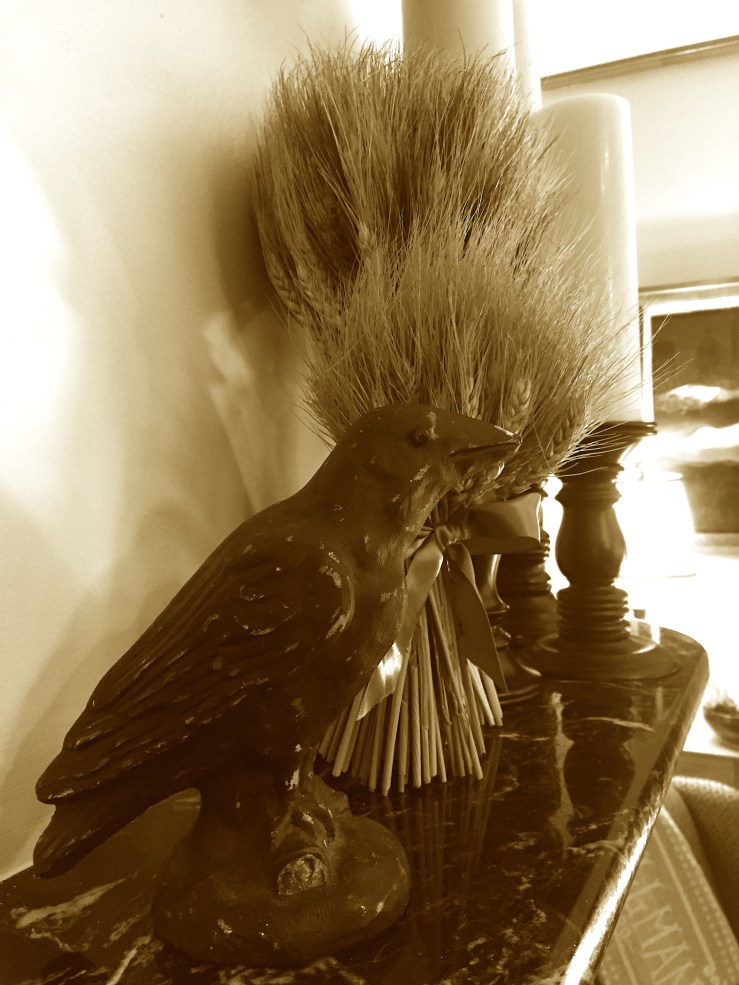
In truth, the images associated with the Harvest Moon are of grain and pumpkins — which are not harvested at the same time. And this is peak time for neither of them. Grain should be cut, processed and turning into bread and beer by now. Pumpkins are just coming into production, though this is more because the demand for pumpkins is highest around the end of October and going into November, not because pumpkins necessarily prefer growing in the cold autumn. Growers always engage in a complicated dance around the frost that kills pumpkin vines and the peak demand of Halloween that usually happens after that killing first frost.
All that said, I chose to keep the Harvest Moon in my calendar because it is so firmly ingrained in my culture. From New Mexico to New England, the full moon closest to the equinox is the Harvest Moon, no debate. Corn mazes, dried stalks rattling in the lightest airs, beckon when the equinoctial full moon rises. Hay rides and bonfires and haunted houses draw us into the moonlight. Fall celebrations all try to take advantage of the moon’s light. The Harvest Moon is cultural, not agricultural. And I chose to keep it among my yearly traditions.
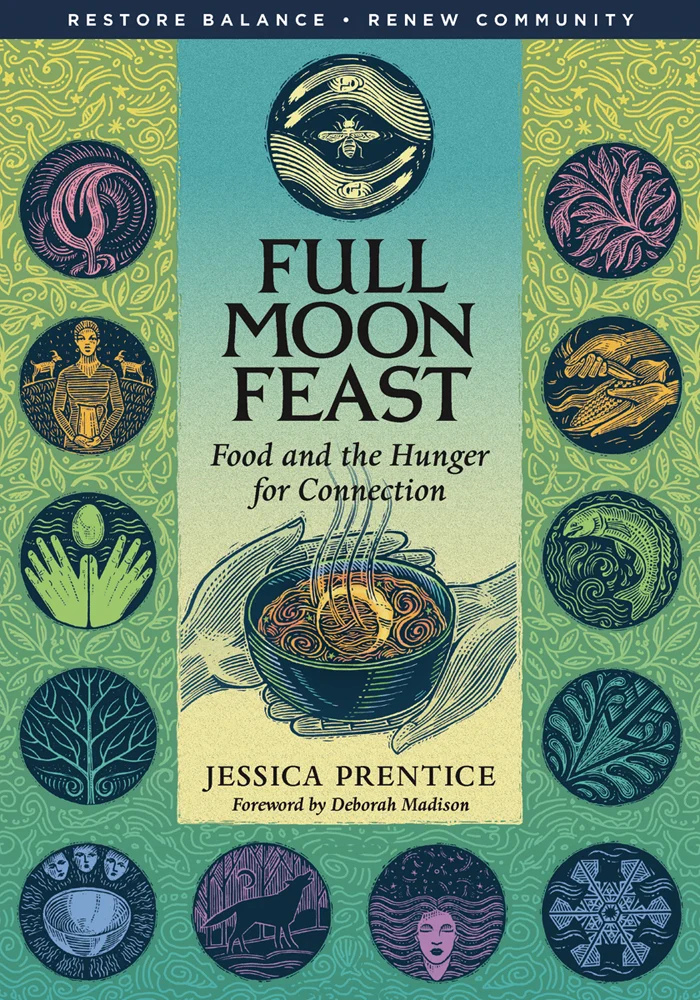
But it must be said that it’s not a terribly deep tradition. When Jessica Prentice set out to create a monthly calendar of food, Full Moon Feast, she very notably left out the Harvest Moon. The Corn Moon falls in late summer when the corn is ripe. The Salmon Moon follows, falling sometime around the equinox. And then she chose to keep the Blood Moon of the late autumn livestock culls, what I call the Hunter’s Moon because I think that name has deeper roots in my part of the world. There is no Harvest Moon in her Full Moon Feast, I think, because there is no one particular Harvest Moon — there is always a harvest provided by this wonderful Earth.
This name and the ideas around it might be no older than the Romantic Victorians, who generally were clueless. Cute, but clueless. They saw the world as they wanted it to be. Which might be a pleasant way to live, but it’s not very conducive to creating classification and order. Natural settings to most Victorians consisted of the back garden and a well-tilled field. Food production happened elsewhere in processes that were messy and unlovely, and thus ignored. Holidays were purely anthropocentric and largely focused on economic activity. Tradition was a word they adored, however they seemed to invent most of their traditions out of whole cloth with little reference to anything “handed down” from the past (the word’s actual meaning). They were great with pretty pictures; they were incapable of seeing the actual world.
They created the notion of the Harvest Home celebration — with the best of intentions, I am sure — never noticing that if there was only one Harvest in the year, people would go hungry. Nor did they seem aware of the continual round of harvesting work that went into their own lives. And if the Earth provided, it was in bucolic backdrops to human affairs. The idea that this planet feeds us year-round never entered their world view.
For good or ill, these are the beliefs and notions that fed the early pagan revivalists, who are largely responsible for perpetuating Victorian calendrical “traditions”. If I have a complaint with NeoPagans, it’s that they are far too focused on their own navel. It is a mark of how badly the pagan community is failing at its professed philosophy of being a nature-centric path, that Prentice, a thoughtful woman with a deeply embodied spirituality who lives in the epicenter of the North American Pagan culture — the Bay Area of California — looked around at spiritual paths… and chose Christianity. Not because this was her native or familial tradition, but because it best tied the mystery of life to the reality of life. Her Christian church is actually earth-centric in ways the pagans never seem to grasp. In contrast to the pagan Wheel which sets its names and then tries to force reality to fit, her ritual calendar does not include a Harvest Moon. More importantly, unlike the scarcity and fear implicit in the pagan relationship with earth, Jessica’s Earth is a constant provider, with harvests in every moon.
Still, I’m keeping the Harvest Moon. Not because it has any relevance to the harvest, nor even much to do with moonlight. I just like the romance of the thing. And there are such a lot of fun ways to celebrate this lunation, which is what my calendar is all about. I have task lists for all the seasons, to be sure, but the central point is creating a frame upon which to hang conviviality. My moons are also cultural, not agricultural. In fact, I generally avoid gardening by moonlight. Apart from the biting insects and increased incidence of accidents, I like the idea of resting in the dark. I want to stop work when the sun sets, no matter what tasks are pressing…
And, anyway, who can focus on quotidian labors when the Harvest Moon is shining full and bright?
Of Beans and Eternal Fancies: 15 Winifred Mumbles
Nine quarts of dried black beans stored in the pantry. Translates into something like thirty-six pots of soup each lasting me a week. There’s corn enough for tortillas through March. Then, I guess, it’s wheat flour. Where from? No idea. Not my part of the world. Always appears when needed though. Wheat is magical that way.
Suppose it’s not that magical. Nor is it actual wheat, from all I can tell. Some perennial grass they grow upriver in Colorado. Tastes just fine, but doesn’t have the elasticity of real wheat. Sometimes, I put a bucketful of einkorn into the winter paddock to get that rise out of bread. Sometimes, that’s the only way to bake apple cake in September.
These blue October skies make one thoughtful. Here we are, confronted with time and decay and finitude all laid out in its bright array. Can’t hide from a mountain covered in the orange and gold preparations for winter sleep. Though it has been tried. What led to here, I suppose.
There once were balloons in these blue autumnal skies, skirting the valley mists like so many soap bubbles. Thin envelopes of air carrying those ancient people of rust and waste up and above the fall and all its temporality. Never mind that they all came back down. No doubt, some with abrupt finality. Thus erasing the escape entirely.
Never understood that rusty need to travel and then just return to where you started. Go places, yes, but stay there. Don’t negate all the time spent in moving just to return to start. But even going is a nuisance in the harvest season. Or any other part of the growing season, I suppose. Must be, there were those who had no bonds to body or land, and so they could just up and wander off with the tumbleweeds. But tumbleweeds are dead. And a pain in the ass.
And they never come back.
Can’t see how they found joy in all that. But then there isn’t much apparent happiness in most of their stories. Always running away, they were. Escaping from their own and only lives. Sad state. Did they not notice that there is nothing to escape to?
There was that book of the dead written in the autumn of rusty culture, when all that was made was crumbling and burning.
…and, lo, they built sprawling box markets in which to buy the garbage that in time choked the mighty oceans, and they covered the lands in concrete so that they might spend these few hours in transit between here and not here, and they hung screens to occlude vision so that the people would always be nursed on a proper pabulum and might never entertain a thought for themselves — for if they did, then woe betide those few who praised the synthetic moonlight.
So some noticed. At least when the center failed to hold. Most story-tellers were never so observant. Tales of space colonies erupting when the planet could not contain their fear of dying. Hm… And again, even a blind chicken could see that there wasn’t a shred of reality in these stories. So why build? Why spend effort and thought and resources and lives on these empty fantasies? Fireside epics are nice for winter storms, but you leave them there in the dark gloaming. You don’t go building bridges to elf-land. Even if you could breathe those airs and eat fairy food, you don’t survive in the places that don’t know your body, that your body doesn’t know and trust for sustenance.
How could people be satiated or happy if they never learned to be earthly and bound up in the mystery and enchantment of living in this web of beautiful reciprocity? Churro fleece on my back. Grass in churro bellies. Sunlight and rain transmuted into sweet grass. Sun the engine of all this life. And me? I just attend to it all here in my space, gaping in sheer amazement that it all exists in this particular brief time just to nourish me. Why would I want to escape! What better could there be! And if I escape, then the ring is broken.
Sad that a whole society never asked themselves these sorts of questions. So sad that they did not question and so did not see the hole in the center of their collective soul. October must have been truly terrifying to a people running from the ring, running from their life and its incumbent death. Look at the tales they invented. Beings that stole breath from children so that they could live forever. But in such a state! Old and bent and ugly except for glamoured skin. Could be a metaphor for their whole culture. How could they not notice that they were dying all the same?
I might pity them if they hadn’t made such a complete mess of things. Still cleaning up their undead disasters. Ironic that the waste is the only bit of their chasing eternal life that was perpetuated even a second beyond their last bodily breath. Plastic and poison and concrete and desiccated airs. And flames. Some still burning in the bogs and deep places where the canaries all died — but the digging carried on nonetheless. They told themselves stories of eternal hell to frighten the living out of people. Flames in the darkness and an eternity of dying. Well, they succeeded in making that real enough. It’s still here. Undead. Because none of it was alive to begin with.
How they couldn’t know that, I’ll never know. Just like I’ll never understand a desire to escape my only life. Yes, maybe it would be nice to not have to sweep away the sand from the front door or to clean the tumbleweeds off the fence. And I’d not say no to an escape from cleaning the chicken coop. But that’s no reason to go to the extra effort of leaving. Better to just sit down. In place. Enjoy the color on the mountain. Breathe in these blue airs. Warm these old bones by the stove. Listen to the hens and churros complacently singing themselves to sleep. Drink tea from my garden.
Not much that a hot cuppa can’t fix.
And if you really need escape, lie down in the stables and dream sheep dreams. Now, there’s a break from human reality, with no need for fuss and recovery.
But if you really need an escape, ought it not be permanent? If you dread life so that you have to run away from your days, maybe it would be better to run to something better instead.
Rusties didn’t get that, I’m sure. To much ringing logic.
It’s said there were ships like floating cities, built for nothing but escape. Inns like palaces erected in the sands just to see a different sunset on a handful of days. Books printed in the billions with nothing but the architecture of escape plans. All that to run away from their own dead souls. When all it takes to be happy is to be where you are. What you are. Who you are. In your time and place and body.
Look in the eyes of a hen. There’s nothing but contentment. And curiosity. And love. When she’s not considering how you might taste if she were bigger, that is. And even that is a kind of bond. You feed me, I’ll be you, we’ll carry on together down this path. And this path is eternal. Well, as infinite as anything a bound universe can offer anyway.
But the rusties lamented the things that fell apart and never saw that all those parts became new wholes.
Pathetic.
Things for amazement: the willful capacity for human blindness.
Things for sorrow: same.
But my harvest is here all around me. Nine quarts of black beans to build a life through the winter. And blue corn tortillas. And churro wool to keep out the cold. And the odd egg in December. Makes me angry that anyone would run from all this giving and living. Such profound ingratitude! When they never did go cold or hungry!
And they thought that was down to their own cleverness…
Where else can you find the peace of a full belly and warm bones? Not in the stars. Awfully cold and hungry out there. Not a bean to be found. Never mind a churro. Nor even a flame-kissed mountain under blue skies. No blue in space to fill up your dreams. Unlife, that is. Running away, never to…
Well, enough of that. That void can suck up all thinking. Might be a reason the rusties were so unreasonable. But not me. I’ll take my time, thank you. Time to sweep the sand and clear out the tumbleweeds and watch the skies turn blue to pink to purple to black. And then to the kitchen for black bean stew and blue corn flatbread. And a pot of lavender and honey tea while my tired feet rest in front of the cedar fire. Where in all the universe can you find such luxury?
And all I had to do for this harvest is to live… in place… and time…
Makes you think…
How much narcism can a body bear? This world has had all it can manage and more. But it will always find ways to draw the gaze away from the navel. A species that uses up all the oxygen will die. And then the trees carry on filling up the void with new creation. There’s where the escape leads…
Right back to where we all started. No matter the energy expended.
So why bother…
I’ll put the bean stew on to warm, shall I…
©Elizabeth Anker 2023

 By My Solitary Hearth
I am glad you are back in form.
LikeLiked by 1 person
This “of beans” prose is the most wonderful thing I’ve read in a long time.
It’s so special I almost couldn’t believe it was written by the same person
apologizing for including the Harvest Moon.
LikeLiked by 1 person
[…] gives evening light to those who are harvesting the fields, racing against the sunset. However true this might be, at this time of the year, the daily difference in time of moonrise is at its yearly minimum. So at […]
LikeLike