

If music be the food of love, play on;
Give me excess of it.
          — Shakespeare, Twelfth Night
November 22nd is St Cecilia’s Day. Nothing of her story bears repeating, but through it she became the patron saint of musicians. And maybe there is more in that story of a feisty Roman girl that we could find if we cleaned up all the sexual politics and the grisly death.
Purcell’s wonderful musical ode, “Welcome to all the pleasures“, was published and first performed on the feast of St Cecilia, “a great patroness of music”. Similarly, Handel used this day to present one of his most beautiful works: Ode for St Cecilia’s Day. It is more of an oratorio than a short ode, with a libretto based on a poem by John Dryden. The work is centered on the Pythagorean theorem of harmonia mundi — that music is the central force in creation.
I’m not sure there are central forces, but I do live my life centered on harmony. And it does seem like there is something that tends toward accord in the universe. For no reason at all, we exist. There is balance. There is beauty. There is music. Call that what you will, but I think Pythagoras is as accurate as any.
I’ve said before that music is magic. It is “a cause and effect relationship that doesn’t fit what we think we know about the world.” Music one of the types of magic where the effects are large, all out of proportion to the cause. Think about it: music is simply organized sound. Why should that cause our emotions to change? Or our physical health? Why would Stravinsky’s Rite of Spring provoke Parisians to riot? Why do we hear and remember these sounds at all? Many creatures make music. Birds, whales, frogs, cats, crickets. Trees, if you know what to listen for. Stars and oceans and the roots of mountains also make music, as Pythagorus noted. We don’t know if any of this is intentional, but then we don’t really know if what we do is intentional either… or just what we do…
But all of us make music to some extent. The human voice-box seems to have evolved specifically to turn pressure waves into pleasing forms that evoke responses in humans — and many other creatures. There is some evidence that even houseplants respond to some of our human forms of music (and not just these HousePlants). Certainly, those animals that live closest to us seem to have similar emotional responses to music. Not just that they like our music generally, which is strange enough as it is when you think about it, but they pick up on our specific tastes. A dog who lives with a blues lover responds more to that art form than to, say, Handel. A cat who listens to a violinist practice every day seems to find music that has violins generally interesting and will come into a room where the violins are playing and listen. Of course, these examples are affected by the relationship between the human and the dog or the cat and undoubtedly have as much to do with that relationship as the sounds. (Though not completely: I never could convince my black lab to stick around for Skinny Puppy…. nor my kids, for that matter.) But relationship, that is what music is — relationship between different sounds, relationship between listener and what is heard, relationship between types of music and the meanings we assign to them. Truthfully, magic itself is really nothing but relationship: a response to something is a relationship with that something.
Music is integral to nearly all our gatherings and rituals. There are few religions that do not have their own music. There are no community celebrations that do not incorporate music, even if it’s just clapping. We put music behind our movies and use it to set the mood for theatre performances. We stream soft music into most of our communal spaces, particularly those that generate anxiety — elevators, large shopping centers, airports. We mark time itself with music. We have morning music, night music, summer music, harvest music. And no season is more defined by music than Midwinter. It begins with Saint Cecilia and runs right through Twelfth Night. There are songs, concertos, symphonies, ballets and operatic works for just about every day. Western culture in particular has spent at least the last 1500 years putting our best efforts into making music for this time of year. I suspect it goes back far longer and is far broader an impulse than that. It is no exaggeration to name this the season of musical magic.
If you still need convincing that music is ritual magic, then give this a listen, especially the last song. If you doubt that music has magical effects on your body, then listen to these simple and elegant tunes and note what they are doing to you. If you need a bit more convincing, or just want a bit more music, this is perhaps the most affective and effective work of magic ever created.
So have a magical and musical day on this, St Cecilia’s Day, and all the remaining days of the winter holidays!
More Food for Thought
  When I sit on the seashore and listen
  to the waves beating on the sand, I
  feel free from any obligation, and I
  think that all the people of the world
  can change their constitutions
  without me.
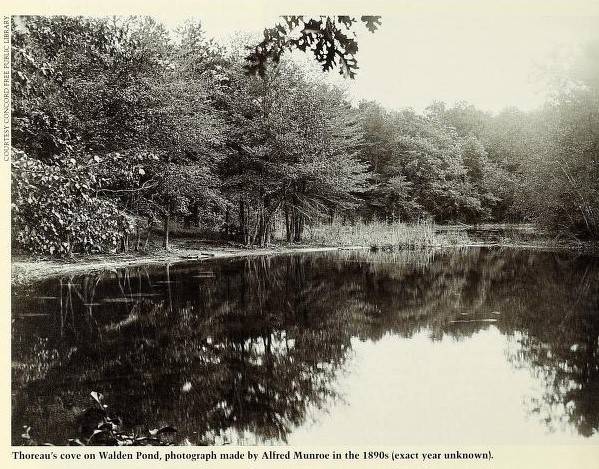
     — Henry David Thoreau
     Tolstoy's Calendar of Wisdom
     22 November
Wednesday Word
for 22 November 2023
gratitude
You can respond in the comments below or go visit the All Poetry contest for November. Your response can be anything made from words. I love poetry, but anything can be poetic and you needn’t even be limited to poetics. An observation, a story, a thought. Might even be an image — however, I am not a visual person, so it has to work harder to convey meaning. In the spirit of word prompts, it’s best if you use the word; but I’m not even a stickler about that. Especially if you can convey the meaning without ever touching the word.
If responding on All Poetry, you are limited to the forms of that medium, though my contests are fairly open as to form. However, if you have something long, post it in the comments below. That said, please don’t go too long. Keep it under 2000 words. I’m not going to count, but I’m also not promising to read a novel.
Unless it’s really good!
If you have nothing to say, that’s fine. I know you all are busy and distracted. But if you’ve read this far, then I’ve made you think about… gratitude.
involuntary gratitude
and it is decreed
that we shall be thankful
upon this day,
pay
homage to grim ghosts
who come with harquebus and book
to take what they may claim.
we shall bow in obeisance
to the once purified,
honor shivered assurance
of freedom from tyrants.
and we shall grin
in rictus
as we remember
the theft that founded this feast.
for lo! were they not mighty men
who unburied the seed stocks
and lay waste the safe harbors!
verily, we give thanks
gratitude to greying gods
that they came to these green shores
and turned the world
away from the sun

©Elizabeth Anker 2023

 By My Solitary Hearth
Gratitude for Small Minds
“A weak mind does not accumulate
force enough to hurt itself;
stupidity often saves a man
from going mad.” Oliver Wendell Holmes Sr.
We are born whole, body and mind
Like all animals there is only one,
of not knowing
the separation of being.
Of living torn apart
as a mind and a body.
A duality at the heart of madness.
Then the separation begins.
We are mind,
and we are body.
At first, we control the mind,
then the mind begins
to control us,
what we think,
what to think.
Why to think at all.
As the unity breaks down,
we yearn for the oneness
of animals, without knowing,
what that even was.
The unity of being,
fractured, torn apart.
LikeLiked by 1 person
Can i make a small edit to my poem. New title. “Gratitude for Small Minds”
LikeLike
Done… and I learned that I can edit the comments of others. 🙂
LikeLike