

In my part of the world, this is the season of Midwinter. The nights are long and days are short. It is the time for snow angels, sledding, skiing, and ice fishing… except… it’s not.
Last week, ice fishers on the Upper Red Lake in northern Minnesota needed rescuing when the lake ice they stood upon broke up and floated away from any connection to the shore. The organizers of the sold-out 15th annual New England Pond Hockey Classic — cancelled in 2022 and moved to higher elevation in 2023 — are nervous about a Christmas without ice though the tournament doesn’t take place until the first week of February. Skating is ill-advised even in the upper elevations. There was a New Year’s Eve picture in our newspaper of “the last of the ice“, a thin film that couldn’t even support skeleton leaves — on a pond at 1096ft (334m) elevation.
It has been snowing off and on for weeks, but little of it is sticking around for long because the temperatures are hovering just at freezing both day and night. There has been fog so thick we can’t see across the street and some of this is freezing to trees (and power lines… and roads… and my back steps…), but the ground is brown. If I were part of the ski industry right about now, I might be deeply reconsidering my life choices. It’s hard to even make snow when it’s raining, and it’s certainly not terribly fun to ski on narrow trails of fake snow laid down on the otherwise bare mountainside — though I have seen desperate — or clueless — tourists heading upslope with skis on top of their SUVs. All out of state license plates, of course.
Logging too is getting to be tricky. It’s been weeks of mud season, which is hard enough to navigate in a normal car on dirt roads. Run a tractor and sled on the soft earth and you may lose them entirely. Logging was already in a slump after the warm winter of 2023. If it doesn’t freeze solid soon, there are going to be defaults on equipment loans. (Not saying I know this explicitly, but…) Similarly, the pot-holes typical of mud season have already opened up on every paved surface. Some of the roads that were just newly fixed, after the flood turned them into karst, are already cratered and crumbling into the eroded berm. Nothing heavy can drive on those roads… and my little car could just be swallowed up by some of these holes.
I’m not sure what this is going to do to the garden. There have been some cold temperatures and hard freezes, but probably not enough to kill off the pests. I’m glad I gave up on gardening last fall. If there were annuals planted out there, the warmth might trigger growth. As supporting evidence, there are weeds sprouting. (Because of course there are…) Probably there would not be much growth because it’s still too dark, not enough daylight for most plants to do much photosynthesizing. But any young leaves poking above the mulch in January are going to be frost-killed at some point, damaging the entire plant. And we have months of potential cold weather to go.
Or maybe we don’t. We did have a snowstorm in the middle of May last year, though January 2023 was over 12°F above the 20th century average and almost 10°F above the 21st century mean. So, cold weather in the spring is theoretically possible even with warmth now. But with this very strong El Niño and a record shatteringly warm autumn leading into the winter, 2024 might not get much colder than it is now. While we do see the coldest temperatures after the winter solstice, in January and early February (just like we see the warmest temperatures after the summer solstice, in July and early August), the ground has too much heat to shed — and the atmosphere is not obliging with delivering cold to wick away the warmth. This has not been a season with a notably droopy polar vortex, perhaps because it’s just not that cold up there either. Calgary, in Alberta, CA, at 51°N latitude, did not see its first freeze until October 30th; there are parts of the Hudson Bay that are still ice free (as of January 1, 2024); and Greenland is apparently trying to live up to its name.
This is frightening in so many ways. But right now I’m focusing just on my particular list of fears. For starters, a warm winter is not going to give me and my garden its usual annual relief from predation. Ticks aren’t going to die. Nor fire blight and emerald ash borers. Nor mosquitos and potato blight. But then, they haven’t been for many years now. That’s why all these parasites and diseases are moving north along with the new hardiness zone lines. And more parasites and diseases will also be coming in with the harvest that I store, meaning that unless I can keep it near freezing — not possible in this weather without refrigeration — then it’s going to rot. I had to toss quite a lot of potatoes, most of them actually. Luckily, I ate what few apples I harvested before they could turn mushy.
Another problem for my vertical property is that a warm wet winter is going to increase erosion. If the hillside is a slurry of mud in the winter when many plants have died back and the soil is exposed, then the hillside is simply going to slide down to the river. This is why we’ve seen so many trees just falling over. The saturated and liquified soil means that roots can’t find anchorage. The warm wet also increases breakage of large limbs, especially if there is a cycle of night surface freezes and daily melt. The water in plant cells expands with freezing and then contracts with melt, breaking cell walls and weakening tissues. Add any extra weight from ice or tension from wind and those weakened tissues will crack open, particularly on heavy old branches that have already begun to rot. So my jungle is falling apart as I watch. Luckily, it’s largely downslope from most buildings, but there is an unfortunate power line stretched along its bottom edge. I’m thinking this is a time bomb.
On the other hand, it’s warm enough now for apricots and rosemary to grow here. Without protection. I’m not counting on that remaining true permanently, but if there is little cooling after El Niño wears off — and I don’t know how or why it would cool off — then Vermont of the near future might just be the same hardiness zone as New Mexico of the not so distant past. I don’t know how to feel about that.
I am also ambivalent about the furnace. Warmer definitely means that I won’t be burning as much oil — which is unequivocally good. But lots of ice and rain and falling tree limbs also means lots of days without power and therefore without any heat. Though it’s warmer than “normal winter”, it’s still not warm enough to turn off the heater even if I keep the house sealed up. I’ve been wrapped up in blankets, trembling in the dark, unable to do much of anything, for far too many hours already. And that is truly a terrifying experience.
What is really bizarre though is the juxtaposition of holiday imagery with all this drippiness. Granted, this has no real consequence for anything. But it is hard to feel grounded when the songs are all about the deep midwinter snow and there are snowmen in the entryway looking out on a rainy, brown garden. I realized today that many of the oldest midwinter songs were written in Europe in the Little Ice Age, when December was cold — and January was the leading cause of death each year. Jingle Bells is harness racing song, but where the horses pull sleds on frozen rivers instead of wheeled sulkies on graded tracks. The Nutcracker Ballet is from 19th century Russia, the definition of snowy weather. Winter Wonderland was written from a mountain tuberculosis sanitarium when the lyricist looked out his window at a couple walking hand-in-hand in the snowy town park. Most of these songs have little to say about Midwinter, but this is what we hear from Halloween to New Year’s Day. So according to our noisy traditions, it’s supposed to be snowy right now — and it’s not. Feels like gaslighting on a grand scale. Especially when you add in the loud messaging telling us all that there’s nothing unusual about this weather — nothing to see here, folks, carry on with the excess — and that we don’t have to concern ourselves with what we are experiencing as visceral evidence of climate change.
At work last week, the leading topic for grousing was not the imploding logging and ski industries nor the exploding pest populations nor even the frequent bouts of powerlessness. Nope. Everyone was most put out about the lack of a white Christmas. I mean, priorities, folks… But I can’t help but think that they’re going to be increasingly disappointed on that front. So much so that maybe we need new pictures of the holidays in our heads.
Maybe a song about mud-bogging to Grandma’s…
But we already have other images. Christmas is built on a Mediterranean harvest festival, where snow is just not much of a thing. There is a substantial northern overlay, of course, because the northerners had their own winter solstice traditions, mostly related to trees and fire and the position of the rising sun when it was as far from the north as it could go. But there isn’t much longing for snow, not even since we sent St Nick to the North Pole and gave him a sleigh pulled by flying caribou. Notably, the sleigh flies; it doesn’t skid over the snow. You see, nobody celebrated snow until we started burning vast amounts of ancient carbon to counter the cold. We still don’t really. It’s telling that people almost universally claim to want snow at Christmas, before the winter weather really gets going, and then no more. You don’t hear people singing with longing about a white January, when snow actually happens… It seems we like the idea of a Christmas draped in pristine snowy white, but not so much the snow itself.
Ice and snow do make storage of meat and milk and fragile fruits and vegetables easier — though the cold wet makes grain storage a crap shoot. Transport is also a bit easier when the bogs are frozen. But that extra ease is more than negated by our biology. We know that we are a naked ape with too much exposed surface area. We know that we don’t fare well even when temperatures get close to freezing, never mind falling below. We don’t hibernate, and we know we have to try to figure out how to be out in the cold and how to find or store food when plants are dormant or dead and many of our prey animals have gone to ground. We also have to figure out how to feed our domesticated animals when the plants they eat are dormant or dead. Moreover, we have to make sure we have accessible sources of heat when overland travel is difficult — even to the woodshed and back — because everything is covered in deep, slippery, white, wet stuff.
And then there’s the isolation. What’s on all those postcard images of Christmas? A small hamlet, or even just a homestead, surrounded by deep, trackless snow. Pretty maybe, but chilling. Even if you’ve managed to store up what you need to make it through the long nights, this is not an image of celebration. It’s lonely. Rather scary, actually. What happens when Grandma falls or the baby starts coughing? There’s no help coming. But even if spared the worst, being cut off from the world is not exactly conducive to a festive spirit. I look at those postcards and shiver. I imagine our more sensible ancestors would have done so as well.
Snow was not the part of Midwinter that people celebrated. Nobody wanted a white Christmas until we were quite sure that we could escape all the consequences of that whiteness. Midwinter is a celebration of abundance and warmth and the growing length of days after months of contraction. It is a festival of warmth despite the cold, dreary dearth of snow. The colors of Midwinter are not ice white and glacial blue, but the red of berries and apples and fire — and pulsing blood — and the green of the eternally living firs and pines and holly. The Holly wears the crown, you know… because it is perennially verdant and because it has bright red fruits that draw all sorts of birds all winter long — pretty and a potential source of winter nutrition on the wing.
White comes later, deeper into the winter, and is more traditionally associated with Candlemas and the festivals of early spring purification, not necessarily snow. My house is richly colored at the Midwinter holidays, reflecting that light and warmth and abundance in the darkest days, when snow may or may not lie ’round about. Midwinter is about the Mother gestating the spark of life in that darkness and the Mothers helping that light to come back to the world. And again, Saturnalia was a harvest festival, the winter grain reaping. None of this has any positive relationship to snow.
So why are we fixated on snow? Maybe because Christmas was reinvented in the cold Victorian days — largely as a castigation on the rentier class who were nicely insulated from the weather. When Dickens resuscitated Christmas, there were memories of King Frost Day in February of 1814 — when the Thames froze solid — and 1816, the year without a summer after Mount Tambora erupted — “eighteen hundred and froze to death”. And we are so tone-deaf a culture that we took what Dickens likely felt was an apt symbol of the wealthy class — a killing landscape that granted no mercy to the poor — and made a virtue of the snow. Because it is pretty…
We like pretty. We also like to think that we’ve risen above the weather. Note that skiing became an industry precisely when we had no need to strap runners on our feet to get from one frozen place to another. It became a pretty pastime for the wealthy. In any case, snow carries themes that resonate with moderns. But it also is true that we don’t have much notion of what Midwinter is actually celebrating. We probably wouldn’t like it if we did. No matter if we choose to focus on the vestiges of Saturnalia or the Christian story, there is very little profit in the actual holidays. There is even — shudder — the distinct possibility of wealth redistribution and work stoppage.
No… let’s look at all this snow, shall we. See how pretty it is lying there undisturbed. More importantly, see how we manage to carry on with all our busy-ness even in the midst of winter, making of that frost no more than a sparkly setting for nostalgia and romance.
I don’t know if that’s what’s under the white Christmas imperative. Probably not implicit anyway. But our subconscious creates all sorts of nonsensical preferences. Many of our deepest desires are illogical when examined — and so we don’t examine them.
Except when Bing Crosby is singing about snow in a mud-bog world.
Midwinter is not pretty now. Nothing to distract us from the warming climate except our fantasies.
Or, you know, maybe we could embrace the real Midwinter of mothers and harvest gods and the fragile, almost imperceptible growth of the light…
Yeah… right…
Oh well… we’ll probably still be singing those songs when even the Arctic is ice-free all year long…
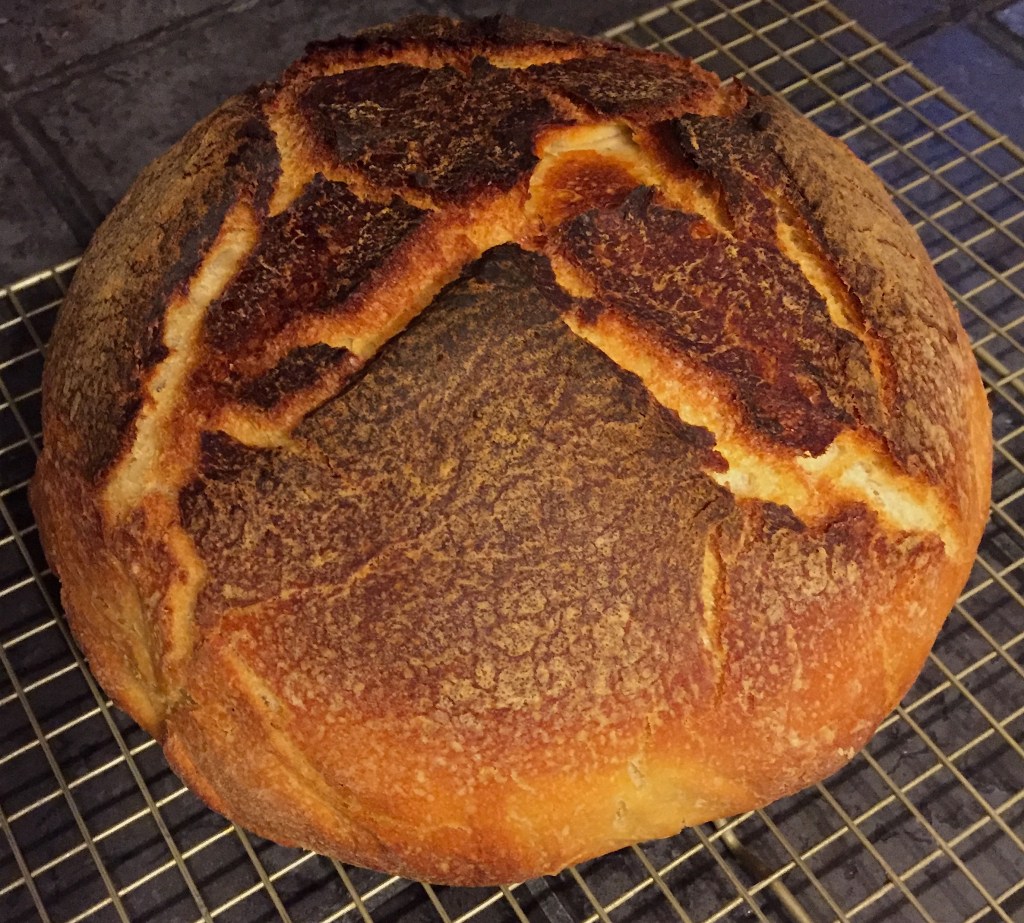
Meanwhile, here’s what I did with the New Year… first loaf of 2024!
I also made a casserole of the leftover stuffing — brown rice, wild rice, and black beans — from the stuffed winter squash I made for Christmas dinner. Involved making a sauce of shallots, portobello mushrooms, goat cheese and eggs. Also a quantity of nutmeg sprinkled on top. I like that I used up all the leftovers. I love that it tastes SO GOOD!
©Elizabeth Anker 2024

 By My Solitary Hearth
Thanks for broadening your scope and putting Vermont weather in muddy context. I think this essay must be revelatory of your core personality. I especially enjoyed your telling of “Walking in a Winter Wonderland” because it featured sanatorium confinement. Made me recall existential psychologist Rollo May, who was treated for TB during WWII (Saranac Lake, NY). Rollo understood how brains might get mired and potholed in isolation. Oh, it’s rentier not renter I think you intended. You gave me an account I could read with relish this morning. I’ve eaten all my pies and leftovers too. I am concerned about my pear trees getting fireblight without a hard freeze.
LikeLiked by 1 person
Good catch on the “rentier”. That little “i” makes a world of difference. Thanks!
LikeLike
Since my eldest son and his family moved to Norway, I have developed a clearer understanding of the snow issues you write about – it doesn’t snow where I live. This year the snow is waist high in places and the schools have been closed because of the weather conditions. While we are used to bouts (scheduled or not) sans electricity and days (we are now day eight) without the provision of domestic water, they have been without either for two days already. I take my hat off to you for coping with these extreme (and worrying) conditions. Your bread looks absolutely delicious!
LikeLiked by 1 person
Since I grew up and lived in San Diego until my mid-20s, there was never any white Christmas and since I no longer even celebrate Christmas, I don’t have much attachment to the concept. However, when it’s as warm as it is right now, that is what’s unsettling. We don’t have ice on the city lakes and they are usually deeply frozen weeks ago. We haven’t even had a subzero night yet. The DNR has warnings up for the whole state to keep off whatever lake ice there may be.
Your bread looks lovely. Well done with the leftovers! My husband likes to get creative with combining leftovers too, which I really appreciate!
LikeLiked by 2 people