


It is Epiphany, 6 January, the close of the Christmas season and the beginning of mundane time, a shift to Imbolg and the hope of spring — after we, hopefully, survive the worst of the winter weather. This is the date the Catholic Church assigned to the arrival of the Magi and also, later, the date that Jesus met up with John the Baptist and was blessed by God in the river.
Epiphany comes from a Greek word meaning “appearance” or “manifestation”. On this day, the Magi discovered the infant Jesus after following a star; and then later, on the banks of the River Jordan, Jesus revealed himself as the Son of God made mortal. In both stories he appears, he comes out of hidden places and into the light. In fact, an older root of the name means “to shine”, and it is this sense that folk traditions follow in naming this a festival of light. The Feast of Epiphany is most often celebrated to the light of numerous candles and blazing lamps though there is little about light in either story — except that star. In my hygge home, I carry on with candles and the lights of Midwinter right through to Candlemas.
Epiphany is the 13th day after Christmas. It is the last feast day of the previous season and the first day of conventional time in the new calendar year. It is traditional to take down all Christmas decorations on 12th Night, and normal household work resumes with Plough Monday and Distaff Day in a day or so. So Epiphany is the end of holy days. Few people remember that this day also commemorates the baptism of Jesus. In many traditions, Epiphany is celebrated solely as Three Kings Day or Little Christmas. Traditionally, this is when gifts are given to children in much of the world, in honor of the gifts that the Magi brought to the infant Jesus.
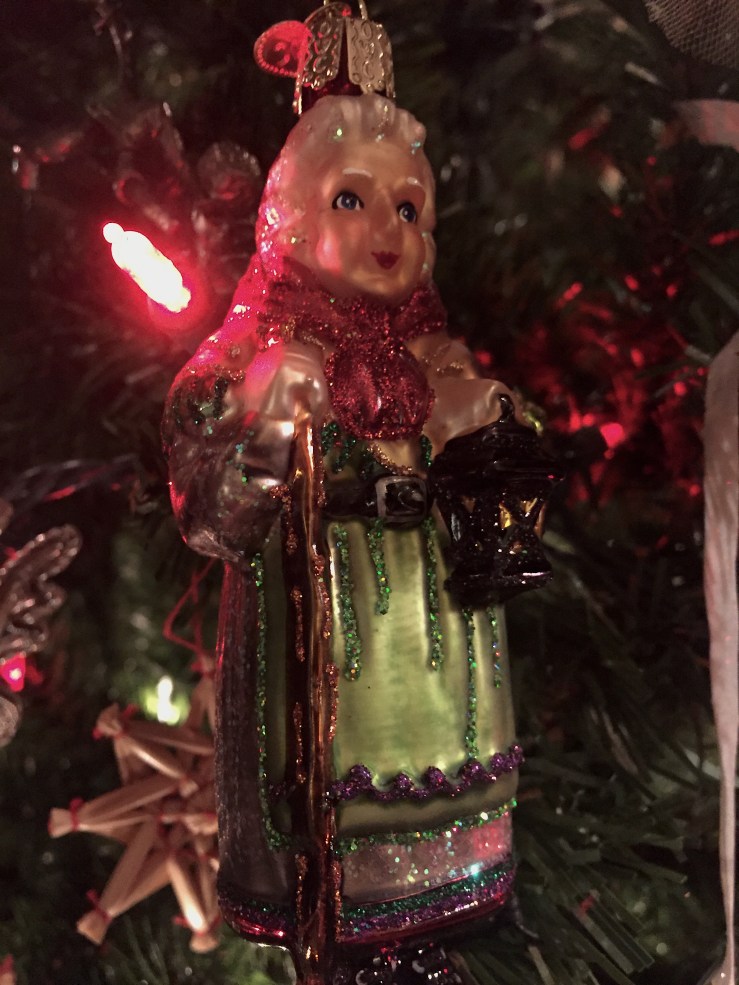
In Italy, this is when la Befana rides her broom through the night giving out presents to all children since she still hasn’t managed to find the Christ Child. In fact, her name is probably just a nickname based on the late Latin, Epiphania, the name of the feast day. The story goes that, one day while she was out sweeping the front walk, the Magi stopped by her cottage asking for directions and then inviting her to come along on their journey. She declined, claiming she had too much to do, and so the Magi shrugged and went on with their travels. A bit later Befana regretted not setting out with the caravan. She tossed together what she thought might be a good gift for a baby — mostly food and warm clothes. She then put her house in order and tottered out the door, still clutching her broom. But the Wise Men were too far ahead for her to catch up and she never found them again. Nor did she find the home of Jesus. But she did find that her broom could fly. The whole world in a night. And ever since, over millennia, on the eve of Epiphany, she still flies around the world, searching for the Child of Light and giving good gifts to all children — mostly food and warm clothes.
The story does not say why the Wise Men were in Italy on the way to Bethlehem (which town’s name, in an interesting happenstance, means “house of food”, much more relevant to la Befana’s idea of proper gifts). But the Bible doesn’t say much about their travels either. In fact, there is actually nothing to indicate that they were kings or that there were three of them. The whole story is but twelve verses in the Book of Matthew.
Matthew 2:1-12
New International Version
After Jesus was born in Bethlehem in Judea, during the time of King Herod, Magi from the east came to Jerusalem and asked, “Where is the one who has been born king of the Jews? We saw his star when it rose and have come to worship him.”
When King Herod heard this he was disturbed, and all Jerusalem with him. When he had called together all the people’s chief priests and teachers of the law, he asked them where the Messiah was to be born. “In Bethlehem in Judea,” they replied, “for this is what the prophet has written:
But you, Bethlehem, in the land of Judah,
    are by no means least among the rulers of Judah;
for out of you will come a ruler
    who will shepherd my people Israel.”
Then Herod called the Magi secretly and found out from them the exact time the star had appeared. He sent them to Bethlehem and said, “Go and search carefully for the child. As soon as you find him, report to me, so that I too may go and worship him.”
After they had heard the king, they went on their way, and the star they had seen when it rose went ahead of them until it stopped over the place where the child was. When they saw the star, they were overjoyed. On coming to the house, they saw the child with his mother Mary, and they bowed down and worshiped him. Then they opened their treasures and presented him with gifts of gold, frankincense and myrrh. And having been warned in a dream not to go back to Herod, they returned to their country by another route.
(In apocryphal traditions, the Magi also warned Joseph that Herod was likely to attack and sent the Holy Family away to Egypt.)
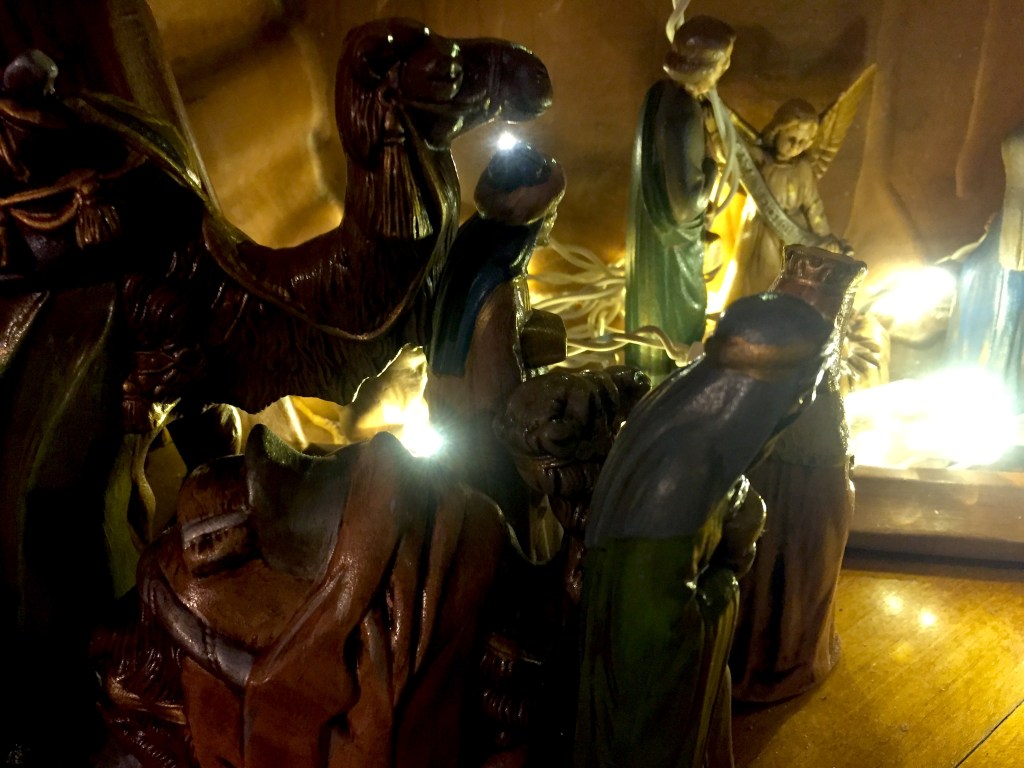
Most Christians know that the Magi did not come to the stable. There is good reason to think that the infant was a toddler by the time the Wise Men showed up at Mary’s house. After this short tale, Herod, in a rage, decided to kill all infants who could possibly be this new king, and he chose to slaughter all male children two years old and younger. Presumably the Magi led him to believe that the “king of the Jews” could be as old as two. In any case, the Magi find Mary and Jesus in a house, not a barn. Yet, all the images of the Nativity have three richly dressed Kings, with their crowns and their camels, all bending down to worship a baby in a feeding trough.
This is odd enough but perhaps understandable. It makes for an easier story — and somewhat mitigates all the bloody horror with Herod. What is stranger is that of this truly epic story — men of great learning set out across miles of desert, following a blazing star, seeking a hidden king — we seem to have only heard and latched on to the last words of the penultimate verse, the gifts.
When I learned this story as a child, I was dumbfounded by all the unasked questions that lay behind this gifting. “Who cares what they carried!” I thought. Who were these people? Where did they come from? East of Jerusalem is a pretty large place. It wasn’t until much later that I learned that these were Magi, that is Zoroastrian priests, and therefore from Persia. How did they ever find Bethlehem, and then how did they find one small peasant family in their hovel, just by following a star? And if they could see it, why couldn’t anyone else? Why did Herod not see it? What did that star mean to them? Why did they bother with perhaps years of searching? Why don’t we talk about that gift — the time they took from their lives to go find a baby!
And what kind of bum gifts are gold and incense for a poor young mother and her infant anyway! These are just the symbolic things that rich people pass amongst themselves to show that they are rich. These “gifts” would have been worse than useless to peasant folk. Having such wealth in your hut would invite certain calamity. At best, the tax collector would ask difficult questions. More than likely, if you tried to spend it or trade it for something useful, you’d end up imprisoned for theft. Or worse.
Yet gifting useless rich people stuff is what we commonly take away from this whole astonishing story. We summarize the tale in our Nativity scenes — wealthy men, kneeling at the manger and giving luxurious gifts to the Child. Why they are three and also kings is probably tied to the fact that there are three very expensive gifts listed, and that couldn’t possibly be a catch-phrase for “magnanimous generic offerings” — that undoubtedly included more practical things like food and warm clothes. No, we place emphasis on the luxury. These rich men gave gifts that only rich men can give — and nobody can really use. In other words, this gifting is a status display and has very little to do with generosity or benevolence — or even sacrifice — and this is the sum total of wisdom that we wrest out of the whole scintillating tale of the Wise Men.
For this is how we give in this culture. Either the story has been polluted by our culture or the narrow focus on the last bits has influenced our culture (probably both), but this presentation of symbols of our own status is how we do gifting. We do not give. We present. We display. We exhibit our own worth. There is very little attempt to give what is wanted, much less what is needed. Quite the opposite, gifting in our society serves as a singular measure of how little the giver cares to know the recipient. Often insultingly so. (How many presents have you opened only to be bewildered at the idea that anyone would think you would want that thing…) Gifting does not involve care. Gifting is almost solely focused on pleasing the giver’s ego. Compound this selfish meaninglessness with the horrible waste — the manipulation and the deception and the packaging and all the expense and stress on both sides — and there is little to like in this unfortunate tradition.
Seems unlikely that Wise Men would approve of what we have made of their story.
Perhaps they would prefer that we look at the time they spent. Or the knowledge that they possessed, that which made them Wise, that which prompted them to follow a hunch across years of lonely travel just to see a miracle. Maybe they would like to be remembered as priests and holy men who came to acknowledge a greater holiness. Maybe they didn’t give gold or incense at all. There is such a lot lost in translation. Maybe they gave honor and praise. Or food and warm clothing. Maybe they gave everything they had, which after two years in a desert of brigands was probably not much.

Especially if they made it all the way to Italy before they asked for directions.
Maybe they gave nothing but their hearts.
Maybe they were seeking the light — and they found it in a young mother’s arms.
Isn’t that a more compelling story?
(Incidentally, my mom made this beautiful Nativity for me, many decades ago now… I only added the lights.)
©Elizabeth Anker 2024

 By My Solitary Hearth
I love this! Your questions about the Magi and the gifts used to puzzle me as a child too. I also enjoy your names of the days and references to an older rhythm of living – we have nothing of those traditions here and are in the wrong hemisphere anyway. Your writing is inspiring.
LikeLiked by 1 person
In 1963 my beloved teacher, Ms. Norma Minges (then 28), recruited me for the lead in “Amahl and the Night Visitors.” It was a story about a less-abled Palestinian boy whose mother hosts three Persian Zoroastrian wizards traveling to adore the Christ Child. As a red-haired, pale-skinned, soft and pudgy kid resembling Clint Howard I was an unlikely choice, but I could sing, sang all the time to my teacher’s annoyance. She assured me I could portray Amahl well because I had been an abused toddler, and understood disability. This little operetta was important to Norma because acute Lupus had robbed her of performing. By December Norma was confined to a wheelchair by an autoimmune crisis but persisted in the production. Community pity for our teacher protected us as we delved into lesson plans exploring Christian mythology and the life of Gian Carlo Menotti, the composer. The opera was not carried on our local NBC affiliate because an African American was portraying King Balthazar for the first time. Previously a caucasian singer had performed in blackface. Had our audience known that Menotti was an openly gay man we might have not been well-received. But we 7th grade kids knew this and many other esoteric facts, and were instructed to keep some secrets from out families. I remember when we returned to classes after Christmas. Norma devoted one day to a post production debriefing, and thanked all of us for achieving a maturity and understanding beyond our years. 1963 had been a traumatic year, Kennedy had been assassinated, but Norma had devout optimism 1964 would be better. I really can’t remember if it was, but I do vividly recall singing “Don’t You Dare” and attacking the Page after he catches my mother (Irish redhead music teacher, Shirley Austin) stealing the gold intended for Jesus. And I remember donating my crutch, then being miraculously healed and leaving with the entourage. I was wary of sharing these memories with Eliza at first because it could be construed as bragging and hypocrisy. I want anyone reading this to understand that Norma was struggling against impossible odds to morally and ethically uplift an ignorant textile mill community where by March, my winning essay about Gastonia becoming an All-American City would be disqualified because I included an account of the Mill Strike of 1929. Had I removed that paragraph I would have won a $100 savings bond. My real mother attacked Norma in her wheelchair for telling me to refuse censorship. All I could say was,”Don’t You Dare!”
LikeLike
Anne may be in a better hemisphere: Only time will tell.
LikeLike
The Magi were probably in Italy because, like men in all times and places, they refused to ask for directions 😉
LikeLiked by 1 person