

A Miraculous Weather Update
After weeks of darkness, the skies are absolutely clear today! Praise be! There will be eclipse viewing in Vermont!
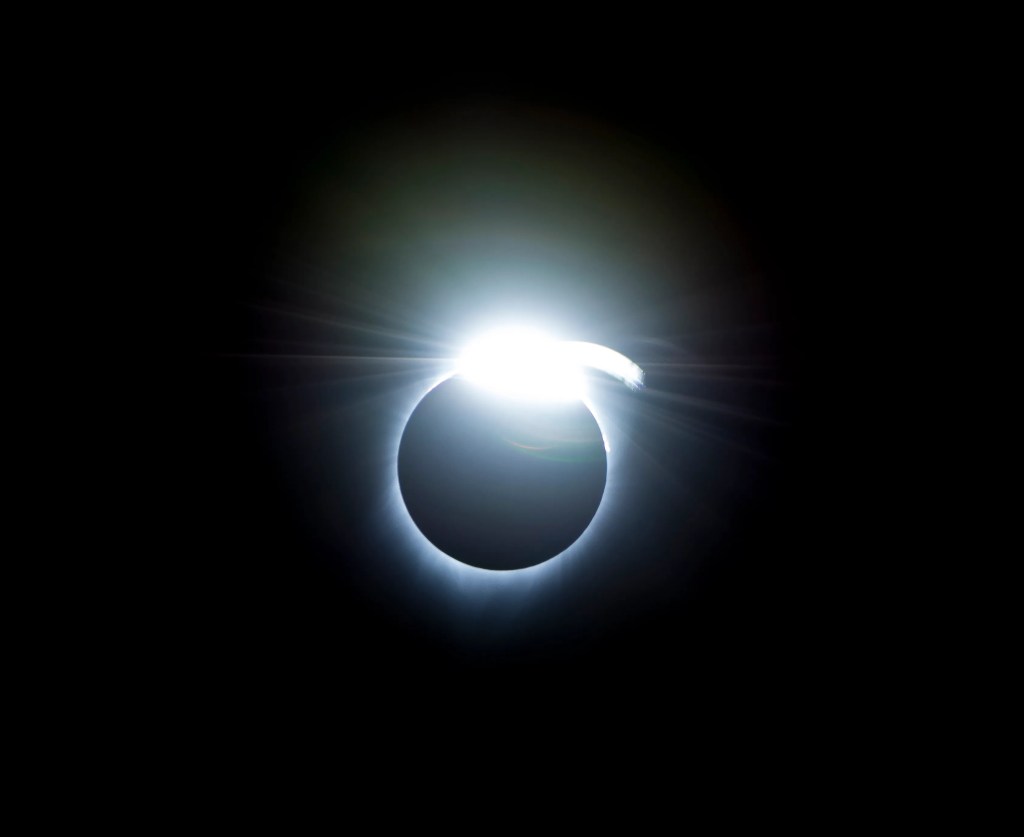
It’s finally here! The last full solar eclipse to pass over my part of the world in my lifetime, maybe in the lifetime of anybody currently living in Vermont. (Here is a map of future totality… New England is notably devoid of eclipse fun after today.) Today the Sap Moon goes dark at 2:21pm. In this round of passing between the Earth and the Sun, the moon is positioned just right to block out the Sun. In much of North America, there will be a partial solar eclipse. That is, the sun will be dimmed but not dark.
However, here in northern Vermont, we are in perfect alignment to see the moon totally covering the sun at 3:28pm. There will be dark skies in the middle of the afternoon, and the famous diamond ring of totality will shine high over the western mountains.
Humans have been watching the skies for as long as we’ve been humans. Early in our story, we created ways to predict astronomical treats like eclipses. I have heard it said that we feared the Blood Moon and the darkness covering the Sun, but I’m not sure that’s true. For one thing, there’s absolutely nothing to fear. No harm, no uncanny evil. Just a beautiful moment, a brief pause in the daily round to wonder at this marvelous world. And truly, it is just short of miraculous that the relative diameters of the Moon and Sun and the Earth’s distance from the Sun are so exactly matched as to make eclipses possible. I would wager that this might be one of a very few places in the universe where you can see a diamond ring in the sky.
For another thing, it seems like humans spent quite a lot of effort to create viewing centers for astronomical events. What is Stonehenge but a stadium for the skies! Hundreds of people could gather in places like Avebury and Newgrange. They came together for seasonal festivals, celebrating the solstices and the equinoxes. They gathered for moonrises and moonsets on days they felt were important. They watched for the rising of various constellations to mark the passage of the year. I am quite sure they also gathered for eclipses. They certainly knew how to predict them. I expect they anticipated these moments of pure beauty with the same quivering joy that I feel today. And they probably cherished stories of the total solar eclipse that they viewed as a child or as an old woman, passing on these stories like drops of moonlight shining through the generations.
If anything, we moderns are less sky savvy and more prone to fear and confusion. Our disconnect from the world leaves us far more apprehensive about a great many things, especially things that go bump in the night or that are associated with darkness. So we are the fearful ones and we project our terrors onto our “primitive” ancestors — who knew enough about the night skies to engineer enormous stone calendars that still keep perfect sky-time. So… who is the primitive?
I thought I might repost my Moon-splaining essay today. It doesn’t talk much specifically about eclipses, but it will help you wrap your head around the geometry of today.
But if you live in the path of the eclipse, do not spend time staring at a screen. Go out and watch it. It will not last long. And it will not come again, probably in your lifetime.
A Moon Intervention
I believe, our inability to comprehend the moon’s geometry is rooted in our anthropocentric languages. These languages evolved under a view of the cosmos in which the Earth is the still center and the universe drifts around her in concentric rings. The moon rises. The sun sets in the west. The stars whirl overhead (save the Pole Star, which really ought to have been the first clue that language was clouding our perception).
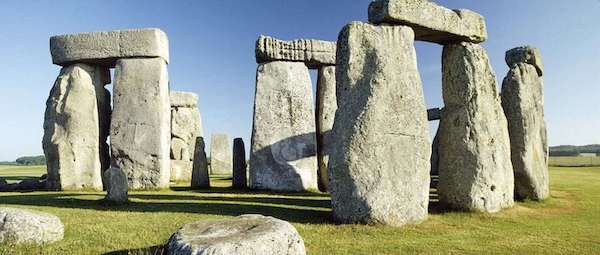
It makes me long to know the languages of our Neolithic ancestors, those that worked in the first silicon time-keeping technology (many thanks to Sir Terry Pratchett for that endlessly useful characterization). These ancients worked massive stone in ways that testify to a clear understanding of sky geometry. They placed massive granite and slate in configurations marking sky events — and made no mistakes. We can still use their clocks thousands of years later. If they believed that the moon rose and set around a fixed earth, their calendars would have failed.
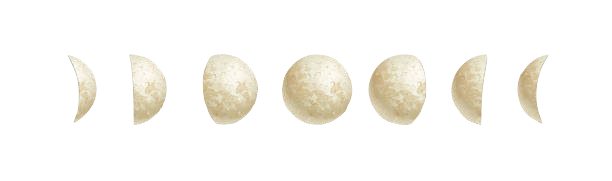
The moon does not rise. The earth beneath your feet turns toward the moon wherever he is in the heavens. Furthermore, the moon does not rise in the evening. As the moon hurtles around the earth and the earth hurtles around the sun, we can see the moon in various guises in the daylight just as often as the night. There are not three phases of the moon; he looks different every day of the month. There are perhaps four phases, though full and new are not properly included.
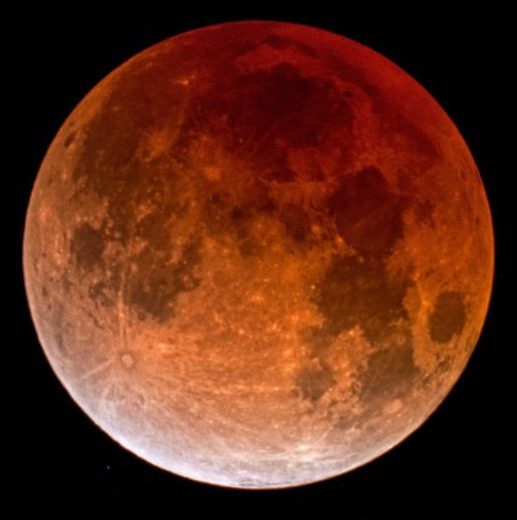
This next might not need to be said, except Math Lady is including it for completeness: there is no change to the moon. The moon does not physically wax and wan. We see more or less of it from our perspective on earth based on the moon’s position in its orbit. And no, this is not because the moon is in the shadow of our planet. That does happen a few times a year. Only on the full moon. We call this a lunar eclipse; it looks very different from a dark moon because it is a very different optical effect.
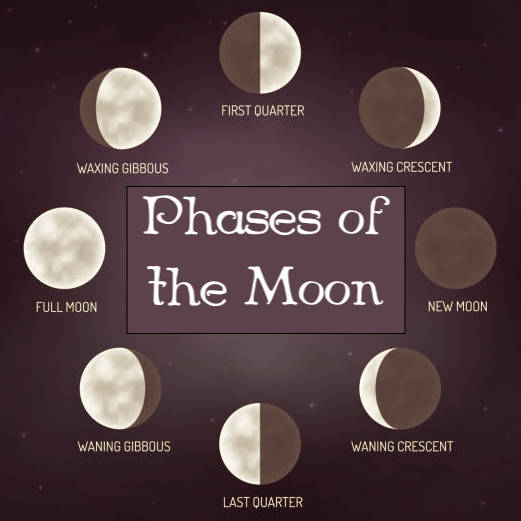
The appearance of waxing and waning is caused by a fixed light source, the sun, shining on a sphere, the moon, that is traversing a ring and being observed from a third point, the earth. Take a large ball into a dark room and shine a bright flashlight on it. To really get this image imprinted in your mind, grab a couple friends to assist you. One person is the sun with the flashlight. One person is the moon with the ball. One person is the earthling, watching this all happen. The sun is stationary, though it does help to have the flashlight beam follow the ball. The flashlight beam is much smaller than the sun’s light bath. The earth is also stationary — maybe crouched down a little to keep out of the flashlight beam — and will turn around to watch the moon. The moon person should hold the ball extended up from the body and keep it in the flashlight beam.
Start with the moon and sun on opposite sides of the earth person. What shape is presented to the earth? A disk. This is the full moon. Note that this is the only time when it is possible for the moon to be in the earth’s shadow, but it is not normally in the earth’s shadow. That perfect alignment to throw blood on the moon is unusual. Most months the moon opposite the sun is bright and full in the sky, the Full Moon.
Now the moon begins a monthly orbit of the earth. The moon person should walk around the earth while the earth watches the light on the surface of the ball. The disk appears to contract. It does not look like a bite has been taken out of the moon; the curves are convex on both sides. This shape is named gibbous, from a Latin word meaning “humped”. It helps immensely to remember this word and its meaning when picturing the moon in orbit. Since in this example the moon is moving away from the full position and the lighted portion is shrinking, we call this leg of the month’s journey the waning gibbous moon. There is also a waxing gibbous phase.
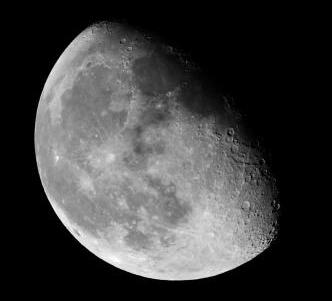
When the moon person is standing to the side of the earth person making a right angle from sun to earth to moon, the lighted portion of the ball is now a half-circle. It has a straight side and a curved side. It is not a crescent. This is important to keep in mind because the language we use to name this position calls it the quarter moon. It is not a quarter; it is a half. In this experiment, this is the waning quarter moon, the third quarter.
This is probably a good time to jump out of the experiment and deal with language again. The moon takes 29-ish days to travel around the earth. We start counting the days at the dark moon, when the moon is between the sun and the earth (opposite of where we began our experiment). There are seven days and a few hours in the moon’s journey from dark to the first quarter — when the moon is to the side of the earth — a bit over seven days again to full, same to the third quarter, and seven final days back to new. This makes four weeks. This is not a coincidence. Because all of us have Math Lady in our heads, we like to map things into easy groupings. We divided the moon’s journey into quarters and called those quarters “weeks”, four of which then make up a month, a lunation — the moon’s cycle.
So back to the moon experiment. As the moon moves from the side of the earth to a position opposite of full when it is between the earth and sun, it continues to contract. But this is when the lighted portion takes on a crescent shape. One side convex; one concave. This is the crescent moon; and as the gibbous shape happens twice, the crescent does as well. It is a crescent in the first — waxing — and fourth — waning — quarters when it is nearer to the sun. (It is gibbous in the second — waxing — and third — waning — quarters when it further from the sun.) The crescent becomes smaller as the moon heads to the sun until the moon is between the sun and the earth. And now what shape is lit? None, from the position of the earth. The sun shines on the moon face that is facing toward the sun — and away from the earth. This is not a shadow. It is merely that the light is hitting the moon on its far side. We see the dark side of the moon (cue Pink Floyd).
Here is another point at which the sun, moon and earth are in alignment. When the moon is between the earth and sun it is possible to have a solar eclipse. Again this perfect alignment is not normal, but the dark moon is the only time the moon casts a shadow on the earth. In a solar eclipse we do not see the moon’s face because the light of the sun is so much brighter than the pale earth-shine that casts light on a lunar eclipse and gives the eclipsed moon its rosy glow.
Our culture calls this position with the moon between the sun and earth the New Moon. I don’t like that nomenclature because it is historically inaccurate and physically sloppy. Those cultures that used a lunar calendar (and there have been more of them than those that keep sun time), began a month with the first sighting of the crescent setting in the west. This was the New Moon. There were folks with the sole task of watching for that slim curve to appear, so the new month could be started. Remember, the cycle is 29-ish days; so first sight of the setting crescent did not occur at a set time each cycle. Hence the need for a druid to watch for the new month to begin.
They may have had no name for the completely darkened disk; we don’t seem to have preserved it at any rate. So I call this position the Dark Moon. It is the last day of the old cycle, not the first day of the new. The New Moon is the next day in my world. If you want to be particular, it is when that crescent hangs above the sunset. But I’m getting too old for particularity. I don’t get paid to watch for it, and here in the New England hills I’d rarely be able to see it at any rate. So my shorthand is that New Moon follows the day after the Dark Moon.
So you’ve probably seen the rest of the experiment, but just because Math Lady will belabor any point… As the moon heads back around the other side of the earth, the lighted portion visible from earth will again expand. It will be a waxing crescent, the first quarter, from the new moon to the point where the moon is to the side of the earth again. From this half-moon shape to the full moon, it will be a waxing gibbous moon. And then the moon ball is back to where we began the experiment. Of course, the month begins just after the dark face, but I think it’s easier to see the geometry if you start with a full disk — more intuitive or something. Anyway, there is no precise beginning to the cycle; it’s all human convention.
Now that we’ve got the phases (shapes) of the cycle down, let’s bring that quote back: A waning crescent is hanging in the evening sky, no indication of which direction “over her shoulder”. (It actually reads like she is looking north… where the moon never hangs.) But the direction does not matter; a waning crescent is never in the evening sky. If there is a crescent, it is waxing and it is in the west. This is the geometry that is very hard to illustrate with balls and flashlights. So I’m just going to baldly lay it out.
At the first of the moon cycle, the moon is a slight crescent in the western evening sky. It begins its journey very close to the sun, rising in the east and setting in the west just after the sun. It is following the sun. In the next week it will become a fatter crescent, and it will drift east away from the sun’s position in the sky. It rises and sets a bit further from the sun each day.
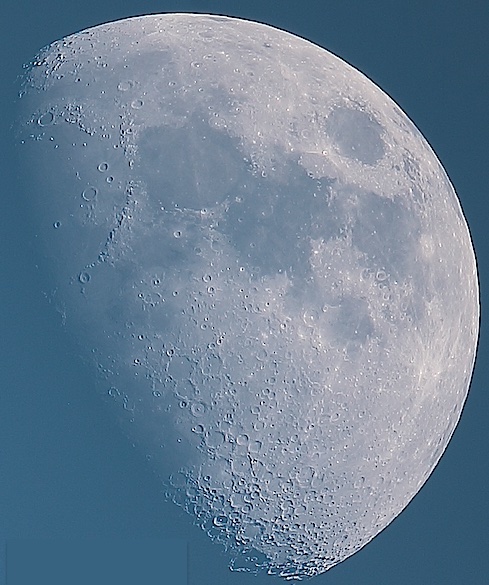
At the half-moon stage, the beginning of the second quarter (week), the moon rises when the sun is highest in the sky — midday — and it sets in the middle of the night. The waxing gibbous moon is the phase that we most notice in the day sky. It is large enough to be visible in daylight and it spends many hours high in the sky during daylight.
During the second quarter the waxing gibbous moon grows fatter and rises later. When it hits the full disk, the moon is rising in the east as the sun sets in the west. Through the third quarter, the moon passes into the waning gibbous shape. It rises later each day until at the half-moon shape at the beginning of the fourth quarter, the moon will rise in the east in the middle of the night and set in the west in the middle of the day. The waning crescent rises later in the dark hours, or if you prefer, later in the early morning hours closer and closer to dawn, until the dark moon rises and sets with the sun.
So how about that ubiquitous literary trope that the moon rises as the sun is setting? That the moon is night and the sun is day? Or how about all those references to rising crescent moons?The waning crescent is only visible in the early morning sky. It is leading the sun — it rises in the dark hours before the dawn and sets in the west ahead of the sunset. As that last week in the moon’s cycle draws to a close it becomes too slim to be easily seen in daylight. Thus most of us never see a waning crescent moon at all! But it will never be seen in the evening sky.
I have seen examples of moon dis-logic literally everywhere. It is pervasive in literature of all kinds, even science fiction where one might expect a bit more familiarity with the solar system. Yes, even in nature writing, I’ve read descriptions of the newly risen crescent moon in the evening sky — which is not a thing — from people who are supposed to be observing the phenomena they record. In theory. And it doesn’t stop with words. There are whole swaths of people that seem to believe that the moon passes from crescent to full back to crescent with nary a blobby gibbous step in between. I’ve seen images of a thin moon hanging in the gloaming labeled as “moon-rise”. I’ve noticed that people often talk as though the moon is visible in the night sky, all night, perhaps every night, and notably only at night — when all of us can see the moon in the daylight many days out of every month.
I guess I’m saying we all need a moon intervention. Time to recalibrate our clocks and see what actually is. Though… that is true of very many things today.
©Elizabeth Anker 2024

 By My Solitary Hearth
No eclipse for us – and even if there were it would be obscured by a heavy cloud cover. I hope you are able to see it 🙂
LikeLike
Skies are clear here!
I hope your skies continue to be cloudy and that those clouds give up their moisture. It is somewhat late in the growing season, nevertheless I’m sure it will be appreciated.
LikeLiked by 1 person