

Today, though the string of longest days ended last week, the latest sunsets end in my part of the world. Tomorrow, the sun will set earlier enough to knock a minute off the evening. By the end of July the day will be about an hour less than its Midsummer length. Also, this Friday the Strawberry Moon goes dark. I think we can declare Midsummer over; the Dog Days are nigh.
For me, this name — the Dog Days — evokes childhood afternoons spent with my collie, Toby, reading under the fig tree, swimming in river pot-holes, and generally doing as little as possible. I have never loved summer best. I’ve never liked heat. Nor did Toby. We invented all sorts of escapes. Mind you, this was before central air conditioning was common. The best AC was at the Library where Toby was not allowed. The most we could hope for otherwise was the window unit that spat out a tepid breeze with such an acrid chemical scent that Toby would be sent into sneezing fits. Which was only amusing for me. Until the dog snot landed on my face.
So we made do in the Dog Days of Summer. We both listened for the ice cream cart. We learned the schedule of shadows. We napped through the late afternoon sun. I’m not given to nostalgia and don’t tend to look back uncritically to Halcyon Days, but we had it pretty good. Me and my very hairy dog in the Dog Days, sweaty and grumpy and smelling ripe. We were, nevertheless, content and busy and healthy. So we had it much better than kids do today. Toby and I, we’d never survive the Dog Days now. The days I remember as mercilessly hot — August in Midwestern humidity, June in New Orleans, July in Phoenix — would hardly be noticed in this climate. Might even be considered cool.

The Dog Days are not named for summers with our childhood canine companions, as much as I think that’s right and proper. This time of year takes its name from the stars, from one star in particular, Sirius, Canis Major, the Dog Star. This bright blue beauty was named Sopdet by the Ancient Egyptians, Sothis by the later Greco-Egyptians, and was personified by a goddess with a star on her brow and often cow horns on her head. The hieroglyph for both the goddess and the star was a dog, though the reasons for this are unknown as Sothis was never depicted with canine features. (One of those mysteries of history.)

Sothis represented fertility and abundance. When her star merged into the sunrise around this time of year — known as the heliacal rising of Sirius, which, because of precession actually fell around the time of the summer solstice in Ancient Egypt — she brought the rising Nile floods, the beginning of the agricultural season in Egypt and also their New Year. With her consort, Sah, a personification of the nearby constellation that we call Orion, she gave birth to the hawk-god, Sopdu, the planet Venus. She was the lady of bright beginnings. Over time, her story was absorbed by the rising cult of Isis, but songs were still sung to Sothis at the New Year. The Dog Days were good days in Egypt.
But the Greeks did not enjoy the heat. They renamed the star Sirius, which may derive from a word that meant “scorcher” in Ancient Greek or may just be a mutilation of Sothis (which also meant “searing fire” in Egyptian). They also demoted Sirius from the embodiment of the supreme fertility goddess to merely Orion’s hunting dog (and, of course, female to male… because Greeks). The Greeks believed that the combined fires of Helios and Sirius, rising and setting together at this time of year, drove people mad. The sea turned into a boiling kettle. Both wine and women supposedly turned sour and bitter. Men became weak. (Oh the horror…) The very air became unwholesome in the scorching heat. The Dog Days were inauspicious. The Greeks did not have a wonderful flood of fertile river waters to temper the heat.
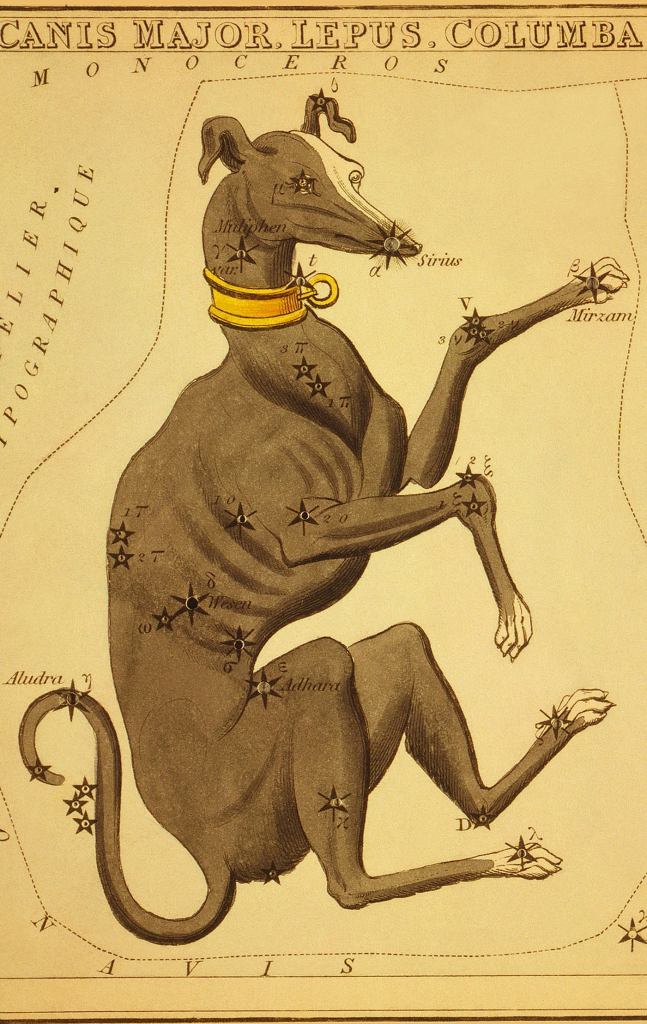
The Romans disliked the heat even more. Pliny tells us that everything from depression to dog attacks increased during this time of year. (He prescribed chicken manure in dog feed to curb their aggression. I’m not sure even Toby would have gone for that. And Toby ate anything.) Plagues of all kinds were thought to begin like clockwork on July 3rd, the first of the Dog Days. There were sacrifices just before the heliacal rising of Sirius to prevent crop failures due to drought. Orchard trees were wrapped in white swaddling because it was thought that the heat would bring black blight to the bark. Sounds somewhat familiar, does it not? Perhaps we haven’t been appeasing the right gods recently?
The Greeks and Romans never had it so bad. The days of merciless heat that I experienced as a child would have been swoon-inducing to the Ancients. Average afternoon temperatures in Greece topped out around 24°C (75°F). Clearly, they had low heat tolerance. Rome was a bit less congenial. Highs of 35°C (95°F) were not unusual. (Toby would have plopped himself belly down on the marble in the cold room at the public baths and never come out.) Though, with a Mediterranean climate, nights cooled off rapidly. (That’s the wonderful thing about dry air; it doesn’t hold heat. Does make for cold winter nights though.) Still, Rome emptied out in the summer, with most people heading for the cooler climes down at the coast or up in the hills. Neither the Greeks nor the Romans — nor even Toby and I — had to cope with long chains of days where the lows never dipped below 38°C and the highs could actually cook flesh — which is approximately where we are now. Even up north in Canada.
Several years ago, writers were loudly proclaiming that the unusual chain of hot days in the Pacific Northwest was the line in the sand. The heat that had been scorching my beloved desert home for over a decade and done its utmost to throw ocean water all over the Gulf Coast and almost literally incinerated California was background. Never mind Australia on fire, thousands dead from heat stroke in Berlin and Edinburgh and Chicago, no summer sea ice in the Arctic and calving off of glaciers the size of Delaware in the Antarctic, actual spontaneous ignition in Subcontinental dumps, and a host of other impossibilities in the daily headlines. Nope, it was the heat in the normally cold, damp Pacific Northwest that would grab the world’s attention and make us take this climate emergency thing seriously at long last. I am not diminishing the suffering in Oregon and Washington and British Columbia, but it seemed to me that, of all the devastating impossibilities, that was an odd one to declare the end of denial. And of course, in the end there was no end. Only another line in the sand.
There are new lines. Last year it was epic flooding and most of Canada on fire. This year, I suspect the Paris Summer Olympic Games are going to be interesting. Paris is famously empty after Bastille Day because nobody can stand Paris in the summer. And this was true back when a hot day was around 24°C (76°F). This summer, Olympians may be facing a long tail of Dog Days with temperatures never dipping down to those former highs. Olympic contenders are already voicing concerns.
But nobody is much listening. De-nile runneth over in this Dog Day heat. Humans get inured to impossibilities so very quickly. I suspect that next July there will be another line drawn… And another… And another… I doubt there will be much done besides this scratching in the scorching sands.
Me, I spend the Dog Days hiding from the heat and dreaming of Toby and the fig tree and summers when the Dog Days were not littered in impossibilities. And there is often ice cream.

In her later incarnation as Isis, Sothis was represented as the rose. This week, my roses are scenting the entire neighborhood. I also am facing raspberry armageddon… The canes are loaded. I’m only one person. It could get ugly…
Anglo-Saxons called July the “maed” month, which could mean “meadow flowers” or it could also be the mead that northern people brewed from honey — honey that bees brewed from meadow flower pollen, of course. Mead was the sacred drink of Nordic peoples, and it remains a favorite summer drink.
So it seems a good time to share a recipe for Berry Rose Mead, a drink that may be just as good as ice cream at helping you keep your cool in Dog Days heat. And it might use up a good pile of those raspberries.
Gather about a gallon of rose petals, the stronger the scent the better. Make sure nothing has been sprayed on these roses. (Probably eliminates any roses from the florist.) When I am gathering rose petals, I pick newly opened flowers either in the early morning or late evening, but not under the Dog Days sun nor when it is raining. Using clean and sharp snips, cut the stem beneath the flower to the first node (a reddish bump on the stem), then gently pull the petals from the flower head. Compost the stems.
Clean the petals as you pull them off the flower by picking off the inevitable bits of spiderweb, insect bodies and other grack. Also remove any petals that look diseased or eaten. After you’ve finished gathering petals, if there is still clinging stuff or dirt, wash by placing the petals in a colander and dipping this into a large basin of cold water. Don’t leave the petals in the water for long or you’ll wash away much of the scent and color. I find it is easier to do this one or two roses at a time while gathering, rather than trying to clean the whole gallon at once.
Next pick a full pint or so of strawberries, raspberries &/or red currants, enough to yield two rounded cups of chopped and lightly mashed fruit.
Place all the petals and the fruit in a non-reactive container (I use my bread fermenting tub) and cover with two quarts filtered water. Cover the container with a lint-free towel and let it stand in a dark and not too warm place for three days, stirring occasionally.
On day four, mix a pint of good honey into 2 quarts of water and bring to a boil. Let boil for three minutes or so, then remove from the heat. Let it cool to about 120°F (warm on your skin, but not hot) and then add to the petal and fruit mix.
Add 3 Tbs of apple cider vinegar. (If you can get a bit of the cloudy vinegar “mother” in those tablespoons, all the better.) Add half of a 5g packet of winemaking yeast. (This is probably overkill on the yeast requirement, but it’s better to go over than short on yeast.)
Mix the whole mess together, cover with a clean cloth firmly secured with a large rubber band or twine, and let it ferment in a cool, dark place for another 14 days. Lightly stir it up it every other day. If it looks too foamy or if the fruit or rose petals look off in any way, you can strain out the solid stuff after 7 days.
At the end of two weeks, strain out all the solids. I use a colander lined with a thin towel for a strainer, but there are wire fine-mesh strainers made in the shape of a funnel that probably work better. Less mess anyway. Pour the liquids into a fermenting jug fitted with an airlock. I use a 3-gallon carboy.
Mix another pint of honey with another 2 quarts of water and bring to a boil. Let it boil three minutes and then cool to about 120°F again. Add this to the fermenting jug. You can add an additional 3 Tbs of vinegar and the rest of the winemaking yeast packet if you want higher alcohol content. I’ve heard other people say they add a few teaspoons of active dry baking yeast at this stage because the ferment is much lower in alcohol. I’m not sure what this would taste like. Maybe something like soda water.
Let your mead ferment in a cool, dark place until it is done fermenting. After two weeks of fermentation, if it looks too cloudy for your preference, you can strain it into another carboy. You can repeat straining every 2-3 weeks for as long as you ferment the mead, though you can also just ignore it for the whole time. (One hard-earned nugget of fermentation wisdom: the ferment does not need you and often does better without you.)
When there is no more gas coming off of the mead, the ferment is done. Airlocks usually have ways of letting you know when no gas is escaping. But a simple airlock that obviously shows when the fermenting is done can be made by poking a sewing needle through a balloon’s end and securely fitting the balloon’s mouth to the carboy’s mouth. When there is fermentation, the balloon is inflated. When it’s done, the balloon hangs limp.
When done fermenting, strain one more time, if desired, though it’s fine to leave a bit of the cloudy stuff in the mead. This stuff is edible, though it does make for a vaguely chalky texture in your mouth. Bottle the mead and let it age for up to a year, though no less than three months.
This mead will be slightly rosé and more sweet than dry. Serve it well chilled. Goes great with summer nibbles like fresh fruit, bread and cheese.
But obviously, you won’t be drinking it until the next Dog Days.
If you need mead now, these fine people ship.
©Elizabeth Anker 2024


I prefer heat to the cold – having grown up in a rather warm part of the country. My memory of childhood summers includes hours spent in the public swimming baths, eating mulberries and mangos off the trees, and making lemonade 🙂
LikeLiked by 1 person