

St Swithin’s Day

St Swithin's day, if thou dost rain,
For forty days it will remain;
St Swithin's day, if thou be fair,
For forty days 'twill rain na mair.
In the last week, my sister down in Phoenix has seen a long chain of daytime highs of over 115°F (46.1°C) with nighttime temperatures never dipping below 95°F. My mother in Indianapolis is watching the corn shrivel in one of the worst droughts ever seen in the Midwest, while a friend up in Minneapolis — typically the drier climate — is soggy. Last week, Minneapolis had a rain bomb — 2 inches in about 45 minutes — which wasn’t even tied to Hurricane Beryl, while that storm had destroyed Houston and then ripped across most of the country without losing much punch to dump over 6 inches of rain on my Vermont hometown and then carry right on to Greenland. At some point in the deluge, about half of my raspberry canes were broken and flattened and the erstwhile glut of berries were pummeled into the mud. Meanwhile…
British Columbia and Alberta are generally on fire and have missed out on the moisture but have had fire-fanning winds and lightning strikes. Smoke from these fires is laden with toxic chemicals from Canada’s fossil fuel industry. It is dangerous to inhale as far south as Nebraska and Iowa, and even in Vermont we’ve had smokey skies from distant fires and choked on breathing them in. Last Wednesday, the Wood Buffalo fire in Alberta was uncontrolled at over 104,000 acres burning and a shift in the flames generated frantic evacuations at about the same time my son’s town was evacuated for flooding. Meanwhile…
No… I’ll just stop there, or this could go on all day long.

Today is St Swithin’s Day. It’s an old weather marking day. It is referenced by Chaucer, and he called it the lore of old folks. The Ides of July may actually be one of the oldest weather marking days in this culture because this is when grain farmers in the temperate northern climates start to get nervous about the harvest. As with hay-making, the grain harvest needs to have dry weather for many consecutive days. Not necessarily forty days, but enough for the work gangs to go around the manor fields and bring it all into the threshing floor.
Swithin was a 9th century Anglo Saxon bishop of Winchester, though almost nothing written about him dates from prior to the 11th century, so he may be a bit of a fiction. In a bit of irony, St Swithin is who one calls upon when there is drought, though auspicious weather on his day is dry and sunny, the very things that cause drought. A sunny day will bring forty days of dry and sunny weather, according to the other lore. Now, forty days is a long dry spell in the British Isles where St Swithin’s day is observed, but historically there is a scientific basis to the weather duration, whether wet or dry.
Around this time of year, the jet stream settles into a pattern which remains somewhat constant until the beginning of September when the days shorten enough to allow more cooling and therefore more fluctuation — autumn weather. When this steady jet stream flows north of the British Isles, then continental high pressure creates the dry weather English farmers need for the grain harvest. But when the jet stream settles into a more southerly flow, then Arctic and Atlantic weather moves in — with rain for forty days and forty nights. (Incidentally, now you know why the English King James translation of Genesis has a forty-day flood when it’s an unspecified duration in the original.) So in normal years, St Swithin’s Day is indeed the beginning of a long period of the same weather, day in and day out. Because of the Atlantic currents — oceanic currents and air flow — the jet stream is more often to the north, making grain farmers very happy.
Things are changing though. I wonder how long St Swithin’s day will be a weather predictor. I suspect that if the jet stream settles at all, it will happen earlier in the year because it doesn’t take as long to heat the Northern Hemisphere. Vermont gets sunny drought in April now and Canadian fire by May. But the heating is also affecting the North Atlantic currents. The jet stream is affected by oceanic air flow patterns, of course, and these currents are shifting. It is likely that the jet stream will not often land north of the British Isles; the trade winds may not even reach that far north in years to come. So if there is a settling, it may be wet Arctic and Atlantic air. Not great for English farmers. Probably not great for New England farmers either.
Today, St Swithin is saying it will be hot and drizzly for the next forty days. I hope he’s wrong. Vermont has already had forty days and some of rain. As wet as it has been, it may be time to sow winter wheat before the spring harvest is done. And, rain or shine, the raspberries are now a shambles. I wonder what happens to blueberries after yet another summer of biblical flooding followed by forty days of hot humidity…
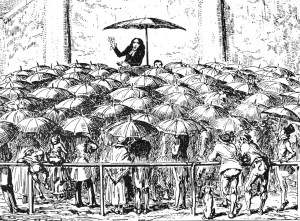
Whether the weather be cold
Or whether the weather be hot
Whether the weather be dry
Or whether the weather be not
We'll stick together and weather the weather
Whatever the weather we've got
Apropos of nothing… Day after the flood, I was slap happy. At one point I decided to count the squirrels that were rampaging around my property. I may have counted a few twice, but I came up with 24. Probably. So, being a nerd, I decided to calculate the population density of squirrels here on the half acre or so that I own. Turns out I have a higher density of squirrels than New York City has of humans. So this is the Manhattan of squirrel-dom…
©Elizabeth Anker 2024

 By My Solitary Hearth
I am pleased to note a glimmer of humour shining through the grim statistics – like a smile tugging at the corners of a stern mouth 🙂 The Western Cape here has been declared a disaster area because of the deluge of rain, stormy seas and the unseasonable amount of rain. Where I am in the Eastern Cape, we get the gales and icy weather. This morning was -5’C which has, happily, warmed to 12’C.
LikeLiked by 1 person
Wow! That’s a lot of squirrels! Could it be some of them were displaced by the flooding? What a shame about your raspberries! We had regular rain this morning but the long term forecast looks like it should be dry until Sunday, which would be the longest stretch of dry days since March.
LikeLiked by 1 person