

Cranberry sauce was not part of Thanksgiving until the late 19th century. I feel this was their loss. This is the one part of the traditional Thanksgiving meal that I love, but not that jellied gunk that comes in a can — which is probably mostly sugar and red dye. The real sauce is delicious and so easy to make. During the cranberry harvest season, I make vats of it, using it all winter, as a sandwich spread, as jelly on toast, with cheese and crackers, on ice cream — it’s especially delicious with butter pecan. I also make chutneys with both fresh and dried cranberries, mixing them with everything from tomatoes to peaches and serrano peppers. I eat a handful of dried cranberries, craisins, on my oatmeal every day and use craisins in all sorts of baked goods. Cranberry-orange scones are my favorites. I prefer cranberry juice over any other fruit juices. (Not only because it goes so well with vodka…) Cranberries will keep fresh in the refrigerator for months, and I don’t believe they can expire once dried. They’re just so sour! Cranberries are also some of the last foods to harvest before winter, a welcome burst of tart sweetness from late September into November.
A close relative of the blueberry, cranberries have all the health benefits of their other vaccinium cousins but with a flavor all their own, a sour that can shut down your taste buds, a bright sweet that is best described as “red”, and a bit of berry must. Many people tolerate the berries only with cupfuls of sugar to mask the tart, but I like the sour. However, if there is one fruit that can stand up to sugar in every way, it is the cranberry. A glass of cranberry juice each day keeps blood sugar under control. Cranberries have also been used for millennia to tone the urinary tract and clean out the kidneys. They prevent infection and reduce inflammation. Just a handful will relieve upset stomach, and if you suffer from motion sickness, cranberry juice is your best friend. Cranberries are even reputed to promote heart health and moderate some of the effects of aging.
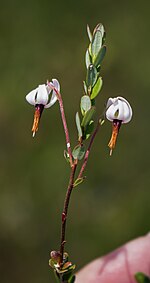
Cranberries, like all the vacciniums, are also beautiful shrubs. They do like boggy conditions, so this isn’t a typical garden plant. But if you have a damp space, cranberries are well worth growing. Low-growing and evergreen, the bushes ramble in twists and spirals, covering up to two meters. The leaves are shiny and glaucous, tiny coins that glint and glimmer in the sunlight. The plant gets its name, crane-berry, from its flowers, which are delicate and dancing in the spring. The half-woody stems are a rich claret somewhere in between chestnut wood and black cherry, a fine contrast with the leaves, but the heartwood is blonde, almost gold, swirled and veined like rock maple. If you are a woodcrafter, old roots and thick trunks make exquisite turned wood pieces — and as you might expect from a bog native, the wood is highly rot resistant.
The berries are gorgeous, but they don’t last long on the bush, being favorite foods for all sorts of animals. One of the names of this plant is bearberry, and bears are indeed so fond of the fruits that they will strip a whole acre. Birds of all kinds love the berries, so much so that craisins are now common in bird seed mixes. Woodpeckers particularly relish them. I have seen downy woodpeckers drill into a seed log to get to the craisins, tossing aside all the more typical bird foods.
For those of us who do not live in bogs, there is another genus of plants that produces cranberries, the viburnums. Highbush cranberry, viburnum trilobum, is a large bush or small tree that has large maple-shaped leaves that are somewhat felted in texture. These leaves turn brilliant shades of burgundy and scarlet in the autumn. They make a lovely hedge planting on the veg garden — which is where mine are growing. Like other viburnums, highbush cranberry tolerates shade, but it sets more fruit in full sunshine. The berries are smaller that true cranberries, but far more numerous, forming clusters rather like elderberries. The cranberry taste is almost exactly the same, but these don’t keep as well as true cranberries, so it’s best to harvest them quickly — before the birds devour them — and make them into sauces and jellies.
And so here is my bog-standard recipe for sauce… I already have a bowlful in the fridge. I will try not to eat it all before Thursday… but my sons know I make no promises on that. Fortunately, it’s quite simple to make more.
Cranberries Sauced
Ingredients
a bag of fresh cranberries (usually 12-16 oz)
juice of a large lemon (or orange)
about 1 cup water
1 cup sugar
1" ginger root, minced and smashed to release juice
1/2 tsp ground coriander
1/2 tsp ground cinnamon
pinch of ground cloves
very small amount of black pepper
1/2 tsp ground ginger (optional, for extra punch)
few drops of orange extract (optional if using orange juice)

Instructions
Wash your cranberries under cold water. Discard any that look suspect (mold, too squishy, too green).
Juice a large lemon. You want to get 1/8 to 1/4 cup of juice. I more often use orange juice, but today I had lemons and decided to go with that.
Put the juice in a measuring cup and add water to fill the cup.
Peel and mince the ginger root. Using the flat side of the knife, squish the minced roots to release juices. Add this to the water and lemon juice, being sure to get as much of the ginger juice as possible.
If you are using lemon, add a few drops of orange extract to the liquid mixture. Or you can just go with lemon. I like the combination of orange, ginger and cranberry; and that is the flavor that my people expect when they demand my cranberry sauce… so…
Pour the liquid into a wide, shallow, heavy bottomed pan. I used my apple butter pan.
Add one cup of sugar and all the spices and bring to a boil. Stir constantly or it will boil over. Which is a horrible mess to clean up… Let it boil 1 minute to allow the liquid thicken a bit, but don’t let it get foamy.
Remove from the high heat and add the cranberries to the liquid.
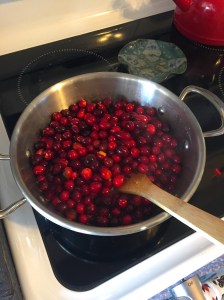
Bring the mixture back to a rolling boil over medium heat. Stir enough to keep the mixture from boiling over. Let it stay at boiling for 2-3 minutes.
The berries will float at first (they contain lots of air space). As they come to the right gelling temperature, they will pop and sink. You will hear this popping before you see much happening.
When most of the berries have sunk into the liquid and many have broken down, turn down the heat. Put the sauce on low heat on a heating surface that heats the whole bottom of the pan evenly. (This is really hard to do on a gas stove… another reason to ditch that menace…)

You will want to cover the pan because all those little explosions will spread berry everywhere, and it stains. (Note: cranberries are excellent dye plants, yielding possibly the only natural fuchsia color with a vinegar mordant.) But you need to let water escape to cook it down a bit. So I use a splatter guard.
Cook the mixture down not more than half, stirring occasionally to keep it cooking evenly.
It will be dark, syrupy and most berries will be broken up when it is done. This can take anywhere from half an hour to several hours. So don’t be worried if it seems to be puttering along. It will get to that nice thick dark goo eventually.
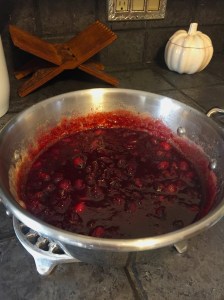
Take it off the heat and let it cool in the pan until it can be poured into your storage/serving container.
It can be served once it is cool enough to eat, but it’s best to make this at least a day ahead of time and let it set up even further in the fridge (or on an unheated porch that stays about 45°F, if you’re tight on space before the meal).
This can be frozen for up to a year. Probably longer. Never had it remain in the freezer for that long.
I’ve never tried this, but I suspect you can preserve it in a water bath canner also. It certainly has enough sugar and acid. But look up instructions on that before trying it.
It can be used as the traditional cranberry sauce on your holiday tables. It can also be used for sandwich spread (especially on those bird leftovers). I used a small bit to flavor oatmeal. And it’s fantastic warmed up and drizzled over baked goods of all kinds. I’ve even paired it with pumpkin pie. Because why not!
From the Book Cellar
The center of Thanksgiving is not food, but family. That, of course, means an increased likelihood of small people running around while there is work to be done. So here are some books that older siblings and cousins can read to the tots. Or maybe the Grands can take a load off and enjoy time with the kiddies. These books also make for great discussions during the [interminable] school holidays.
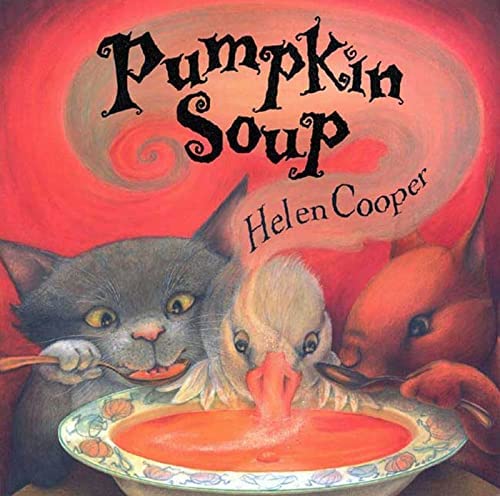
Pumpkin Soup by Helen Cooper (Farrar Straus Giroux, 1998). Quite possibly the best book ever created on cooperation and sharing and friendship. Vivid art, engaging story, adorable characters, and soup… also bagpipes… Cooper continued the quest for soup in two more books. Squirrel, Cat and Duck return in A Pipkin of Pepper (FSG, 2005) which explores being lost in unfamiliar places. Then Delicious (FSG, 2007) deals with the dreaded fussy eater. (“I won’t eat that! It’s pink!”). All three are great read-alouds. And there are recipes.
Princess Scargo and the Birthday Pumpkin, written by Eric Metaxas, illustrated by Karen Barbour (Rabbit Ears Books, 1996). Not about Thanksgiving, but certainly a wonderful story about giving to your community and sharing this Earth.
Bear Says Thanks by the wonderful team of Karma Wilson and Jane Chapman (Margaret K. McElderry Books, 2012). The irrepressible Bear learns to accept the gift of friendship and fine food, to say “thanks”. A skill more of us need to work on…
Thank You, Sarah: The Woman Who Saved Thanksgiving (Aladdin, 2002) written by Laurie Halse Anderson and humorously illustrated by Matt Faulkner tells the story of the superhero… ahem… “dainty lady with a pen” who made sure we remembered to give thanks even in the darkest times of our collective story.
The First Thanksgiving, written by Jean Craighead George, illustrated by Thomas Locker (Puffin Books, 1993). Gentle language and rich heroic illustrations. Relatively true to history. And told from a perspective centered on the enduringly solid Plymouth Rock.
The Thanksgiving Story, written by Alice Dalgliesh, illustrated by Helen Sewell. Not quite “the” story but a story, it tells of an important two years in the lives of the Hopkins children, four of the many that sailed on the Mayflower. Award-winning, highly original art.
Always pair these books written by the descendants of the settlers with two books from master storyteller, Jospeh Bruchac. Circle of Thanks: Native American Poems and Songs of Thanksgiving (illustrated by Murv Jacob, Bridgewater Books, 1996) is appropriate all year round as an excellent introduction to fundamental concepts of gratitude, spirituality, and the place of humanity in the wider world. Squanto’s Journey: The Story of the First Thanksgiving (magnificently illustrated by Greg Shed, Harcourt Books, 2000) is a loving portrayal of Thanksgiving through the eyes of the man who made contact possible, Tisquantum, known in English as Squanto.
Plimoth Plantation, the historical re-enactment village now named the Plimoth Patuxet Museums, partnered with Scholastic and then National Geographic to put out many books that bring to life the years after the Mayflower arrived. The Scholastic books are (mostly) written by Kate Waters and feature photography by Russ Kendall of young people enacting a typical day in the life of a settler. Set in the Plantation and with many of the Plantation’s professional re-enactors filling in the adult roles, the books are history made tangible. Sarah Morton’s Day (1989) tells of a historically real nine-year-old who came to the colony in the wave of settler arrivals after the Mayflower. Similarly, Samuel Eaton’s Day (1993) describes a seven-year-old on the day of his first rye harvest.
There was a need to correct the blank space left in this narrative that should have been filled with all the Native inhabitants of these lands going about their days. So in 2001, Plimoth Plantation and National Geographic created 1621: A New Look at Thanksgiving. Written by Catherine O’Neill Grace and Margaret M. Bruchac and filled with glowing photography by Sisse Brimberg and Cotton Coulson, 1621 is exactly what its title implies. A new look is presented with both the light and the darkness of the story revealed. Includes historically accurate recipes for stewed pumpkin and nasaump — the quintessential Pot of Something.
National Geographic and Plimoth Plantation also cooperated on two other books — Mayflower 1620: A New Look at a Pilgrim Voyage (2000) and Pilgrims of Plymouth (1999). Both feature the re-enactors in period setting photography. Pilgrims lists only Susan E. Goodman as the author. The photographs in this book seem to have come from the museum staff. Mayflower has the same photography team as 1621, and Catherine O’Neill Grace is listed as an author along with Peter Arenstam and John Kemp.
There is a final book from Scholastic and Plimoth featuring the work of Kate Waters and Russ Kendall. It presents the story of a Wampanoag boy around the time of Thanksgiving. Tapenum’s Day: A Wampanaog Indian Boy in Pilgrim Times (1996) tells the story of a fictional youngster navigating the uncertain waters of contact and sometimes conflict between two radically different cultures. I am not as fond of this book as the others; the title sort of reveals why. It is not as centered as the stories of the white children.
All of these Plimoth books are invaluable resources for teaching our kids about the meanings and roots of both our country and our culture, including, of course, Thanksgiving.
Interestingly, Squanto’s Journey relies upon research by Joe Bruchac’s sister, Marge, who co-authored 1621 and who regularly is called upon as an advisor to museums and historical re-enactors across the country. Look closely at the paintings in Squanto and you will see many familiar Plimoth faces from the other books. Makes for a great discussion on art and how we portray ourselves and others.
©Elizabeth Anker 2024

 By My Solitary Hearth
Serendipity: I bought a litre of cranberry juice this morning 🙂 I like adding dried cranberries to my fruit cake mix.
LikeLiked by 1 person
Thank-you for this lovely post! I, too, adore cranberries and have a boggy spot, so will be searching for plants.
LikeLiked by 1 person