

There are many ways to divide up the year. We all use several different calendars — one based on months, one based on seasons, perhaps a school calendar or a business calendar. Some cultures emphasize the moon, with varying degrees of correspondence to the solar year. Some cultures don’t bother with a framework and base time on place-based markers. For example, in Bronze Age Ireland summer started when the hawthorn bloomed. This did not happen on the same day every year. It may not have happened in the same month. But the hawthorn, the may, ushered in the summer. Similarly, many Puebloan peoples still follow the star calendars of their ancestors, watching for celestial bodies to rise over prominent geographic markers like mesas and mountains. Sometimes they build their own markers. Chaco Canyon is one elaborate “wall calendar”. Its structures preserve alignments with the solstices and equinoxes, with the rising of Venus and the Pleiades, with the moon’s 19 year cycle, and many other celestial cycles. Today, Puebloans still hold dances on these critical time markers. This is their calendar. (And it is far too complex to hang on a wall…)
I have another calendar. I don’t think I invented it, but I don’t remember where it came from now. I call it the calendar of the land. The four seasons don’t work very well for noting land cycles, and months are just useless. But if you divide the solar year into thirds and allow the periods a bit of flex and braiding, you get a pretty close approximation of the garden year. This calendar doesn’t have weeks and days; it is based on the weather. So, for example, the year begins with the end of the growing season, the first hard frost.
For shorthand, I named each of these divisions for one of the Mothers, the old Triple Goddess of Europe, and the beginning of the year is the time of the Crone, the wisdom keeper. This is the time of recuperation and rest. It is a dark time, introspective and quiet. It is a time to remember, a time of ancestors and old recipes. It is a time to sleep and dream. As winter deepens its hold, it is a time to analyze the past and use what you have learned to forecast and plan the future.
The Maiden energies kindle at about Candlemas in my part of the world, when there is enough sunlight to allow growth of winter crops. The Crone is still predominant, it is still the resting season for many weeks, but the next phase is awakening. The Maiden is the creator, the maker, the initiator. This is the time of regeneration, of germination, of birth, of opening out and moving about. In the garden it is the planting phase, and it begins with sap season or when it is warm enough to plant peas, usually some time in March. This phase lasts until what was monsoon season for me in New Mexico and now is hay-making season in Vermont (though it is increasingly flood season these days). This is when planting shades into harvest, the time of the Mother, the great provider and defender. As the Maiden begins to stir at Candlemas, so the Mother first appears in the early harvests of greens and peas and strawberries, foods that are delightful, but not particularly sustaining. The Mother presides over the time of contraction and gathering in, the time of abundance even as the land is preparing for its annual death. And near the end of this time, when the leaves have mostly fallen, the Crone awakens. This usually happens around Michaelmas.
Why is this important today? Because there is an interesting thing about this way of looking at the year. Both solstices become a sort of time out of time, a time when all three energies — growth, senescence and decomposition, or in garden terms, germination, seed-setting and fallow — are symbolically present. In the summer, the seed of winter’s darkness is sown at the height of the growing season, yet in a period of rest between planting and harvest. In the winter, the light of summer is reborn in the depths of winter’s repose. The darkness is dying. The light is growing. The land is still sleeping. However, there is a new restlessness, a change from dwelling in the past to looking toward the future. Time to dig into the seed catalogs and plan.
In any case, this is the Mothers Night. The time when all three are brewing up the rebirth of the sun and the new cycle of light and regeneration to come. All Three — wisdom keeper, creator, provider — are active principles on this night. And tomorrow, the Crone’s hold on the land will begin its waning.
Post-agricultural cultures are mostly patriarchic and often grossly misogynistic, yet much of ritual, imagery, and myth is centered on women. This is because the major pagan celebrations, those that form the bones of our ritual calendar, largely honor female deities. The king of the gods may be a male sky-god, but most of the narrative and energy is devoted to female deities, mostly of the hearth and home. Vesta, the principle deity of the highly patriarchal Roman Empire, is a prime example. Her Greek counterpart, Hestia, is known as the “first of the gods” in a culture that did not recognize women as sentient and rational beings. Hindu myth has many swashbuckling heroes and powerful, if shadowy, creators; but the deities that receive daily adulation are female. They are also usually the saviors in any given myth. And then there’s Amaterasu… the sun deity who is so central to otherwise male-dominated Japanese culture that she is centered on their national flag.
Tonight some celebrate the birth of the Christian god in human form. This story was included in the selected writings from that time period — and the resulting ritual calendar — fairly late in the evolution of the religion and the Book. There is scant reference to the mother of god anywhere else in the Bible except this lovely story of the hidden Chosen One born to commoners in a lowly stable. How is it that this atypical story became second only to the crucifixion in importance and arguably more significant in the broader context of world culture?
Because this is the story of the goddess.
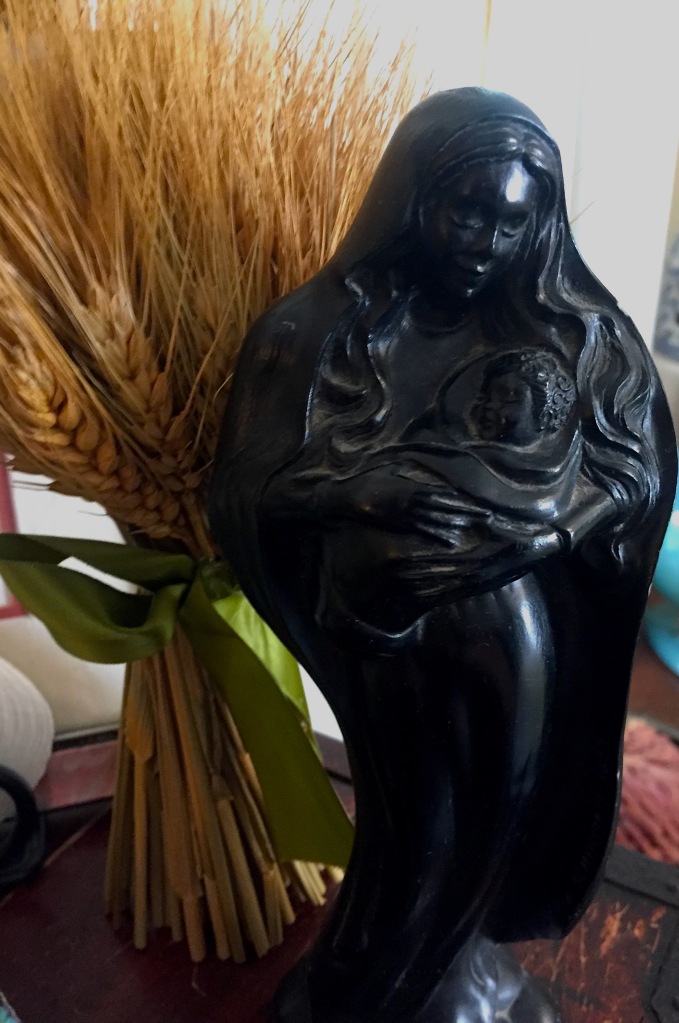
She will come through every myth, even those that deny her existence. Mary is the Queen of Heaven, the Star of the Sea, the Rose of Galilee, the Mother of God. She is eternal and magisterial, but also gentle and loving, watching over and tenderly caring for even the least of her children of Earth. Her original name is from a Hebrew word meaning “beloved”, but the name given to her in translation has the overlain sense of “marine” or “drop of the sea”, a name that has far too many parallels with the Mediterranean sea-born goddess of love to be mere happenstance. Mary is a very old story of deep love.
The pagans would not accept a faith that expunged their Mothers, the triple deity honored during the darkness of the winter solstice for millennia. This is Mothers’ Night, Modranacht, the night when North Europeans remembered their Mothers, the ancestors and spirits that created and preserved their very being. The Roman Catholic Church resisted Christmas for centuries but finally included the myth of the holy birth in order to win the hearts of those given to the goddess. Not only the Germanic and Celtic peoples, but myths throughout the Mediterranean are echoed in the birth of a savior deity from a virgin, complete-in-herself, mother. This is an old and powerful story, one that will not be abandoned to the sky gods.
And so we have Mary and Joseph and the Christ Child. We have shepherds and angels, donkeys and sheep. We have Magi, who were not kings, but Persian wizard-priests. We have a midnight birth and a harrowing escape. And we have a fierce mother who gives her child life and protects that tiny flame against all the howling winds of humanity.
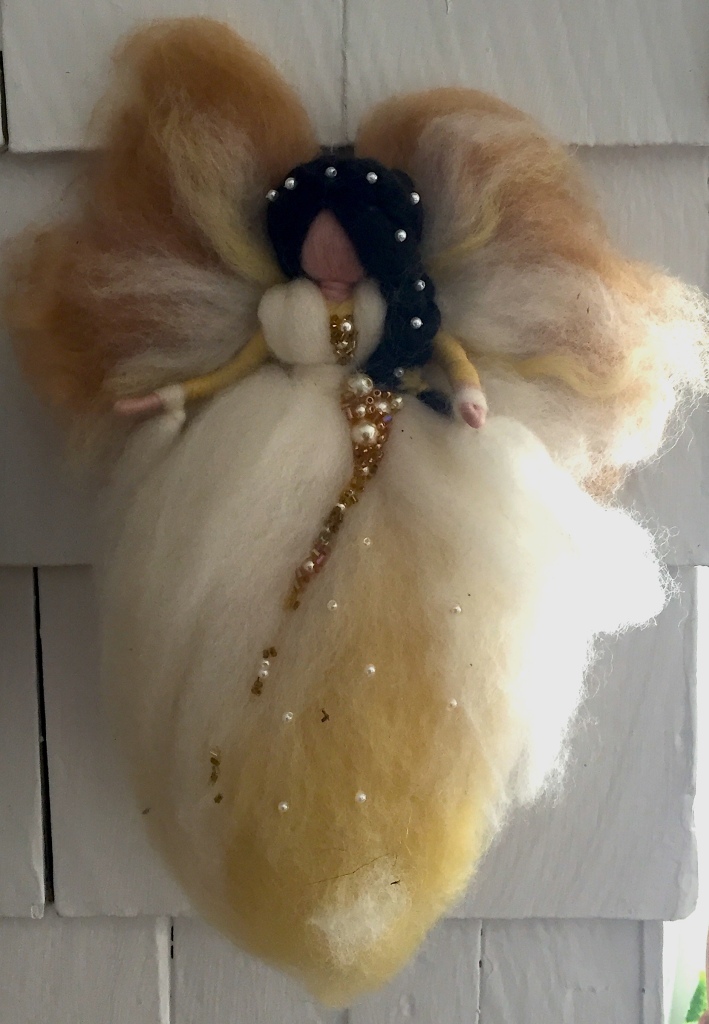
In Looking for the Hidden Folk, Nancy Marie Brown tells the story of an Icelandic matriarch who did not wake her household to do the evening work of midwinter because she was away dreaming. In her dream, the woman came to the elf-land, into a large hall filled with people. The woman was brought to a lady’s bedchamber and saw an elven woman struggling in childbirth. The woman understood that she was to be midwife to the elven lady and her baby. The human farmwife delivered the elven child and soothed the mother, setting all right with the world. And then she woke.
Brown notes that there are variants of this story in cultures all around the world. But in Icelandic it takes on special significance. The Icelandic word for “midwife”, ljós-mo∂ir, is literally translated as “mother of light”. The midwife brings light into the world.
Brigid, the Irish goddess turned saint, is a mother of light. She is the midwife to god. In a very similar story, Brigid falls asleep and is transported to a stable in Bethlehem where she finds Mary in labor. Being a practical Celt, Brigid sets about preparing for the birth. She makes a cradle from a feed trough and tears strips from her own gown to make swaddling for the newborn. She tends to Mary and keeps the stable warm. In some versions of the story, she even prepares food (after a bit of very Brigid-like thievery).
At midnight all the animals in the barn turned and bowed to the emerging child of light. Brigid caught the baby as he came from his mother. She deftly wrapped up the child, kissed his brow, and placed the baby in Mary’s arms. Then she awoke in the cold North.
This is a time that is thick with the mothers of light. The old women, the midwives, the grandmothers. The light is struggling and the wise women must help smooth the delivery.
The thing to think on at Midwinter is that there will always be a child of light. And there will always be Grandmother to wisely and lovingly ease that light into the world.
This is Modranicht, Mothers Night. Bede tells us that the heathens honored their triple goddess on this night of the sun’s renewal. By Bede’s day, the late Romans had turned their solstice new year celebration into the birth of their new god. The actual day of the solstice had already shifted substantially earlier than 25 December, but since the focus had also shifted away from the unconquered sun it didn’t matter so much which long night was considered holy. Apparently, either Bede was confused in his dating or the Northern peoples also left their solstice rituals at the antique Roman date because Bede very clearly states that the heathen new year began on 8 calends of January, 25 December; and the night before the new year was dedicated to the triple goddess, the Mothers.

Many choose to imagine these pagan deities as young women. But I’m not sure that my ancestors even considered their gods to be human. They staunchly resisted all Roman attempts to make images of the gods in human likeness. But the Mothers were certainly not young. Even in the southerly stories of this archetype, the spinners of fate and weavers of fortune, they are powerful old women. I might even call them the Grandmothers. In my mind, they are the wise elders who guide us through the perilous liminal night between years and bring about the annual renewal of time. They preside over the rebirth of the sun and of all that comes from the sun’s strengthening. They midwife the light.
This night of the Mothers was always the sacred time. The day itself was denouement. The child was born in the night, the sun rose, the new year’s threshold was crossed, and time reverted to the quotidian, albeit without normal obligations for the day. It was a day of release and jubilation. People gathered together for gift-giving and feasting to celebrate the relief of once again coming through time. But all the ritual import and observance, the prayers and vigils, songs and libations, all took place in the darkness as the Mothers brought the child into the world.
Though it is no longer the new year nor the solstice, Christmas Eve is still the holy night, a night of quiet solemnity and mystery. So many centuries of tradition are heaped on this night that it is suffused with significance, though we are vague on exactly what that might be. Some look to magical gifting from a fat old man. Some seek out romance. A few even tell stories of ghosts creating change in the cold hearts of men, bringing benevolence and generosity and goodness into the world. I remember the Mothers, the Grandmothers, the wise elders who tenderly guide us through pain and darkness. For me this is Midwinter, the night that gives way to the growing light. The worst of winter weather may still be ahead, but nevertheless, this is the midpoint. Nights will no longer grow longer, and sometime soon, the sun will rise early enough to go about morning work without candles.
For now, the Midwinter revels are at their peak. The next Twelve Days are given over to celebration. We’ve once again made it through the Night.
If you are like me, I am sure you want nothing more to do with holiday music by now. Or perhaps you want nothing to do with what this culture considers holiday music. All these greedy, grasping stories of getting mountains of stuff under the tree. And even more songs about finding romance, or perhaps, more accurately, finding validation of your worth through romantic encounters. Nothing at all about light. Nothing about wonder and beauty. Certainly, nothing about mothers and midwives. These tunes are all as shallow and vacuous as the latest trends found on shop racks in tired malls.
But there is such beautiful music for Midwinter. Even contemporary music. Here are a few songs that are worthy of the time.
Josquin des Prez, O Virgo virginum (recorded by the Orlando Consort)
Alison Krauss and Yo-Yo Ma team up for the traditional Wexford Carol
Luciano Pavarotti singing O Holy Night with the National Philharmonic Orchestra and then Ave Maria with The Three Tenors and the Los Angeles Philharmonic
Holst’s In the Bleak Midwinter sung by Tenebrae and then again by Voces8
And quite possibly the most beautiful song for winter ever created, For Now I Am Winter, written by Ólafur Arnalds and Arnór Dan, here arranged and performed by Voces8, and then reworked and performed by Nils Frahm
©Elizabeth Anker 2024

 By My Solitary Hearth
I am going to enjoy listening to your suggested music 🙂
LikeLiked by 1 person
thanks for the musical suggestions … I too found myself cornered by bad Christmas music … really liking the Voces8 album … my warmest memories of Christmas are all mingled up with the music … my mom was the choral director for the local Methodist and Lutheran churches (raised in one, moved to the other when she married) … she filled the house with carols and such for two weeks leading up … then we went to the Christmas Eve service – church full of candles and chrysanthemums, otherwise dark … talk about a pagan ceremony! … most of the spirits I sensed were definitely uninvited …
Merry Christmas!
LikeLiked by 1 person
My holidays were always about music also. We went wassailing and there was at least one Nutcracker every year; I played in several. There were usually wrangled tickets to the Music School performances where the snow chorus would spread out through the music hall so that voices were everywhere. And holiday music is how I got involved in early (pre-Baroque) music, playing flutes and pipes in madrigals. I still go to midnight mass now and then for candlelight and carols, though there isn’t as much pomp here as there was in New Mexico. More organ, fewer bells. The best concerts each year in New Mexico were the Musica Antigua de Albuquerque holiday concerts. The Sheinbergs are incredible musicians. Look up Musica Antigua. I think you’ll enjoy it.
LikeLiked by 1 person