

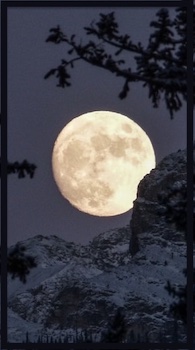
The Wolf Moon went dark yesterday at 7:36am and Chinese New Year, or the Spring Festival, began with all its riotous color and spark last night. Today, the Snow Moon, the fourth moon in my lunar year, is new. In my calendar this is the season of Imbolg, the stirring of spring in the belly, which slides almost imperceptibly into Early Spring after Candlemas.
In many cultures, this moon is called the Hunger Moon. Because it is full between 9 February and 9 March, there is not always snow, even in Vermont, but there is always hunger, in both belly and mind. In most of the northern world, it is time to tighten the belt, take stock. If you’ve planned well, you still have half of the food you stored from the harvest. If not, well, you need to eat less now and plan better for next year.
There is also hunger for the vigor of spring. This time of year many of us become restless, wanting to be more, do more. Luckily the Snow Moon and the season of Early Spring are traditional times to clean and cleanse. Get out those rubber gloves and give your home a good scrubbing. Start that exercise plan and get your health back. Stop making lists and plans and start putting them into action. It also is time to donate, repurpose and recycle what is no longer useful in your life. But getting rid of the overburden is not as easy as it sounds. In fact, it can be downright impossible to responsibly dispose of some waste. So this is also a good time to consider ways to eliminate waste altogether. Investigate ways to live abundantly without generating waste. (Pro-tip: this largely involves getting the plastic and superfluous electronica out of your life…)
Today is Up-Helly-A’ in Scotland. This translates roughly into “the holidays are over”, but it does not mean a return to work. In true Scots fashion, today is a day to celebrate. Pancakes are eaten, alcohol is consumed, and games are played, often a local variety of the ubiquitous spring ball games that plow their way throughout the town and usually involve a great deal of pain. Apparently, shop windows must be boarded up while the game is on.
Another traditional day for the ball games of Shrovetide (the time leading up to Lent) is Feasten Day which falls on February 10th this year. Feasten Day is set to be the first Monday after February 3rd (the day after Candlemas and the absolute latest end of the Midwinter holidays). Feasten Day is more widely distributed than the Up-Helly-A’ celebration, with the most famous game, Hurling the Silver Ball, happening at St Ives in Cornwall to commemorate the dedication of their church to the Celtic St Ia (Anglicized as Ives). These early spring ball games are usually accompanied by community suppers, almost always involving pancakes, but Feasten Day has its own recipe, Feasten Cakes. These spiced and fruit-laden cakes are neither pancakes nor true cake. They look like thick pancakes, but they are baked, not fried, and there is yeast for leavening rather than the acid-and-salt of real pancakes.
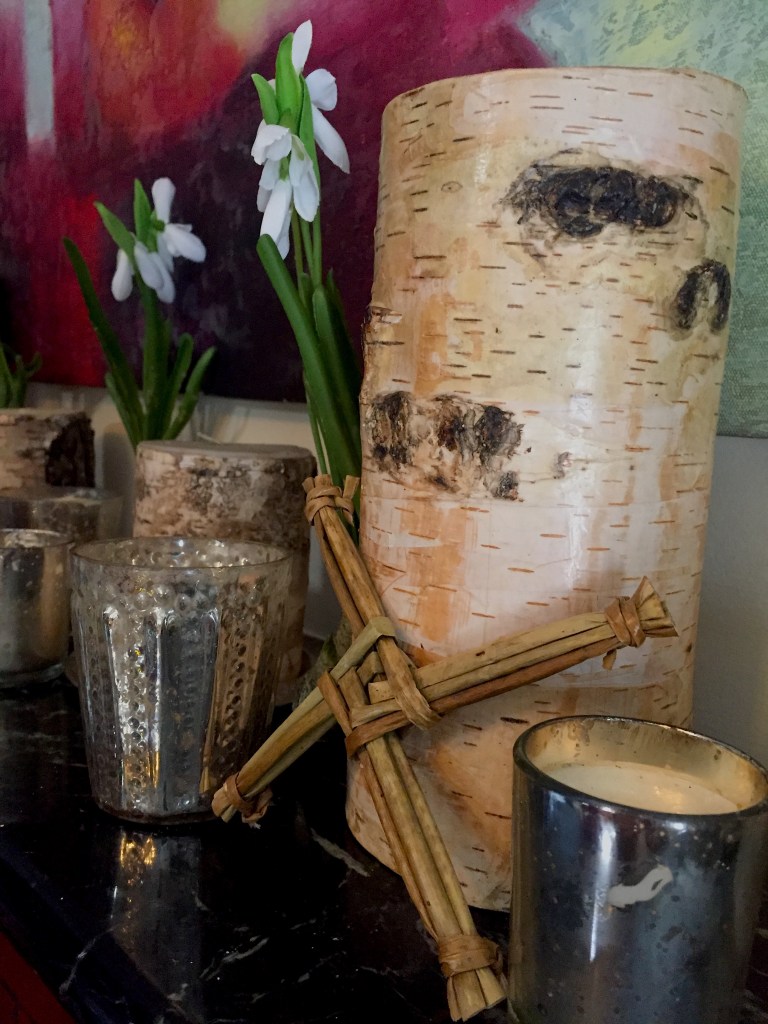
Tomorrow, the Imbolg holidays begin with St Brigid’s Eve. Since days begin in the evening for the Celts, this nearly pan-Celtic holiday starts on January 31st. Most of the ritual also happens on the eve of the holiday itself, which is February 1st. There are pancake suppers in many communities, but this holiday tends to be more private than public, with much of the ceremony happening in the household. So the feast is usually a family affair.
In Ireland, where the traditions are still strongest, it is traditional to weave St Brigid’s Crosses from rushes and prepare a welcome for the Saint either at the threshold or on the hearth. A prudent family does both. As this is the start of the lambing season and there is milk flowing again, traditional foods are creamy. Colcannon or champ, thick and milky soups of potatoes, with or without cabbage respectively, are both ubiquitous. I make potato-leek soup and serve it with soda bread. Both will last me for many nights, not just Imbolg Eve, so I rarely have to bother with cooking for the first week of February.
February 1st is Imbolg, renamed St Brigid’s Day by the new faith. It is the beginning of the beginning of spring which is presided over by the great Celtic goddess and now saint, Brigid. Brigid, both as saint and deity, is associated with inspiration, healing, fire and water. There are wells dedicated to Brigid wherever the Celtic peoples have lived. A perpetual flame is tended in the saint’s original abbey at Kildare, but there are also flame-keepers tending their own lights throughout the world. Brigid even came across the Atlantic with Celtic immigrants. But she took on a new mantle in the South and throughout the Caribbean, where she became Maman Brigitte, the fiery and foul-mouthed, bourbon-drinking, chain-smoking Lwa of death in the Voduo tradition. I think in this wonderfully blended culture of ours it is perfectly acceptable to toast Brigid in all of her guises.
The Roman Catholic Church was never comfortable with Imbolg, even after they renamed it for St Brigid (and this was before Brigitte showed up…). So they set another holiday to this time. There was a nice bit of synchronicity of the stories. Imbolg, the first faint stirrings of spring, happened halfway between the winter solstice and the spring equinox, so about 46 days after the solstice. In the story of Jesus, Mary was allowed into the Temple to present her infant son to the community 40 days after she gave birth. So the Feast of the Purification falls neatly on February 2nd, just a day after Imbolg which has gravitated to the 1st.
Another interesting thread woven into this holiday comes from pagan Rome. February was the last month of the year in the Roman calendar. As such, there was much preoccupation with cleansing, throwing out the old to make way for the new, getting yourself in right relationship with the world in order to start the year auspiciously. February is named for the mother of Mars, Februa, and her festival opened up the month. In this celebration, women began the purification rites by silently walking the streets carrying lit candles. This candlelit processional was embraced by the Church to honor the Virgin’s purification. Women who had borne children in the previous year carried candles to the church to be blessed. Over time, the mothers were joined by young girls who were dressed in white, representing both the theme of purification and Brigid, who in tradition wears white, sometimes with a blue mantle. The processions died out even in the Celtic lands after the Reformation quashed all beauty and fun (and most of the meaning…). But there are sporadic attempts to revive the tradition with quiet candlelit parades around the village square, followed by a pancake church supper. I imagine this makes for nice counterpoint to all the manly noise entailed in the spring ball games.
This whole hybrid edifice gradually became the celebration we call Candlemas, which did not start out as the same thing as Imbolg but has, through time, been blurred into one festival. Truly, because most Celtic holidays used to be spread over three days, Candlemas could be seen as the third day of Imbolg with or without Roman and Church involvement.
And then… Because of the calendar shift that didn’t take hold in the British Isles until very late and was not fully embraced until just a couple generations ago, Imbolg has a reprise in the middle of February, ignoring the eleven day shift and observing the holiday where it was in the solar year before the officials tweaked things. This tendency is particularly strong in Protestant Scotland, where Brigid is known as Bride. So February 12th is Old St Bride’s Day, and February 13th is Old Candlemas. Some communities celebrate the new, some the old; but some seem to do both. Because you can’t have too many pancake suppers, I suppose.
February 13th also marks an even older celebration: the Roman festival of Parentalia begins on that day. This is the time when you get in right relationship with your immediate ancestors before the year’s end. It also includes the festivals of Lupercalia on the 15th, an ancient fertility festival that honors the mother of the founders of Rome, and Quirinalia on the 16th, a grain festival that honors Ceres and celebrates Romulus in his deified form as Quirinus, who is often conflated with Mars. The founding twins of Rome, Romulus and Remus, are usually portrayed as foundling children who were fathered by Mars. Later, Romulus seems to have become Mars. Now, Mars was the god of war in later times; however, he began his story as an agricultural deity especially associated with cattle, grain fields, boundaries and spring. As we have seen, his mother, Februa, a goddess of purification and cleansing, is honored throughout this month, making way for the month of Mars, the beginning of the year and the beginning of spring, March.
February 14th is Valentine’s Day, of course, but this is also the time that traditionally sees the opening of fisheries in the Atlantic. At midnight on Valentine’s Day at Pedwell Beach on the River Tweed, Scots fishermen from the north side of the River and English from the south gather together, bringing their nets for blessing and prayers for safekeeping. Similar gatherings happen throughout Europe around the Snow Moon. For example, the Navigation of Isis, the traditional opening of the sailing season on the Mediterranean on March 1st, falls just after the Snow Moon goes dark this year.
And so as we move to the close of the Snow Moon this year, we come to February 24th, St Matthias’ Day, the day when Winter’s back is broken. If there is ice, it is no longer trustworthy after St Matthias’ Day. This is also when the Cailleach, the Celtic crone, finally gives in, climbs the nearest mountain, and turns herself into stone until the days begin to shorten once again. In some stories, she has imprisoned Brigid who escapes with her lover and is pursued by the frost-wielding hag all over the country. In other stories, the Cailleach and Brigid are one and the same, and this is the time when the hag of winter rejuvenates herself, becoming the maiden of spring.
So the Snow Moon is time for taking stock before the reawakening of the green world and the renewal of the year. Before it goes dark on February 27th, take time to appreciate how far we have come… For now, it is still Winter, but we have made it through the darkest parts yet again. And Spring is just around the corner.
In Early Spring, the growth of the light is speeding up. The days are not only getting longer, but they are getting longer faster. This week, there are over two minutes added to each day, compared to the few seconds we were adding back at the solstice. This is adding up. On February 1st, the sun sets after 5pm in my part of the world, and 8 February sees a sunrise before 7am. The 4th is our first 10-hour day of the year. So these changes are tangible and appreciated. I can see when I am heading out to work and can still see when I get home in the evening. But it keeps going faster and faster. By the end of the month, each day will be over three minutes longer than the one before, about half an hour gain each week. However, the changes slow after that, and by the middle of May we are back to adding on just a couple minutes to each day — though by that time, day is decidedly longer than night… and we are starting to think about the shift back the other way again…
February 4th is King Frost Day, a celebration commemorating the Great Frost of 1683-84, when the River Thames froze solid for over two months, building up a reported foot of ice, so that there was a whole trade district opened on the frozen river that winter. That year was exceptional, but many smaller Frost Fairs were held on the frozen Thames, which froze solid enough for mercantile trade to happen on the ice about once every decade throughout the Little Ice Age (the 16th through the early 19th centuries).
These days the Thames rarely freezes. The last hard freeze was in the winter of 1962-63.
The Thames is in a fairly warm climate relative to Vermont, being bathed in warm tropical waters carried north by the Atlantic currents. (Which may or may not be true much longer…) But Vermont has also lost its ice. In fact, though it has been quite cold, it hasn’t been cold enough to freeze Lake Champlain solid this year. This used to be an annual occurrence. There were never fairs, though food vendors have been known to set up shop on the frozen lake to sell to the dozens of ice fishers and winter sport enthusiasts who were daily out on the ice. It used to be possible to schedule ice-fishing competitions and regional outdoor hockey tournaments in January or February. But you can’t count on such things any longer. Last year, Lake Champlain never froze at all. This year, there probably has been some thin ice, but I have not heard that it is safe enough for sport, never mind food trucks.
In fact, according to the Vermont Almanac, last winter, December 23rd through February 24th, was the hottest on record, shattering the old record. The warmth was not just in Vermont. For the entire continental United States, including Alaska, last winter was the warmest in 130 years of record-keeping. Several communities in Vermont, for example, never saw a dip below 0°F throughout the winter. February by itself was 7°F warmer than the average of the last three decades of February record-keeping.
The highs were not as much to blame as the lows. The high temperatures were above normal, but not exceptionally so. However, the low temperatures never could be described as such, being not much below the highs. So the day’s average temperature was dragged much higher by those “high-lows”. In fact, the average for each day was about the same as the afternoon high. This seems to be the new normal everywhere. In New Mexico, for example, temperatures in both winters and summers keep creeping up and up and up, but the daytime highs are not much above what they were thirty years ago. However, the nighttime lows are tens of degrees warmer. Since this is a desert with very little cloud for insulation, heat used to escape when the sun went down. However, these days, the warmer air moving across the region is also holding more moisture. This might good for rain, but it also traps the heat at night. In fact, in summer the sun’s heat tends to burn off the cloud so that it is only cloudy at night. So while temperatures used to swing between 45°F and 0°F each winter day, now the lows stay near 30°. Worse, in the summer, the daytime highs of 95°F never drop much lower than 80°F at night, making it impossible to cool off… in a place that does not have much in the way of refrigerated air conditioning. (Because it used to be sweater weather every night. Just open the window…)
Last winter wasn’t just warm in Vermont, it was dry, with the second-lowest level of precipitation on record and several large wind events desiccating the region as well as knocking over trees and power lines. However, it was not sunny… my weather journal recorded just a couple days in February 2024 without dense cloud cover. These insulating clouds are partly to blame for the high-lows that happened throughout last winter. It takes clear skies to release the day’s heat, even when the days are short. This year, we have had a very strange combination of nearly continuous dry snow and close to normal overnight low temperatures at or below 0°F (sometimes we never get above that). It’s getting that cold because the snow doesn’t seem to need much cloud cover — it’s more like all the moisture in the surface air is freezing — so there isn’t much insulation. In fact, many nights even the snow lifts away and reveals an inky spangled sky. With all the bright planets together, it has been arresting, stopping me in my tracks whenever I go out in the evening. This will continue into the Snow Moon, so perhaps there won’t be as much snow as moon for a nice change. Though it will probably stay cold for some time yet…
Venus is very bright this month. At -4.8 magnitude, it is strong enough to cast shadows. Though you can’t see it, Venus will be in conjunction with Neptune very early in the morning on St Brigid’s day. On the 25th, Mercury and Saturn will be in conjunction. Unfortunately, the actual point of conjunction will not be visible from my part of the world, but the pair will be close together at sunset, low on the western horizon. Mercury, at -1.1 magnitude, will point the way to fainter Saturn. Both will be visible together within the field of binoculars, though Saturn isn’t much to look at right now as its rings are pretty much edge-on to our eyes. It is just a pretty, bright yellowish wandering star this month.
©Elizabeth Anker 2025

 By My Solitary Hearth
Another fascinating read to start my day 🙂
LikeLike