

If you see that some aspect of your society is bad, and you want to improve it, there is only one way to do so: you have to improve people.
And in order to improve people, you begin with only one thing: you become better yourself.
— Tolstoy in his Calendar of Wisdom on 17 March

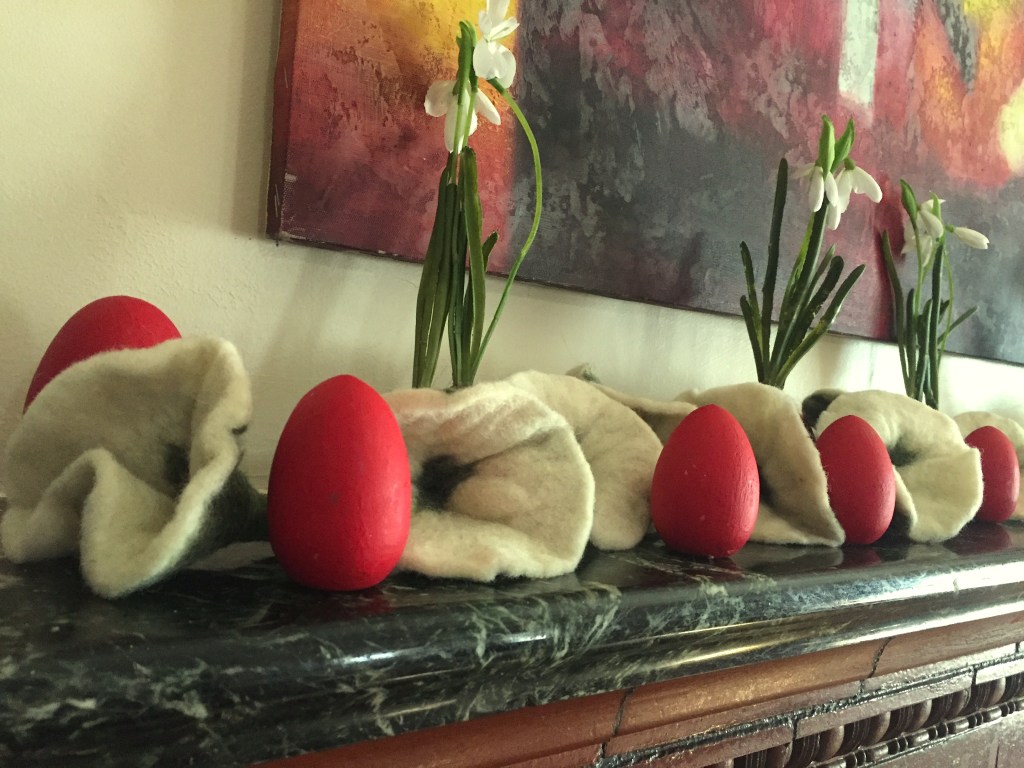
I declared winter over last week. I got the flu or something on Wednesday night. By Friday afternoon, I was over the fever but still snotty and achy. So I did what I usually do on such occasions — I cleaned house. I swept the grit and road salt off the sidewalk around my house before it could poison my roses. I washed the kitchen walls and tossed a few more things onto the rather alarming donation pile in my guest bedroom (which needs to be emptied here soon so Son#2 can come up for a visit). And I finally put away the last of the winter sparkle and the snowflake lights that have been welcoming me home since St Nick’s Day. I dug out eggs, as well as the dishtowels and pillow covers with more color. It is not yet time for flowers, and I tend to save the rabbit for Easter and May Day. But the birds are definitely more active, so I figure eggs might work as an appropriate charm to bring on the spring.

It seems to have worked. Most of the snow is melted — actually, it mostly just evanesced into the warm sunshine we had on Friday and Saturday. I am not sure that evaporation is good for the soil. After it’s been frozen for months, it could probably use a good soaking. But I do appreciate that it did not make its way to my garage, which is sporting its usual March frozen pond, this one some two inches deep. That will take a while longer to melt and flow out because the cold concrete doesn’t warm up quickly, and the drain pipe in the cold concrete is still blocked with ice. I did leave the door open to get as much air and warmth into the building as possible, but the garage faces north and is shaded by evergreens. It gets no sun and what wind blows from that direction is rarely balmy.

In any case, we did have balmy days, and I am taking credit. (Or maybe it was my fault that winter was holding on so long — because the winter decorations were still out in March.) In addition to the increased bird activity and the vanishing snow piles, there was also the first mention of sugaring season in the local paper. I also managed to clear off the raised beds and plant my peas and cold-tolerant greens. And finally, one snowdrop bloomed yesterday under the cedars where the snow was never too deep.
So spring is definitely here now. Though this might have more to do with the fact that today is the true equinox than my egg charms.
Today is… the equinox?
Vernal Equinox Quiz
True or False: The vernal equinox is when spring begins.
Not exactly. The beginning of spring depends on where you live, and it is more a cultural phenomenon than a meteorological one.
Tradition in Ireland has spring beginning with St Brigid’s Day on 1 February. Spring weather may not happen for months yet, but their season of spring lasts from 1 February to 1 May, with the equinox falling in the middle of the season. This was probably true as well for the Celtic people in what is now the south of France who followed the Coligny Calendar, if not generally in Celtic-language cultures. The Coligny month that would have corresponded to the time of the equinox was named Edrinios, which means (approximately) “fire season”, which is probably a reference to the warming of spring.
Those places that celebrate Chinese New Year say that spring begins with the New Year, which is also named the Spring Festival. It does not ever fall in March, let alone on the equinox. Nowruz, the Persian New Year is also the first day of spring in their calendar, and in this case it actually is on the equinox. So there is one culture that begins spring on the equinox.
Those who followed the Roman calendar and mutations thereof also began the new year’s cycle at the same time as spring. This New Year festival took place in March. However, they didn’t quite hit the equinox. Much like Christmas, the date of the Roman New Year celebration coalesced around the 25th, which is about where the equinox fell in the solar year in Roman times. However, when Julius Caesar moved the New Year celebrations to 1 January, the old festival of spring drifted a bit and then landed on March 1st, being a good solid date to begin business-y things. Most Romans subsequently honored both the new spring and the new year on March 1st, not January 1st. And then just to confuse things a bit more, the Roman Catholic Church tied Lady Day (the Feast of the Annunciation) to the old New Year festival, 25 March, which is coincidentally also the traditionally accepted date for the creation of the universe — a beginning if there ever was such a thing! Thus much of Medieval Europe welcomed in spring on Lady Day and left New Year’s Day on 1 January.
Interestingly, in the US we associate March most with St Patrick’s Day and Ireland — or just “things Celtic”. Illustrated calendars feature shamrocks and leprechauns, and the best time to hear excellent Celt-inspired music is around St Patrick’s Day. But this is the one culture that does not begin either spring or the new year around the vernal equinox. In fact, there seem to be no native observances of either equinox — though maybe there is an echo of a vernal celebration in the large number of Celtic saints’ days concentrated in March.
Spring doesn’t actually exist in tropical regions where there is little year-round difference in temperature. There, the growing season is tied to annual rains more often than the sun. And the rains usually come after the summer solstice.
For farmers in New England, spring begins when the maple sap is running, and it’s planting season when the oak leaves are as big as a squirrel’s ear. Obviously, this doesn’t happen on the same date each year, and it’s very rare that planting begins as early as the equinox. This year we might be able to plant peas today, but it might be best to wait for another week or so. The soil is still fairly solid with ice. I have cleaned off the beds though, so whenever I can shove my thumb into the top few inches I can follow that up with cold-tolerant seeds like peas and radishes. I also did plant some fresh greens in my cold frame, since the over-wintering greens were buried under a couple feet of snow for most of the last three months. I am sure it was warm enough in there with all that insulation, but, sadly, it was both too dark and too dry for my micro-greens.
In North America, we say the season of spring begins on the vernal equinox. But that’s just a human convention and has little to do with either the season or the equinox.
True or False: The vernal equinox is the day when day and night are equal length.
True, right? Nope. Equinox does in fact mean “equal night”, but the calendrical equinox is not that day. There is no one day all over the globe that day and night are equal; latitude affects day length. Actually, you know this already. At the equator, day and night are always equally twelve hours in length, but at the poles it’s day for weeks around the summer solstices and night lasts all winter. Well, similarly, the day when day and night are equal varies with latitude.
Let’s look at the Northern Hemisphere since I’m talking about the vernal equinox (which is six months away for the Southerners). The sun’s apparent path through the sky moves north between the winter solstice and the vernal equinox. At the equator, as I said, day length is always twelve hours. As the sun moves north — or more properly as the northern hemisphere of Earth becomes more tilted toward the sun — northern day length increases along the sun’s apparent path. So Florida sees equal day and night before Vermont.
At New England latitudes, day and night are closest to equal (12 hours each) on St. Patrick’s Day — today! — 3-4 days before the calendrical equinox. By this year’s vernal equinox on 20 March (at 5:01am), day will be nearly ten minutes longer than night in my part of the world.
True or False: The vernal equinox is when the sun rises due east and sets due west.
Somewhat false. Or maybe truth-y… This too is dependent on latitude, but much less so. At the equator, the sun always appears to rise over the horizon directly due east. In the subtropical regions, the sun rises due east for several days around the vernal equinox. Up north where I live, the sun rises at 90°E on March 18th. By the equinox on the 20th, it’s one degree north of east. Same for sunset. Not that you can see the difference, but still, the equinox is not when the sun rises and sets exactly due east and west.
True or False: The vernal equinox is when the sun’s apparent path, the ecliptic, intersects the celestial equator, which is a ring around the Earth directly above the planetary equator.
Or in uglier terms, the vernal equinox occurs when the apparent ecliptic longitude of the Sun is 0°.
Yes. This is true. It’s also really hard to visualize. Or much care about.
But this brings up a dilemma for those interested in the exact timing of astronomical events. As you can see there is some confusion over exactly what event even takes place on the equinox. If for some reason you need to know exactly when the sun will rise in the east or when day and night are equal length, use an almanac for your geographical location. It will very likely not be on the equinox. On the other hand, if you do need to know when the sun will be at the cross-roads of the ecliptic and the celestial equator, that is the time of the equinox — and it is a very short time!
However, if you are celebrating spring and renewal and the warming of your home town, you can go ahead and do that when it happens in your locality — from when the sap starts running until whenever you figure summer has begun. Time is relative. Make of it what you will.
That Other Calendrical Observance
Obviously, there is another reason to note this day. Since about the tenth century, Irish Catholics (and many others as well!) have been commemorating the anniversary of St Patrick’s death on 17 March in the mid-5th century. Patrick was already a legend lost in time before his cult became popular, so we only have fragments of tales from his life and these are mostly recorded hundreds of years after he lived. What seems to be true is that he was the son of a Romano-British tax collector and a Welsh mother. He was supposedly born in 389CE in the Roman town of Bannavem Taburniae, modern Banwen not far from Swansea Bay. He was apparently educated as a child, because he could read Latin, a not terribly common skill so far from Rome. He was also an early convert to Christianity, as were most of the Romanized British.
When Patrick was a teenager, slave traders (maybe Cornish pirates?) captured him and sold him in Ireland, where he became a ridiculously over-educated shepherd. After a few years, he managed to escape or perhaps was sold again. In any case, he began wandering for a couple years and finally managed to make his way back to his family home. But he was not destined to stay there. After a series of dreams and omens, Patrick became convinced that his mission in life was to convert the Irish to Christianity. So he set sail for Ireland and apparently was wildly successful, wielding metaphorical clover leaves, casting out snakes, and transforming the country through all manner of miracles.
(Incidentally, the banishing of snakes is probably a euphemism for purging the country of druids and their divination tricks… snakes never did make it to Ireland after the last glaciers retreated.)
However, he had his enemies and was perpetually turning to his god for protection. There were many attempts on his life, and he seems to have never lived in one place. Nor does he have a family in his folklore, though he did have a devoted charioteer and friend who gave up his own life to save Patrick from a murderous plot. Still, there is no community that bears his name like the other missionary monks of his day, and in his mythology he is presented largely as a solitary wanderer.
He became a saint not long after his death, and Christian communities sprouted all over Ireland and beyond. Irish Christians were a peripatetic bunch, going on missions and establishing churches and religious communities from Scotland all the way to Central Europe. Patrick, himself, is likely to have traveled to Rome or Constantinople in his wandering years after his escape from slavery. By the time of his Irish mission, he is uniformly named a bishop, and in his day — not much over a century after Constantine decided to convert his empire — there were few in Europe who might have conferred this position upon him. Either he was self-styled (not impossible) or he had dealings with Church hierarchy.
So by the tenth century, Patrick was honored as the founder of Irish Christianity and the preserver of the faith in Northern Europe. St Patrick’s Day began as a day to celebrate his life and works. It was and remains a day of very long church services. However, it is also very near the time when Europe was celebrating the renewal of spring and the new year. It is a time that has long been seen as one of new beginnings, appropriate for the feast of the man who remade Ireland. But as such, even when this day was purely a religious festival, it had a nationalistic hue. There have been special foods and processions and colorful Irish pageantry intertwined with this day for centuries. There is also a slight relaxing of the Lenten rules on this day when it doesn’t fall on Friday. In Ireland, it is traditional to drink from the St Patrick’s Pot today. A shamrock is tossed into a large pot of whatever alcohol is preferred. The person who drinks the dregs fishes the shamrock out of the bottom and tosses it over his shoulder. If you “drown the shamrock” you have good luck for the coming year. However, the really old school Irish don’t wear the shamrock on this day. It is far more common to braid St Patrick crosses and pin them to your lapel or hat.
When the Irish began their diaspora in the 19th century, they took all these elements with them. So we have parades and corned beef and cabbage (which is not an Irish tradition, being that St Patrick’s Day always falls in the Lenten fast, with a slightly better than 1-in-7 chance of landing on a Friday — because of Easter calculations and Leap Days and so on). There is Irish music and dancing and storytelling all over the world on this day. Of course, some of the largest celebrations are in the US where Irish communities managed to preserve their roots and gain wealth and prestige. The Boston St Patrick’s Day parade is truly epic in scale. And afterwards there are church suppers all around Massachusetts hoping to gather the thousands of parade-goers into the Church.
I’ve never been to one of those suppers. My Irish grandparents were definitely old school when it came to Patrick. You went to mass in the morning, and you ate potatoes and cabbage for dinner. (My mother still hates cabbage…) Sometimes, the holiday fell on a Friday and then there was fish, but no beef, salted or otherwise. Also no beer, green or otherwise. I’m not sure if this was part of their fast though, because they didn’t drink much beer in any case, preferring more distilled spirits.
My grandmother also thought it was nonsense to wear green on St Patrick’s Day (she’d be appalled by plastic beads). In all likelihood, Patrick dressed in Roman whites — which may also have been the color of druidic costumery. Green has only been associated with Ireland (and not with Patrick specifically) since the mid 17th century, when the natives (and the assimilated Normans) used it to contrast with the more bloody colors of their English overlords. But I like green and any excuse to wear it is fine with me. Though I won’t be one of those annoying folks who goes around pinching people who forget.
So today, I wear green; I usually eat cabbage and potatoes with soda bread; and I’ve been known to go watch a parade — though not often. More often than not, I go find music and dancing and immerse myself in the culture of my roots. Since moving to New England, where the actual equinox falls on St Patrick’s Day, I’ve been doing equinox things by day and Irish things in the evening. This year, I can’t go anywhere but to work — where I will, no doubt, be frantically trying to catch up after being out sick. But this weekend, I plan to head up to the shores of Lake Champlain to watch the birds as they argue about nesting sites. (Or we think that’s what they’re on about. They could be debating the nature of time, for all we know…) I’ll hit Rí Rá on the way home again because I’m sure there will still be uilleann pipes on Saturday.
Tonight, I’ll make popcorn and wallow in Irish-y kitsch — The Magical Legend of the Leprechauns, a Romeo & Juliet adaptation in which Roger Daltry is the king of the fairies, Whoopi Goldberg is some version of the Morrigan, and Randy Quaid clumps through his role trying to save Ireland from the fairy wars. There is pretty good music. And there is abundant sap… which is about as Irish as it gets and totally appropriate to today.
On Irish Luck
If you think it odd that good fortune would be associated with Ireland, you’re not far off the mark. Furthermore, it’s not really a polite thing to say, though the pugnaciously resilient Irish have taken the original intent and turned it into a national distinction.
The phrase has its origins around the time of the American Gold Rush, which was contemporary with the Irish Famine — the late 1840s. In desperation, millions of young Irish people boarded boats, and many of the survivors of that voyage washing up on North American shores. There was little use for millions of starving newcomers on the East Coast, and this mass influx of the superfluous poor created tensions that often erupted into violence. At best, being Irish was about as welcome as being a cockroach — only it was easier to step on a cockroach. So “Irish” itself was a slur applied to the generally unwanted, the unwashed masses.
Then gold was found in the mill race owned by John Sutter on the American River in what was then the proto-state of California. (California was a military province between the Treaty of Hidalgo in 1848 and its acceptance into the Union in 1850.) This news swept the nation. Understandably, those with nothing to lose and everything to gain flocked to the Sierra Nevada mountains, hoping to strike it rich. A large number of the Forty-Niners were Irish. So it is that many of the first to come up with gold in their pans were Irish men. Some, indeed, became wealthy, though the dominant culture did its best to strip them of their gains, and their good luck did not last.
Being that this was placer gold, that is detritus that washed out of the mountain granite, the bonanza was fairly short-lived. There wasn’t enough of it lining the river bottoms to generate years of mining revenues for thousands of people, and the lodes that fed these deposits turned out to be thin and very hard to access. Not that there weren’t efforts. But it was not a reliably profitable venture, so the Californian Gold Rush quickly died out, stranding thousands with claims to empty lands. (Many then took off for the Yukon…)
And this is where the phrase comes from. Most of the Irish that went West to seek their fortune came up as empty-handed as when they got off the boat. Many were even worse off, being indebted to land-owners, equipment owners, and all those who went West to get rich off of those who were trying to find gold. Many turned to crime, drink, panhandling. The Irish were as unwanted as ever. “The luck of the Irish” meant something between “they never get a break” and “they bring bad fortune upon themselves”.
But the idea that the Irish are especially smiled upon by Lady Luck (and other potent, if capricious, beings) is fairly old. This may be because this is a very old culture that has survived more or less independently despite two thousand years of determined efforts to subdue its peoples and plunder its lands. Or it may be that the Irish have a particular affinity for high irony. Anyway, eventually the slur was embraced as praise. These days it means something like “there’s always gold at the end of Irish rainbows”.
Incidentally, the association of gold with leprechauns — who were and are house fairies, shoe-makers, not notably rich or even concerned with wealth — also comes from the Gold Rush. The Good Folk do not favor gold; they’re more silvery. And really, they most prefer a warm bowl of creamy porridge.
Lucky Charms
The horse-shoe is an ancient symbol and attractor of good luck. Horses were one of the primary stores and signs of wealth in much of Europe, and a person who could afford to put shoes on his horses was rich indeed. Horseshoes are also made from nearly pure iron in the forges of the blacksmith. Iron, that new-fangled metal of the ancient world, offered protection against the malevolent fae, who can’t tolerate such abomination. And the Blacksmith is a universal benefactor of human cultures, though he is often shadowy and quick to anger. The Celtic-language peoples had many smith-gods — from the Welsh Goibhniu to the Gallic Govannon. Lugh, himself, was a talented blacksmith. (But then he did everything…) Hanging a horseshoe above the main door of your home will allow good luck to enter. If you hang it with the ends up, good fortune will pool in the shoe. If you hang it ends down, good fortune will rain on all who pass underneath.
Seems sensible to split the difference and hang it sideways… but you never see that.
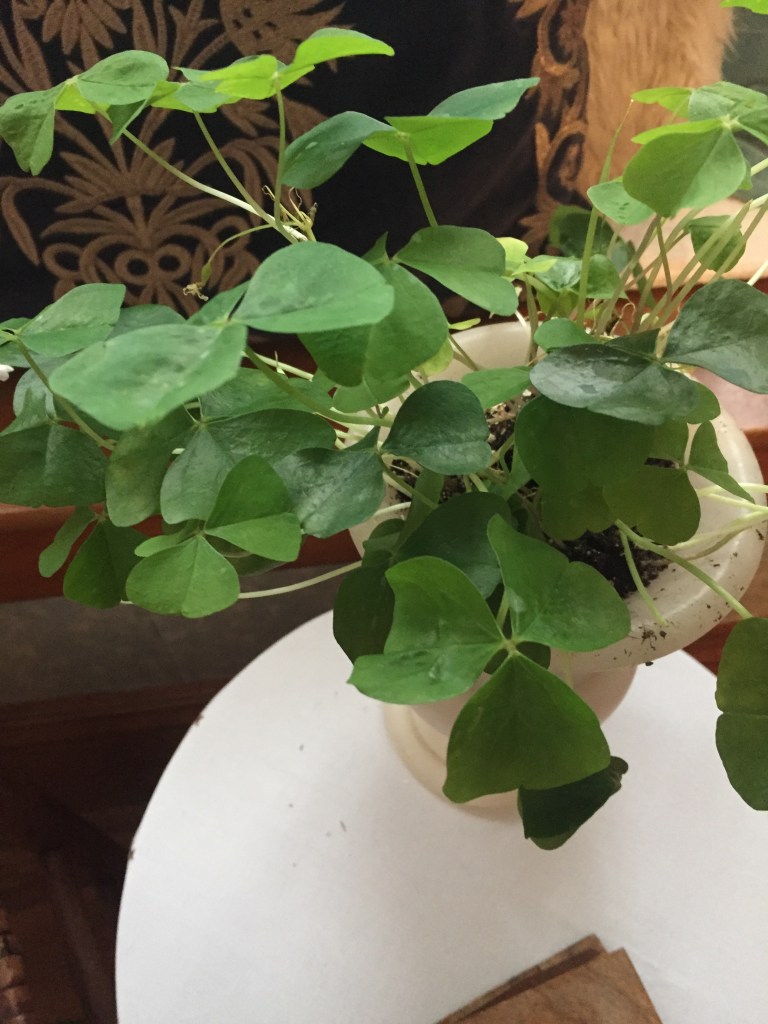
The shamrock is also a symbol of luck. However, there is no agreement on what a shamrock is. It could be the clover that grows everywhere on Irish soil — and a true indication of wealth since this nitrogen-fixer creates the best grazing land and therefore the healthiest herds. This modest plant is probably what St Patrick used to describe the Trinity, though there was little need to explain a triple deity to the Irish. (The greater difficulties probably lay in convincing them that this new supreme being was male — and shared with… foreigners… where’s the advantage in that!) The clover is also the “white” that Guinevere, which means “white track”, trailed behind her wherever her feet touched the soil. This was the magical fairy plant that bees favored and turned into the sweetest honey — which could be brewed into mead. But the clover that we most often associate with good luck is one with four lobes, not three. I’ve seen some folks say this is specifically Ireland, being a map of the four outer provinces (the lobes) and Meath at its center (the ring that forms when you hold all four lobes together). It may also just be the rarity. There is only a 1 in 10,000 chance of finding a four-leaf clover — though some of us are very good at it and seem to beat those odds. (I have so many pressed four-leafed clovers squirreled away in my library that I’ve stopped picking them.) There are many other plants native to the British Isles that have three-lobed leaves. Wood sorrel is my favorite of the other contenders for shamrock-hood. It has the classic clover shape, but it is a large and airy plant with delicate pale yellow or white blossoms. It looks like a fairy plant, with its tubular flowers and acid green or purple leaves.
As another illustration of double-edged intent, “shamrock-tea” does not mean an excellent cuppa. It is another slur, the poor-man’s pot. Its weak and watery flavor comes from steeping no more than three leaves.
From the Book Cellar
Tomie dePaola was half Irish. He left behind a number of picture books on Irish legends and life. He produced one of the most beautiful picture books on St Patrick, which also is surprisingly informative. Apparently, he was under duress from his Irish mother to “remember the Irish patron saint with a book”. He must have made her happy with Patrick: Patron Saint of Ireland (1992, Holiday House).
The other books I’ve chosen for today are all about leprechauns. Admittedly, this has nothing to do with St Patrick, but they are all wonderful glimpses at Irish culture — and that actually is part of this day.
— Leprechauns Never Lie by Lorna & Lecia Balian. (My copy is a reprint of the 1980 classic put out by Star Bright Books in 2004.)
— Fiona’s Luck by Teresa Bateman, illustrated by Kelly Murphy (2007, Charlesbridge).
— That’s What Leprechauns Do by Eve Bunting, illustrated by Emily Arnold McCully (2005, Clarion Books).
— The Leprechaun’s Gold by Pamela Duncan Edwards, illustrated by Henry Cole (2004, Katherine Tegen Books).
— Too Many Leprechauns: Or How the Pot of Gold Got to the End of the Rainbow by Stephen Krensky, illustrated by Dan Andreasen (2007, Simon & Schuster Books for Young Readers).
— Tim O’Toole and the Wee Folk by Gerald McDermott (1990, Viking Penguin).
©Elizabeth Anker 2025

 By My Solitary Hearth
I am glad spring is on its way at last.
LikeLike