

Today is the last Monday before Easter. Many spring traditions have migrated to this holiday, including the name of the holiday, which has nothing to do with the Christian story. (Though what is does mean is a subject of debate.) Today it is traditional to bake simnel cake for Easter morning. Simnel cake is a moist fruit cake that involves elaborate frosting in marzipan. It originally started out as a recipe made for Mothering Sunday, but these days simnel cake is eaten throughout the spring. Here is a really good recipe from Nigella Lawson. (I don’t do heavy sugar recipes…)
Today is also the traditional opening of the summer sailing season in ancient Nordic cultures. Called Summersblot, this is when the North Sea is finally free enough of ice for navigation. It was also a good time to plant spring grains, so the farmers also celebrated this holiday. These days it is a good day to plant potatoes, though I tend to wait for the New England weather markers. Plant potatoes when the dandelions are blooming. Which is not this day…
For me, this is when the season of Beltaine begins. The Greenleaf Moon is just past the full. The days are over thirteen hours long. There is more rain than snow (finally…), and it is possible to dig in the soil. This is when the Cuckoo Fairs begin to pop up in traditional Anglo and Celtic regions. People will traipse about trying to hear the first cuckoo call, a marker of summer. With all the traipsing, there are needs for snacks and ale. It is a perfect opportunity to trade surplus for coins. So market fairs crop up in the wake of the cuckoo trackers all up and down England.
Of course, if anybody were to start a New England tradition, I would be delighted!
Spring Eggs

It is time for regeneration. Nests of new life in satiny shells — white, blue, green, pink, yellow, speckled, mottled, striped and solid. No doubt our urge to paint chicken eggs for the late spring holidays is inspired by the wondrous works of art in every nest. And it’s also not surprising that humans have come to focus on eggs as the symbol of renewal. In stories across time and around the world, the egg betokens spring, creation, new life.
Yes, indeed, eggs are new life. But perhaps more importantly to our pragmatic ancestors, eggs show up in abundance at a time of year when there are few other ready sources of food. And eggs are wonderfully nutritious. One egg has only 75 calories; but it contains 7 grams of high-quality protein, 5 grams of fat with only 1.6 grams of saturated fat, plus iron, vitamins, minerals, and carotenoids. Egg yolks are loaded with disease-fighting nutrients like lutein and zeaxanthin. These carotenoids help slow age-related macular degeneration, the leading cause of blindness in older adults. Further, choline from eggs may enhance brain development and memory. And best of all, eggs fill you up. Eat a bowl of cereal with toast, and you’re peckish before lunch. Eat a two-egg breakfast burrito, and you don’t get hungry until the end of the day. If then…
Natural Dye for Eggs
Once again, I decided not to dye eggs this year. Maybe I’ll do it on Easter Sunday. Maybe not. There’s really no need in my solitary household, though I find it pleasurable in a mad scientist kind of way. Maybe not a good enough reason to use eggs unless I plan on eating them. I do like a good egg salad sandwich, made with my spicy hot dill relish and a bit of yogurt. MMMmmmm! However, I fear that the natural dyes make them taste gross. The turmeric recipe in particular is liable to make disgusting hard boiled eggs. It does not smell nice.
Because these are largely left sitting out, you may want to use very fresh eggs — as in “straight from the hen” — or just forego eating them. Though they are cooked and kept underwater and mostly soaking in astringent plant materials, I’m not sure that grocery store eggs will still be food-safe after 6 hours of neither boiling nor refrigeration. However, if you have a friend with hens, the birds are probably laying heavily by now and your friend might thank you for taking the surplus eggs. (Though they also might be seriously considering selling to the local market in these egg-strapped times…)
Caveats aside, for those of you with young kids, egg-dyeing is probably not optional, and the point is not to eat the egg but to have fun with your kids. And natural dyes are great fun! If also messy. This project stays in the kitchen where spills can be wiped up quickly before the dyes discolor your floors, porous countertops, and clothing. Also drape the kiddies in artist smocks, aprons or some other protection. I think a lab coat is perfectly appropriate if you have it.
There are many ways you can used your dyed eggs for more fun. Of course, there is the egg hunt. Leave the basket of bright eggs in the fridge on the eve of Easter Sunday — for the Bunny to hide in the early morning hours (this involved actual cloaks in my household… no daggers…) — and let the kids dash about first thing in the morning. My advice is to keep the egg hung mostly about the eggs. Leave the chocolate in the Easter basket (which should also mysteriously materialize in the morning). Chocolate is not only wrapped in paper or foil and susceptible to turning into a pile of goo in the morning sun and dew, but it is also poisonous to most other animals. And your dog will find the Bunny droppings before your pre-schooler.
There are also many traditional games played with eggs. Egg rolling is goofy fun. Roll an egg down the hill. The one that travels the furthest intact wins, but every egg that reaches the end of its journey without cracking will bring good luck throughout the year. Egg clapping is a strange form of ambulatory begging in which kids go door-to-door banging wooden clappers and singing carols to get colored eggs for their baskets. (I am sure there is chocolate involved these days.) Egg tossing usually uses raw eggs. The goal is to pair up and gently toss an egg back and forth with your partner. The pair that can toss the furthest distance wins. This is another activity that requires protective lab coats… or boil the eggs for less mess… though the mess is the point. Other strange egg games include knocking boiled eggs against an opponent’s egg to see which egg can withstand the most abuse before breaking, and egg passing races where teams move an egg down a line without breaking it, but also without using the hands. A particularly fun one is passing the egg between spoons. The team that gets a whole egg to the finish line first wins. (Often more chocolate…)
There are also very old traditions that invoke the egg’s fertility in charms for protection and abundance. Bury a dyed or painted egg in the foundations of your new home, especially for a newly married couple, and your home is protected from all manner of natural disasters and dearth. The more beautiful the egg, the stronger the charm. Similarly, bury a red egg in your garden or newly plowed field and you will have a good harvest. Or place a dyed egg in livestock feed and your animals will be healthy and productive. There is some merit to these latter two. Including crushed whole eggs in animal feed provides your critters with the same benefits that it brings to your body, and ground eggshell is a great soil additive. But maybe skip the dye. (However, this is perhaps the best use for eggs dyed in turmeric…)
So, here are my simple, natural recipes from 2022. (And here are the not as simple recipes from 2021.)
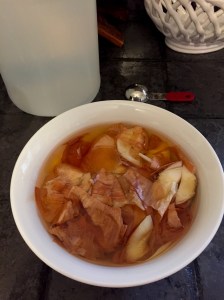
tangerine

pale blue
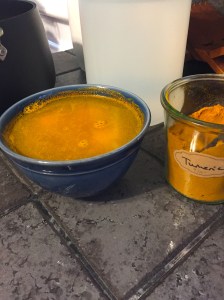
antique gold

bubbly purple
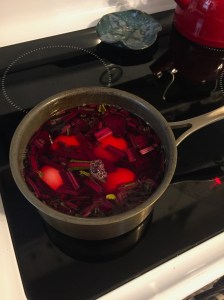
dusty rose
soft taupe
For these recipes, I cooked all the eggs before dyeing them because I decided I didn’t want to simmer most of the recipes. In New England, it’s too cold at this time of the year to open up the house, and the smell is rather too much. I put all the dyes that didn’t simmer in heat-proof bowls in the oven on the warm setting. Not enough heat to cook anything, but enough to keep the reactions going. Or that was the thought anyway.
For the onion peel and red cabbage dyes, I chopped and slightly crushed the plant materials. I put them each in a pot with 3 Tbs distilled white vinegar (for mordant) and enough water to cover the stuff (about 4 cups). I brought each pot to a low boil and immediately poured this warm mixture over 4 eggs in heat-safe bowls and placed these bowls in the warm oven.
For the turmeric dye, I put 4 eggs in a heat-proof bowl. I added 2 cups of hot tap water, 1 tsp of turmeric and 3 Tbs vinegar. This is the one that really doesn’t smell good, so I covered this bowl before putting it in the warm oven.
For the cranberry dye, I warmed about a half cup of leftover cranberry sauce (from the back of the freezer where one typically finds this sort of thing). I didn’t know if the acid in the sauce would be enough to fix the dye, so I added an additional 3 Tbs vinegar. I also added about 2 cups of hot tap water to make enough liquid to submerse 4 eggs in a small heat-proof bowl. This went in the warm oven.
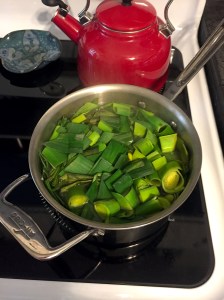
For the beet and leek dyes, I chopped and slightly crushed the plant materials. I put them each in a pot with 4 eggs and 3 Tbs vinegar. I covered all with water, brought the pots to a low boil, and then simmered the eggs.
I left it all to soak up as much dye as possible. About 6 hours. They turned out fantastic!

Here are some other ideas for dye materials, though most of these require more setting time and probably should not be eaten. Pasqueflowers, which as their name implies ought to be in bloom by Easter (the Paschal season), make a lovely bright green. Furze or broom or St John’s wort all make a lemony yellow, compared to the more orangey yellow of the onion skins and the gold tones of turmeric. Dyer’s marguerite also makes a lovely pale yellow. Dandelions can make everything from minty spring green (the leaves) to rusty brown (the roots) to sunny banana yellow (the pollen-laden flowers). Blueberries and all their kin make a bright blue, while the best natural purple comes from combining blueberries with cranberries or raspberries. And strawberries make a lovely rosy-pink. Of course, this means you don’t get to eat the berries… which is asking a bit too much of me…

Here is a great description of the art of pysanky: Pysanky: Ukrainian Easter Egg
And here’s a story based on Eric Kimmel’s popular children’s tale on the origins of pysanky and hares.
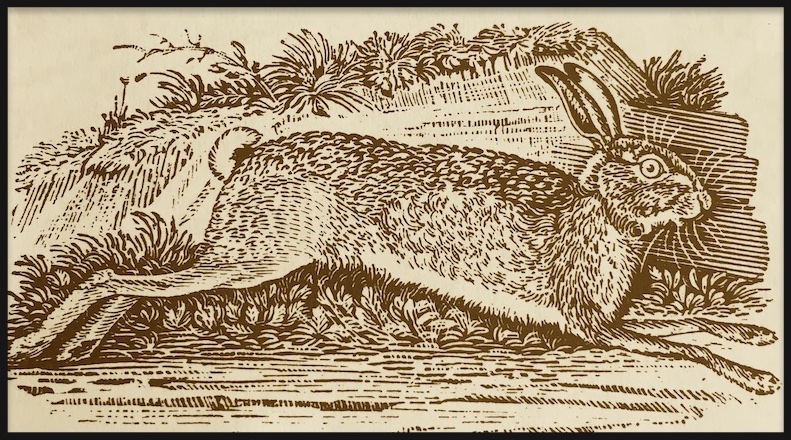
The Hares and the Eggs
The Goddess of the Dawn Light, Eostre, was walking the woods one fine spring morning. Shy woodland blooms nodded at her feet and birches unfurled their leaves at her passing. The sun warmed the earth and a soft southern breeze trailed in her wake. The air around her smelled of hyacinth and apple blossom and rain on dry earth. Wherever she smiled, petals opened like stars over pillowy tufts of dark moss.
Suddenly, the song of the wood thrush pierced the morning air. Eostre stopped to listen to the haunting melody. Its sadness drew a tear down her cheek and a sigh from her throat. The bird, seeing her there beneath him, flew down to her.
“Oh my mistress,” he cried. “Oh lady! Woe has befallen me,” he said.
“But what is it, little brother?” she replied.
“My darling, my wife, she was tossed from our home by the night wind. Her wings and back broken, her beautiful eyes darkened. Oh, that I could die with her!” he wailed.
“But, little brother, if you are gone, who will sing?” she asked.
“I can sing no more if my darling is gone,” he replied.
“Where is your wife?” the lady asked.
The thrush fluttered down to the base of an oak where the broken body of his wife lay upon a bed of moss. Eostre kneeled down and cradled the small creature in her palm. There was a faint heartbeat; the thrush’s wife was not yet gone.
Eostre smoothed the tangled feathers and breathed upon the bird. At this the thrush-wife awoke in agitation.
“Still, still, little sister,” cooed Eostre as she laid the small body back into the mosses. And the thrush-wife calmed, but her breath was harsh with pain.
“Oh, my lady!” exclaimed the thrush when he saw his wife awakened. “Oh, my darling!” he cried and took off into the morning air, singing in happiness. But his wife could not join him in flight. She watched as he sang out in triumph, knowing that his song would soon fail.
“I am still broken,” she whispered to Eostre. And the goddess nodded. The delicate wing bones would not mend even under her ministrations.
“Yes, little sister, you are still broken. I fear you will not fly again,” said the goddess.
“But how am I to get food? Or water? How am I to flee sharp tooth and claw?” The thrush-wife’s panicked agitation drew her husband’s notice, and he flew down to her side.
“What are we to do?” he asked. “For I can not leave her so.”
The goddess considered their plight.
“It is true I can not make your wings to fly again,” she began, “but your legs are still strong.”
“What of that!” spluttered the thrush. “She can hardly walk from hungry jaws, and our nest is far above us.”
Eostre frowned and the bird became silent again.
“Yes, she will not fly. But,” she continued, “I will do what I can to give you both a new life.”
So saying, she thought hard on the small creatures. Strong legs and earth-bound lives, she mused, fleet-footed, cloaked from predator eyes. And the two small brown bodies began to stretch. Skinny legs became muscled and strong. Wings folded in and grew padded paws. Feathers changed to fur and beaks changed to sharp teeth. Ears elongated and tails dwindled.
She did not change their color; they remained warm brown bodies with mottled white breasts. And she did not change their round eyes, so quick to see and to perceive. But when Eostre was done, two hares lay at her feet.
The wife looked down at her body and stretched her powerful legs and smiled. The husband leapt into the air and cried out in happiness. They both danced around the goddess, thanking her for the transformation. And then, as hares will in spring, they hastened off to make a new home in the briars.
Eostre smiled and walked on.
Some months later Eostre chanced to be back in that same wood, and she came to the place where she had turned thrushes into hares. And there they still lived.
They came out to her and they, all three, danced about in the light of the setting moon. But when the dawn was painting the leaves golden and pink, they tired of the dance and sat together.
Suddenly the husband shook himself and declared, “But my lady, we never thanked you properly for giving us the gift of new life. We would like to give you a gift in return.”
Eostre shook her head. “There is no need.”
“Of course,” said the wife in her gentle way. “But we should like to in any case.”
Eostre smiled and inclined her head. The husband bounded into the briars and then returned more slowly, carrying a smooth blue egg.
“But what is this?” exclaimed the goddess.
“It is our thank you gift,” replied the couple with some uncertainty.
“But where did you get it?” she asked.
“It is ours,” answered the wife. Seeing perplexity in Eostre’s eyes, the hare went on, “When you changed me, I was about to lay. The eggs inside did not change. This is one.”
The goddess blinked in surprise. “But then how do you bear children?”
“Oh, the same as any hare,” replied the husband with a chuckle.
“This is my last clutch, my lady,” said the wife. “Take it in memory of us.”
Eostre gazed down at the miraculous egg. Its satiny shell glowed like turquoise in the morning light. It was perfect, a bit of cool sky resting in her warm palm. A symbol of hope and renewal and new life. And Eostre had an idea.
She bent down and explained her wishes to the couple and they agreed readily.
“It should happen when the light of day overtakes the dark of night,” the goddess said, and they nodded in assent.
Suddenly, all about them, there were eggs of all the colors of the rainbow, all patterns, all sizes. All beautiful!
The hares set about gathering them together and carrying them back to the briar den. But the goddess picked up the blue egg. “This one I shall keep,” she said with a smile.
And from that day to this, a hare rouses himself on Eostre’s day and follows the goddess through the pale morning, leaving eggs, symbols of new life, for all who are clever enough to find them.
From the Book Cellar
For detailed instructions on egg decorating and the Ukrainian tradition of making pysanky, read Pauline Campanelli’s Ancient Ways (1991, Llewellyn Publications) and Wheel of the Year (1989, Llewellyn Publications).
Eric Kimmel’s book on the origins of pysanky is The Bird’s Gift: A Ukrainian Easter Story (1999, Holiday House). I’m not sure if this story existed before Kimmel wrote it. He seems to say this is a folk tale that existed before his books, but I can find no evidence for it in my wealth of Russian and Eastern European folklore. I took the themes from the story and made a more earth-based version.
Two wonderful picture books on eggs are An Egg Is Quiet (Dianna Hutts Aston, illustrated by Sylvia Long, 2006, Chronicle Books) and Rachenka’s Eggs (Patricia Polacco, 1988, Philomel Books). The first is the best gift you could buy for a budding naturalist and bird watcher. The second is a gorgeous tale of painted eggs and a magical goose, featuring Polacco’s wonderful Babushka, the grandmother we all want. (Or want to be…)
There are dozens of picture books on rabbits and hares. Beatrice Potter alone can fill a bookcase, and one of my favorite children’s book characters is Rabbit from the Winnie the Pooh books. (He’s only topped by Eeyore…) But there are two unusually lovely books featuring bunnies that I recommend regularly. Ten Little Rabbits (Virginia Grossman, 1991, Chronicle Books) is, as one might expect, a counting book but set in the desert Southwest and featuring delicious art (again, the inimitable Sylvia Long). Then there is the classic tale of the Easter Bunny by DuBose Heyward, The Country Bunny and the Little Gold Shoes (1939, Houghton Mifflin Harcourt) illustrated by Marjorie Flack. Heyward is better known as the author of the novel, Porgy, which was adapted into George Gershwin’s operatic masterpiece, Porgy and Bess. The Country Bunny is surprisingly feminist and anti-racist, not merely for its time, but even compared to contemporary children’s literature.
©Elizabeth Anker 2025

 By My Solitary Hearth
The dyed eggs look lovely! I also enjoyed the story very much.
LikeLiked by 1 person