

Summer Solstice
Today is the solstice; today, the sun stands still. Well, actually, it’s been standing still for a few days now, and it will continue to do so for a few more days. In my part of the world, from 16 June to 24 June, day length is 15 hours, 30 minutes, and a handful of seconds. The longest day of 2025 is today, June 20th; but today is only 3 seconds longer than yesterday and tomorrow is less than a second shorter. Not much of a change. Not one that I notice, anyway. The day’s routine definitely feels stationary at this time of year.
The earliest dawn has already come and gone. The sun began rising at 5:05am on the 12th; it rose one minute later on the 18th, and one minute more will be added on the 23rd. The latest sunsets begin tonight. The sun drops below the western horizon today at 8:37pm and will continue to do so until July. It sticks there until on July 3rd it sets one minute earlier. If you are particular about such things and count seconds, the actual earliest sunrise fell on 14 June and the latest sunset will be 26 June. But you’d be hard pressed to note the differences unless you have a very flat horizon and a clock with a seconds hand.

And that is sort of the point of all this time-noting. Around this time of year, there is no day that feels substantially longer than any others, and that’s because the solstice does not mark a day that is substantially longer than any others. The summer solstice marks not the day length, but the sun’s furthest poleward point on the horizon. This year that happens at 10:42pm, long after sunset in my part of the world. But even if we have the time to note the time, the actual solstice is really not that gripping an event. It is passed before you can give it due consideration. It is a point in time, not substantial enough to even be called a moment.
But Midsummer, itself, is a season, not a point, not a second, not a moment. It is a long strand of moments, weeks of the sun rising and setting at about the same time and about the same place on the horizon, day after day after day. There are many long days and short nights to celebrate, many opportunities to salute the sun. And the day of the solstice isn’t even the best when considered from a cultural perspective. The actual point of the solstice may be a moment, but it is a moment that varies from year to year and, as such, is rather difficult to plan around. It is simply impossible to observe with any ceremony, ceremonies being longer than moments.
However, the historical holiday of Midsummer happens each year on June 24th, the whole day, coming a few days after the solstice moment but still well within the season of sun standing still. It is a fixed day that can be anticipated and celebrated every year at the same time, created specifically for this celebration. This is when A Midsummer’s Night Dream takes place, on the Eve of St John’s Day, Midsummer’s Night. This is when I salute the sun, usually from my garden. I don’t light bonfires because I live in town and don’t have the space to burn things safely. But it must be said that I am in a decided minority in my town, and a bonfire might be unwelcome just because it’s weird. Most people will go to work and grumble about the heat and come home to watch screens and not think about time or faeries or the marvels of this world or much of anything else. Few know that Midsummer is a holiday, a day that used to be set aside as holy, sanctified time, time out of time, a day for paying attention to things bigger than humans. For that matter, few people set aside any time at all for holy-days, never mind in the middle of the vaunted work week. If I were to light a fire on a Tuesday, someone would call the fire department.

Though few people today remember that there is a holiday called Midsummer, this was once the merriest and most common celebration of the yearly round. Everyone celebrated Midsummer until quite recently — the bonfires and feasts were still going strong in Shakespeare’s day. Well-dressing and pageantry of all sorts were ubiquitous. For millennia there were gatherings around ancient stone circles and other public works projects to watch as the sun would shoot daggers into the earth. And even though not many people will note the day today, everywhere throughout time, there are feelings of trepidation and relief as the longest day turns night.
Humans have been saluting the sun at this time of the year for as long as we’ve been humans. Probably longer. Even in these darkened days, sun salutations can still be found if you have a great guide book (or the internet…) But, up until modern times, you didn’t have to search. There were celebrations everywhere. You would be considered odd if you went about your mundane ways and did not join in the merriment. Young and old, rich and poor, city folk and pagans, all would stay awake to watch the sun rise after the shortest night.
Many of the most ancient relics of human culture relate to time-keeping and noting the lunar and solar events that keep time. Most early public construction projects like Stonehenge, Newgrange, and pyramids worldwide are oriented to catch and direct light of sun, moon and stars at the equinoxes and solstices, often in stunningly complex fashion. Our ancestors felt the need to erect these amazing structures, laboring communally over generations, centuries, to honor our magnificent star.
In that light, perhaps I should not feel so very unusual in my desire to salute the Midsummer sun. My ancestors would understand this profound entanglement, connection, communion, this need to feel kinship with the sun, the stars, the rivers, the stones, the wolves and winds and bears and bees and birds. They would know the swelling in my heart at the dawn chorus and the bone-deep calm that descends with the trilling of the resident catbird in the dusky purple light. They too would talk with trees and sing with raindrops and dance with meadow grasses. They would understand me, know me, feel me. I would not be so very unusual.
I would not be unusual, but many of the humans I’ve known would be. This whole culture would be an aberration. It is an aberration. It has never existed before and likely will never exist again. The rampant dualism, the transcendentalism that places human habitation outside and above this living world, the hierarchies and divisions between human and all else, the sheer hubris of humans in denying vibrancy and agency and personhood to any other state of being — none of that would be comprehensible to our ancestors. And not because they were so simplistic that they could not understand modern concepts. They would simply not understand why any thinking human would believe such apparent unreality.
And why would you want to? How could you be so willfully blind as to hold such nonsensical ideas? How could you live a life in such alienation and isolation and rejection? How could you not feel the sun on your cheek and know that for a caress from a living, loving, caring universe? How could you not feel kinship? How could you not pause in your summer work and salute the passing of time and the sun that marks that passage?
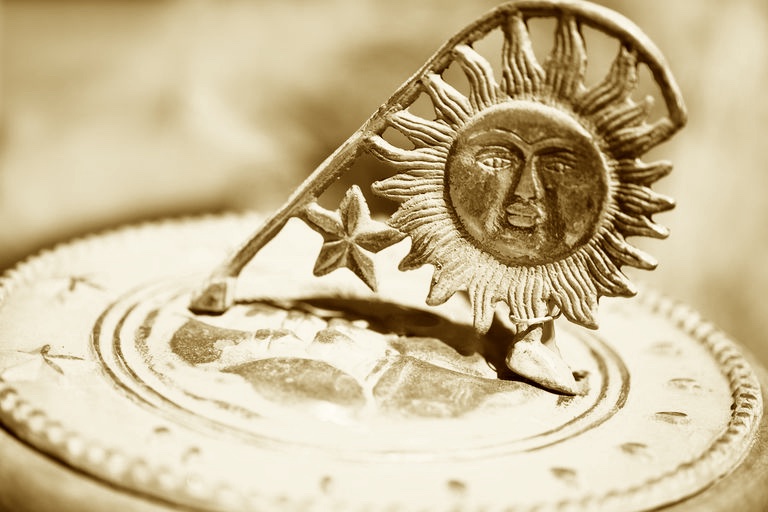
It is my hope that we do not have many more summer solstices that pass largely unheralded as this one will today. It is my belief that this aberrant time without celebratory time will, indeed, pass and there will be common holy days again. But for now I am content to salute the sun and then sit in my garden. Maybe that’s all I need of ritual anyway. And maybe soon… maybe soon there will be bonfires again. Maybe even a bit of faerie mayhem… Enough to wake us all up and make us all alive to this world.
©Elizabeth Anker 2025


I see – more than feel – the weak, wintery sun shining through my study window while the tips of my fingers freeze on the keyboard. I enjoy the astronomical passing of the seasons: a link to our very beginnng.
LikeLiked by 1 person