


February First Fruits & Quirinalia
To highlight just how different the seasonal cycle is depending on latitude, mid-February, the last ides of the ritual year in Rome, was a festival of the first-fruit offerings. While here in Vermont we are barely thinking about the growing season, never mind able to see actual earth, during the Roman-era Parentalia, the first grains to be harvested were tied into sheaves or baked into coarse breads and offered to Ceres, the Roman equivalent of Demeter. This was such an essential obligation for all households that entry into the temples had to be scheduled by neighborhood — the curiae, part tax-district, part family bloodline — one day for each curia.
However, bureaucracy being what it is, through time, many people fell into the edge spaces, not knowing to what curia they properly belonged. For those households who could not determine their place, there was Quirinalia, beginning at sundown on 16 February, also known as the Feast of Fools because these people did not know who they were and how they related to social structures. On Quirinalia, the edge folks brought their offerings to Ceres and therefore at least made themselves right by the goddess of growth and harvest.

Ceres is the deity that is honored in this festival, however it is named for Quirinus, the deity that Rome’s founder Romulus became when he was snatched up from the Earth in a sudden thunderstorm (presumably by Jupiter). Quirinus is a god of war. Romulus, himself, was a son of Mars, the ancient deity of agriculture turned war-god. Quirinus dispensed with the seedy roots of Mars and represented the martial power of Rome with none of the older ties to the Earth. Still… the festival of Quirinus was ritually marked with offerings of food to Ceres.
For those who like roots… the etymology of Quirinus is particularly juicy. Here is what Wikipedia says on the subject:
The name Quirīnus probably stems from Latin quirīs, the name of Roman citizens in their peacetime function. Since both quirīs and Quirīnus are connected with Sabellic immigrants into Rome in ancient legends, it may be a loanword. The meaning "wielder of the spear" (Sabine quiris, 'spear', cf. Janus Quirinus), or a derivation from the Sabine town of Cures, have been proposed by Ovid in his Fasti 2.477-480.

Some scholars have interpreted the name as a contraction of *Co-Virīnus (originally the protector of the community, cf. cūria < *co-viria), descending from an earlier *Co-Wironos, itself from the Proto-Indo-European noun *wihₓrós ("man"). Linguist Michiel de Vaan argues that this etymology "is not credible phonetically and not very compelling semantically."
Michiel de Vaan’s expert opinion notwithstanding, one can see a clear folk etymology between the name of Rome’s founding deity, Quirinus, and the concept of bloodline and proper belonging, curiae. This belonging was more than simply relation to humans; it was bound up with the soil of the place where a family was rooted. So while Quirinus seems to be purely a man of war made immortal, he has strong ties to the land, to food, to nourishment and to physical roots. To life.
I often wonder who average Romans were honoring — especially those whose convoluted history had severed them from ancestral homelands, those who made their first fruit offerings on Quirinalia — the god who protected through military might or the god who preserved through the plow? It must at least have been satisfyingly delicious irony for all those who spent their days toiling to feed the Roman military machine that the progenitor of the empire had such a double-edged name.
Many lessons in there for this latter-day empire, don’t you think?
It’s pancake season! Yesterday was Pancake Sunday in places such as Brittany and Wales and New World communities of Bretons and Welsh. Tomorrow is Mardi Gras for the Roman Catholic faithful. And Mardi Gras means pancakes…
Ok, not really… Mardi Gras actually means Fat Tuesday, or more precisely, Fat Mars-day. The Romans dedicated the second day of the week to the planet named for their war god, Mars. The closest Norse equivalent to Mars was Tyr, or Tiw. Hence it became Tuesday in English and Mardi Gras translates into Fat Tuesday.
The “Tuesday” is important because this is the day before Ash Wednesday, the first day of Lent, however it’s the “fat” that is more significant. This is the day that all the fat needed to be used up before the Lenten fast. A traditional recipe for using up that fat is pancakes. Hence all the pancake suppers on Mardi Gras. Though it must be said that pancakes are eaten right through Lent and probably predate Mardi Gras. So… it’s pancake season!
Christians fast in Lent, beginning on Ash Wednesday, the morning after Mardi Gras. Not everyone follows the same dietary restrictions, but it was and still is common to give up meat and the fat that comes with it. Of course, there was not much meat to give up at this time of year for traditional cultures living in northern climates. So there may have been an element of making a virtue out of necessity. But the result of giving fat up for the six weeks of Lent is that what was in the pantry on Fat Tuesday had to be used up or it would go rancid.
There are many ways to use a large quantity of lard in one day, but there is one recipe that people turn to again and again — pancakes! In fact, eating griddle cakes in the spring may predate Lent. For example, in Scotland oatcakes have long been associated with Candlemas and seem to derive from the holiday’s agricultural traditions, not Christianity. Even today, pancakes and other fried dough disks are eaten with abandon at this time of year without any reference to the Lenten fast — though the best community pancake suppers happen on Fat Tuesday. And in New England Fat Tuesday often coincides with the perfect complement to pancakes — the first boilings of fresh maple syrup.
This year we’re still deep in winter, though the weather forecast seems to be moving toward the freeze-thaw cycle maple trees need to start the sap pumping. So it’s coming, just not this week. So this Mardi Gras, I decided to make a pancake that goes well with honey — blue corn pancakes. In fact, in New Mexico, where this recipe is a favorite, it is more traditional to drizzle a herb honey on the short stack.
I made a pile of these yesterday that will last me most of the week, which is the traditional way to make pancakes wherever you are.

Blue Corn Pancakes
Ingredients
1.5 cups blue corn masa (available here)
1.5 cups coarsely ground pecans
4 Tbs sugar
1 tsp salt
1 tsp rubbed sage
1.5 cups boiling water
4 beaten eggs
1 cup yogurt
4 Tbs melted butter

1.5 cups all-purpose flour
4 tsp baking powder
1.5 cups dried cranberries (craisins)
          (optional: can use any dried fruit or none)
Instructions
If you need to grind the pecans, first chop them a bit. Then, put the pieces between two sheets of parchment or wax paper and run a rolling pin over them. You’ll want a mix of meal and small chunks.
In a large bowl, combine the masa, pecans, sugar, salt and sage. Mix in the boiling water, then cover the bowl and set aside for 15 minutes so the masa can soak.
Melt 4 Tbs of butter however you normally do that. Let it cool slightly before adding it to the other ingredients.
In a small bowl, beat four eggs.
Add the yogurt to the eggs and blend well.
Pouring in a thin stream and stirring vigorously, add the melted butter to the egg mix. Set this aside.
In another small bowl, mix the flour and baking powder. Then add the craisins (or other dried fruit) and blend until the fruit is coated in flour.
When the masa mixture is done soaking (and, really, this can go for as long as you want… I sometimes start masa the night before and let it soak overnight in the fridge… the object is a somewhat mushy texture), add the egg mixture and the flour mixture alternately, blending well.
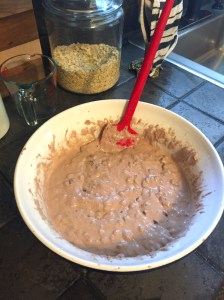
You will very likely need to add more liquid to make this into a batter. I don’t bother measuring, but I think it’s upward of 2 cups of either milk or water. I use water. But if you don’t have New England acid water, then use milk or something that has enough acid in it to react with the baking powder. You want a liquid batter so that it will spread in the pan.
A note on that… this recipe does not flow as well as flour batter sans nuts. So you probably will not get photo-ready round pancakes, and that’s fine.
This batter also takes longer to cook. So you don’t want the pan or skillet quite as hot as flour recipes, or the pancakes will burn on the outside before cooking the inside.
Place a heat-resistant platter in the oven and set the oven to its lowest temperature.
Heat up a medium fry pan or iron skillet over medium-high heat spread evenly over the bottom of the pan. A drop of water should dance around the pan when the pan is hot enough.
Use a bit of butter or oil to keep the masa from sticking, though a well-seasoned iron skillet will probably not cause much sticking. (That being the point of seasoning it…)
Ladle about a quarter cup of batter on the skillet, smoothing the batter into a rough disk. (Ish…)
I can get two pancakes in my pan. You might have a larger skillet. But whatever you are using, leave plenty of room between the pancakes so you can flip them without one landing on top of the other.
As with all pancake recipes, cook on the first side until the batter becomes bubbly. Then flip and cook the other side.
Because this takes longer, you may flip them back and forth a couple times to make sure they are fully cooked inside without scorching the surface.
As each pancake is done, place it on the platter in the oven to keep it warm.
Or you can just hand them out to passing folks to eat hot off the griddle…
But if you’re serving them for a meal, stack them on a plate and drizzle with a bit of honey. Maple syrup works well also… but real maple syrup. There is something in the knock-offs that does not go well with masa. It tastes chemical…
I usually add a bit of fruit on top. I like craisins, and they help my body process the sugar, so I drop a palmful of craisins on top. But you can use whatever you like.
Another excellent topper for this recipe is pumpkin butter. The masa and the pumpkin are two of the Three Sisters in traditional Native American companion gardens and the meals that flow from those gardens. If you’re going to use pumpkin butter (and this will probably be more of an autumn recipe than early spring), then add a quarter teaspoon of mace and a pinch of ground clove to the pancake batter. (Trust me…)
Like most corn recipes, these pancakes are best freshly made. Masa tends to get stiff in the fridge. If that happens, heat the pancakes in the oven. I’ve even been known to pop them in the toaster.
You can freeze these pancakes. They last for quite a while. I’ve never had to test that because they always get eaten quickly in this house…
This recipe makes about 20 pancakes, quite enough for 4-5 hungry people.
©Elizabeth Anker 2026

 By My Solitary Hearth
Yay! It’s pancake time again. I’m hungry.
LikeLiked by 1 person