

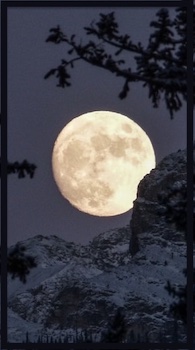
The Wolf Moon went dark yesterday at 7:01am. Both Mardi Gras and Chinese New Year, with all their riotous color and spark, took place last night. Today, the Snow Moon, the fourth moon in my lunar year, is new. In my calendar, this is the season of Early Spring, the long wait of Lent, the thawing of winter and the first signs of the renewal of the green world.
In many cultures, this moon is called the Hunger Moon. Because it is full between 9 February and 9 March, there is not always snow, even in Vermont, but there is always hunger, in both belly and mind. In most of the northern world, it is time to tighten the belt, take stock. If you’ve planned well, you still have half of the food you stored from the harvest. If not, well, you need to eat less now and plan better for next year.
There is also hunger for the vigor of spring. This time of year many of us become restless, wanting to be more, do more. Luckily the Snow Moon and the season of Early Spring are traditional times to clean and cleanse. Get out those rubber gloves and give your home a good scrubbing. Start that exercise plan and get your health back. Stop making lists and plans and start putting them into action. It also is time to donate, repurpose and recycle what is no longer useful in your life. But getting rid of the overburden is not as easy as it sounds. In fact, it can be downright impossible to responsibly dispose of some waste. So this is also a good time to consider ways to eliminate waste altogether. Investigate ways to live abundantly without generating waste. (Pro-tip: this largely involves getting the plastic and superfluous electronica out of your life…)
This year, the Snow Moon is so late that it will only be at its first quarter on February 24th, St Matthias’ Day. This is the day when Winter’s back is broken in traditional lore. If there is ice, it is no longer trustworthy after St Matthias’ Day. This is also when the Cailleach, the Celtic crone, finally gives in, climbs the nearest mountain, and turns herself into stone until the days begin to shorten once again. In some stories, she has imprisoned Brigid, who escapes with her lover and is pursued by the frost-wielding hag all over the country. In other stories, the Cailleach and Brigid are one and the same, and this is the time when the hag of winter rejuvenates herself, becoming the maiden of spring.
In my garden calendar, I have scheduled the planting of the nightshades and basils for this weekend. I have a few tomato varieties to try, though I believe I will buy the main sauce tomatoes as plants from one of the local greenhouses. I would like them to have big developed roots by the time I plant out, and I just don’t have the space for large pots in my house. I will be planting many kinds of peppers, both hot and sweet. These don’t have to be as large by the late May plant-out date because they don’t need to grow as tall and bushy before producing fruit. There will also be a few eggplants, but I don’t put much effort into those nowadays. Eggplant is one of those vegetables that is a nice grace note on the summer, making delightful baba ghanoush and ratatouille. But I’ve had patchy luck with freezing it (it seems to suck up freezer flavors), and you can only eat so much of it at one time. So I stopped growing many plants and now just grow one or two.
The ancient Roman festival of Terminalia is observed on Monday, 23 February. This holiday marks the end of the Roman year and the end of winter. It was celebrated with public rituals at the boundary stones between adjacent lands. The boundaries were recognized and goodwill was fostered between neighbors with song and praise.
Next Sunday, March 1st, is the St David’s Day, the national day of Wales, a day to wear the leek and show your support of all things Cymri. It was also long celebrated as the new year in cultures descended from Rome. As such, it is a good time to celebrate new beginnings. This is also when I typically start thinking about spring in earnest. The last of Imbolg is put away and the symbols of Mid-Spring are set about. I sometimes start brassicas in small paper pots indoors on the weekend closest to March 1st. I will probably plant a flat of bok choi and lacinato kale this year.
On Tuesday, March 3rd, the Hunger Moon is full at 4:50am, bringing a total lunar eclipse to parts of the north Atlantic. In my part of the world, sunrise is as 6:23am, and the palest shimmers of astronomical twilight begin at 4:47am. So we might not get much of a glimpse of totality, though it will be high above the western horizon. So… maybe?
Still, central Vermont might not be moon-gazing on March 3rd. That is Town Meeting Day, and there are school mergers being discussed. This is not going to be a calm process. Nor will it end on March 3rd in most districts. In fact, two towns have already thrown down the gauntlet with early referenda that resulted in a flat refusal to consider closing their elementary schools and sending their kids to another community. I don’t blame them… but I also don’t know that we can keep all these very small schools open while costs are increasing and enrollment is decreasing (because fewer people are having fewer kids these days). It is a conundrum, one that is probably plaguing most of the country. We just get our hands messy with it here in Vermont, being a true participatory democracy.
St Piran’s Day, the national day of Cornwall, falls on Thursday, March 5th, along with the lesser known Navigation of Isis. A much older holiday on the opposite end of Europe, but both celebrating the same thing in a roundabout way — the opening of the sailing season.
On March 8th, daylight savings time begins at 2am. A good reason to stay in bed all day… But then you’d miss International Women’s Day. Also… the Old Farmer’s Almanac says that hummingbirds are first seen in the north around this time. They sensibly follow the sun in their time-keeping.
The last quarter of the Hunger Moon begins on Pennyloaf Day, March 11th. This is a great day for thinking about the hunger that we create with our disasters, especially war. Maybe find a way to donate bread to kids in conflict areas today.
St Patrick’s Day, which is the true equinox in my part of the world, is the last day before the Hunger Moon goes dark this year, which happens on the 18th at 9:23pm. Then the Sap Moon is new on the 19th, St Joseph’s Day; and the vernal equinox falls on the 20th at 10:45am.
So this Hunger Moon is going to carry us right into the middle of spring. Maple sugar season will begin here soon and may be done by the end of this lunation. Though it’s been a cold winter. It will take a while for the ground to thaw… so maybe it will be another late Frog Run. However, it is almost certainly true that we in central Vermont will finally see the soil again after all these months of snow-cover. The forecast for this week looks like there will be many days of melt temperatures, though there are also many days of falling snow. So we’ll see. Here’s hoping that we get to plant peas on St Patty’s Day like the old lore counsels.
In any case, spring is just around the corner!
Evening Skies
Tonight look for the crescent Moon. Mercury, at magnitude -0.6 brightness, will be shining nearby. Saturn will be just above and to the left of the Moon. If you have binoculars, you should be able to see Neptune just to the right of Saturn. Now look down to the horizon. Venus is just rising as an evening star and it is brilliant, -3.9. Even as low as it is for now, it is the brightest light in the sky, possibly outshining the Moon.
Venus will grace the evening skies for most of the remainder of 2026 and will achieve maximum brightness — an eye-popping -4.4! — on September 18th.
Tonight, later in the evening find Jupiter, high overhead. If you have a telescope, you can watch the shadow of Jupiter’s moon, Ganymede, transit across the surface of the gas giant at 9pm.
But this Friday will be an interesting show. At about 6pm, Venus, Mercury, Saturn and the Moon will form a vertical line from the horizon (in that order, bottom to top). Jupiter will also be in the sky to the east, and Neptune will still be near Saturn. And to top that off, Uranus will be very near the Moon. It may only be visible with a telescope, but it’s there. So that’s six planets and the Moon in the evening sky this week.
But there’s more… because if you have dark skies and good binoculars, Comet C/2024 E1 (Wierzchoś) is just visible low in the southwest.
And the weather forecast for central Vermont on Friday?… Four inches of snow… But, hey, when are they ever right these days?
It is Ash Wednesday. In the Christian calendar, this day inaugurates the fasts of Lent. This is holy time, a period of 46 days of cleansing and purging the body and soul before the celebration of Easter. The time echoes the 40 days Jesus spent in the desert before he went to his death, and originally the First Council of Nicaea named Lent as a forty day, not forty-six day, period of fasting, particularly for new converts waiting to be baptized at Easter.
This span of forty days or forty years is used repeatedly in Judeo-Christian and Islamic traditions. Noah’s flood lasted forty days. It is the time Elijah spent fasting, the time Goliath harried Saul’s army, and the time Moses spent on the mountain. The Israelites wandered in the wilderness for forty years and lived under Philistine rule for another forty years. Forty days is also the period that the soul wanders after death in many Christian traditions as well as the Islamic faith. Forty years is recognized as a generational division and the mark of maturity in many faith systems as well as in modern Western culture where the 40th birthday is accounted the end of youth, the time of midlife crises for those who can’t face old age. And diving deep in history, we find that the number forty represented Enki, the Mesopotamian creator deity. For this reason, in Sumerian numerology, forty, irrespective of time, represented flowing fresh water and fertility.
It’s easy to dismiss the pervasive use of the number forty as a generic word for “a lot”. But notice that all these – and these are but a small sample of the use of forty – have one theme in common: transformation. When the number refers to time, this is gestation time, time to become, time for transmutation, usually in some positive fashion. But it was the link to Enki and fresh water and fertility that made me notice that this number forty is also half a season, the time between a cross-quarter day — like Imbolg — and a quarter day — like the spring equinox, the time it takes to go from bleak winter to the middle of spring in the north. (I know you all know that six weeks is not exactly 40 days, but actually 42, which, if you’ve read your Douglas Adams you’ll know, is “the answer to the ultimate question of life, the universe and everything”… but I digress…) This is the time between the beginning of a season, the low point of whatever seasonal qualities manifest locally, and the peak of a season. This is the time it takes a season to blossom and then, on the other side of the quarter day, to fade. This is true everywhere on the globe, regardless of the quality of the season, its day length and its weather. This is the length of seasonal transformation, waxing and waning in time. This is the rhythm of how we, Earthlings, experience the cycles of time.
It is maybe only coincidence that our human life spans also seem to pulse to this rhythm, with forty years of growing in physical strength and forty years of waning. (But there are no coincidences…)
In any case, when the number forty is invoked, we know that change is coming. The forty-six days of Lent is usually presented as an artifact of the complicated calculations of the exact date of Easter, trying to place it precisely in the year with respect to Passover. But why would European Christians, those who created the calendar, choose that particular span of days to prepare for the sacrifice? Why place Ash Wednesday forty days prior? Why not ten or thirty? Possibly because forty days was already a part of their northern culture? Possibly because it is forty(ish) days from Imbolg, the beginning of the perceptible lengthening of days, to the equinox, the time of balance and the greening of their world? Possibly because that number represented transformation in tangible terms, in their own embodied experience… Whatever their reasoning, they gave us a Lent with a resonant span of days, that we humans, particularly those from temperate climates, understand as a time of gestation and change, a time to cleanse our old selves to prepare for our renewal.
And so we have the traditions of Ash Wednesday and the fasting of Lent… a time of purification before the miraculous salvation of Easter.
Originally, the Church fathers devised this period of mortification and purification only for penitents and grievous sinners, those who were cut off from the Eucharist and were obliged to undergo public penance before being welcomed back into the fold on Maundy Thursday. But by the 10th century this aspect of the rite had fallen out of favor. Instead, the entire congregation was daubed with the penitential ashes — for just one day — and then followed a strict fast of no meat and only one meal — also for a day. Between Ash Wednesday and Easter, the fast was loosened for much of the week, but each Friday was another day of abstinence in remembrance of Good Friday. And the cumulative period, setting the beginning of Lent to a Wednesday and the end to a Sunday, became not the original forty days, but forty-six. Still very close to half a season, the magic pulsing 42.
And this is the Lent that the modern faithful observe…
I am not of this faith. I don’t accept that this world is cursed with sin and in need of a sacrificial cure. However, I do honor many Church traditions, among them Lent, partly because Christianity has many good lessons for humanity and the way to learn these lessons is through participation in the ritual time of the Church. However, there are also many Christian traditions that are older than the Church — and Lent is one of these.
The name lent derives from an Old English word meaning “spring season”. Other languages name this 40-day period before Easter with words that derive from “fasting”. We can see from these names that Lent is not merely a season of preparation for the Christian Easter. In fact, its symbology and its name have little to do with Christianity. (Interestingly, the same is true of Easter itself, which means something like dawn, or east, “the place of the rising sun”.) Lent — or to give it its true name, Spring — is the traditional season of doing without intentionally.
Spring, the season of renewed abundance, is preceded by a time of voluntary abstinence to purge the body of winter lethargy, to draw on the strength of soul hunger, to focus our needs and cast away want. Time for sloughing off our winter flesh and winter minds. We diet; we cleanse; we purge our lives of superfluous encumbrance. We release ideas that no longer serve and cast off emotional obstructions. We recreate ourselves, we transform and renew ourselves, just as the Earth is renewing herself under the lengthening days. And this is true regardless of our faith. Think of Vision Quest and Walkabout rites of passage, with the fasting and isolation that lead to a new identity in life, new wisdom, new maturity, new status. This urge is rooted deep in humanity. All of us voluntarily constrain our want in order to effect transformation. All of us do this. This is who we are. We humans renew ourselves through restraint; we prepare for new growth by embracing limits. Is not this an astounding paradox!
And now consider that we embody a culture that refuses us this urge, refuses to accept limits of any kind, refuses to allow us the restraint and rest that lead to renewal. Refuses to let us be… who we are… the people we can still see in ancient traditions such as Lent. We are chained to a continual conveyor of manufactured want. We are made to believe we are insatiable appetite. We are commanded to consume, always, always more and more and more. When we want to fast in preparation for spring…
No wonder we are so confused…
And finally… it’s Wednesday! So time for…
The Wednesday Word
for 18 February 2026
ashes
What does ashes mean to you? Think about it. If you’d like, send me a quick poem or story… or just a few thoughts. If you really have something to say, maybe enter my Wednesday Word contest on AllPoetry.
This is the day of reckoning and atonement. Time for purification in preparation for the coming season of growth. We dip our souls in the cleansing fire of spring renewal and rise phoenix-like from the ashes.
Daubing ash on the forehead is a reminder of our earthiness, our deep connection to this planet we inhabit — we come from dust, to dust we will return. And it is a reminder that, though we are but ephemeral bodies, we have the strength of the flame-forged spirits. We’ve come through winter and renewed ourselves once again.
The days are lengthening and the sun is strengthening. What do you wish to grow? And what needs to be done to prepare the soil? It is time to burn away the weedy and reedy chaff. It is time to repair and make reparations. It is time to bare our flesh, feel the cool fertile earth beneath our feet, feel the warm invigorating sun on our shoulders, feel the springing and singing just under our skin.
We are earth bodies and we are fire. Salt and flame — we are enduring, fervent, more brilliant than stars. What we wish, we will create. The darkness of winter is passing. We turn our backs upon it. We turn to the light. We turn together, as one, with eyes of flame and will of adamant.
What is behind us withers, returning to dust. We will use these ashes to fructify our new world.
What do we wish to grow in this season? We are sowing the seeds of our collective future. Think on this, my friends. This is the deep breath of renewal. We return to the work soon. What work will you be doing? What will wyou grow? What phoenix will we all send soaring into the future? Paint your brow with ash and set yourself to the task. Because it is time.
©Elizabeth Anker 2026

 By My Solitary Hearth
Ashes to Ashes
Egos to Ids
From fire we came
and to fire we return.
Purified by the abstinence
we know not.
Purged of the desire
we cannot shake.
The self that knows
what it wants
but not what it needs.
Like an unrefined metal,
unseparated the good from the bad
and then there was the ugly.
Born of father sun,
And sister life
from the stardust of Mother Earth.
Ashes to ashes, dust to dust,
pilgrims of the unbroken circle.
It is not brother death that breaks the unity
but the Ego now separated from the Id,
interrupting the wholeness from which we came.
A contradiction this individual detached mind
separate yet unequal,
dependent on the other always,
in what haughty pride
we revel in our separation?
By what comfort do we receive kindness,
in the embrace of the other.
I want, what I want, when I want it.
cry the enfants terrible,
Longing for the compassionate caring
that amor mundi can bring.
from the lonely shell of I – alienation.
Whose gods are made to grovel
in the wasteland of I, Me, Mine,
even to eternal life
of the body individual,
that still longs for the unbroken
returning round the circular other,
holding fast to reality.
LikeLiked by 1 person
We got 8 inches of snow dumped on us from yesterday afternoon through early morning when the forecast was for maybe 2. Everyone, including the meteorologists, was surprised. It will be hanging around for a while. I was going to start seeds next weekend but now I’m feeling itchy, and since you are starting yours… 😀
LikeLiked by 1 person