

A Parable of the 1%*
     Imagine a flock of pigeons in a corn field. Imagine that ninety-nine of them, instead of pecking the corn they need and using it as they need it, start to collect all they can into one big heap. Imagine that they do not leave much corn for themselves, but save this big heap of corn on behalf of the vilest and worst in their flock. Imagine that they all sit in a circle and watch this one pigeon, who squanders and wastes this wealth. And then imagine that they rush at a weak pigeon who is the most hungry among them who darest to take one grain from the heap without permission, and they punish him.
     If you can imagine this, then you can understand the day-to-day behavior of mankind.
— William Paley
(found in Tolstoy's Calendar of Wisdom on 23 February)

*my title

Terminalia
23 February is the Roman festival of Terminalia, in which the god of boundaries, Terminus, was remembered as the old year ended and the new began. Terminus was represented by Herms, the faceless boundary pillars set up between properties. On Terminalia, those who owned adjacent lands would meet at the pillar and invoke Terminus into the stone, adorning it with garlands. Libations of honey and wine were poured over the pillar, and honeycomb and freshly harvested grain were laid at its base. A lamb or a piglet would be sacrificed, and the ritual concluded in praise and song. In addition to these private rites, a public ritual was held at a place that traditionally symbolized the bounds of Roman territory — the sixth milestone on the way to Laurentum.
It is fitting that a god of boundaries be honored in Lent, though the two observances have nothing in common except their shared point in the solar year. Ritual acceptance of limits has deep roots in this season. Perhaps meditate on that today. And remember that in Rome, there is no reason to associate Spring with dearth. This time saw the harvest of winter grains and an end of winter’s hunger (such as they felt it at all). Still, instead of Dionysius, Rome honored Terminus at the end of both the year and the winter, and two thousand years later many peoples are following the sober spring fast while the Hunger Moon waxes full.
Strange convergence, no?


It is not spring here in Vermont. On Friday, schools were closed at half day because a terrifying storm was bearing down on us. On Saturday, the snow finally stopped in the evening, having dropped a new 10″ on top of the foot-deep layer that was still blanketing my part of the world. On Saturday night, the clouds cleared off, leaving black skies and temperatures in the single digits. On Sunday, the clouds had returned, but this layer of insulation warmed things up a bit. By sunset, it was a balmy 30°F. But still… not spring…
This is what it looked like on Saturday.



So… That being the weather outside, what did I do inside?
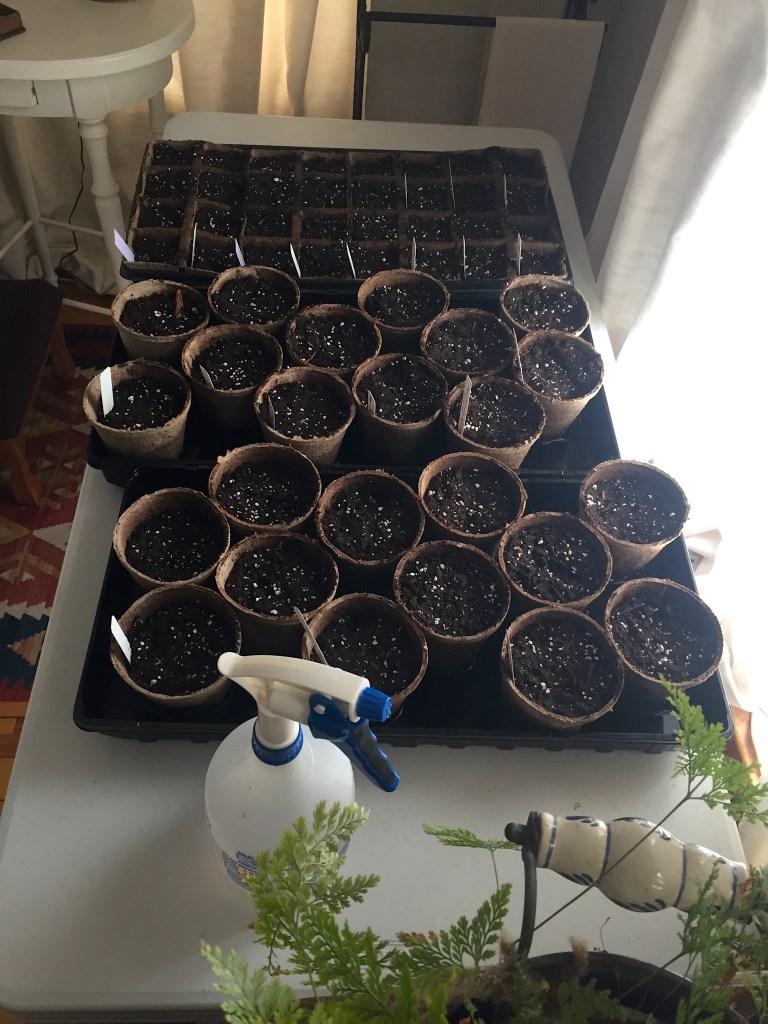
I know winter will be with us for a while yet, but this is the end of February. If the nightshades don’t get started now-ish, then they won’t be ready to plant out in May. At normal room temperatures, it takes upwards of two weeks just to germinate chiles, and it can take three if the nights are too cool. Which is highly likely, given that I don’t have the heat mats out this year.
I’ve put the pots in the guest bedroom which is the warmest and brightest room in the house. However, it also is the most lacking in electrical outlets. So there are trade-offs.
If I don’t see sprouting in ten days, I’ll probably break down and rig up something to plug three mats into one wall outlet. Fortunately, the outlet is close, so a power strip should work. But… I thought I would try the low-tech option first.
I didn’t plant the few tomatoes and eggplants I will start from seed yet. I misjudged my pile of 3″ paper pots and ran out. So that will be next week after a run to Agway. Another week won’t matter as much for these nightshades.
I can use the warm, damp paper towel trick on the tomatoes to speed up their germination. This just involves spreading the seeds over a moist paper towel then covering them with another moist paper towel and keeping that whole business warm and damp for the 3-5 days it will take the seeds to germinate. The hardest part is keeping the seeds separated and labeled. I usually draw rings on the paper towel to contain each seed variety and label the rings.
I don’t much care if the eggplants putter along. I have one packet of seed, a Japanese eggplant, and it can’t be planted out until temperatures are consistently above 60° — which doesn’t happen until late May here. (The other nightshades don’t like cool nights, but they survive. Eggplant seedlings will just wither…) I will probably buy a Rosa Bianca plant locally. I plan to grow both in a large raised planter in front of my house where there is ample sun and no groundhog. (So far…) Eggplant is the only nightshade the hog will harass. (Again… so far…) However, they don’t seem to be willing to climb for it. A 28″ raised bed is enough to cool their lukewarm interest.
So that was my weekend… They say hope springs eternal. I don’t know about eternity, but spring definitely requires renewed hope each year… and will often quash it with a hard April freeze or a May snowstorm. But still, it’s time to plant the seeds and hope…
Guided-ish Meditation
Here’s a new thing. Well, it’s not new for me, but I thought I might share it. Because I suspect we all could use an antidote to the constant stream of incomprehensible chaos that is daily life right now…
A confession: I am terrible at meditating. I can sit for about 4.5 minutes… maybe… before the brain starts chewing on things it has no business masticating…
So I often go with the Western version of meditation, that which was practiced by early Christian hermits and, likely, by the Druids before them. This form does not ask you to empty your mind of all thought. Instead, you choose a topic and focus on that. Your brain will still meander (or mine does anyway). But if you have a focus, it’s easier to direct the thoughts back into that channel than it is to completely dismiss thought altogether.
I meditate in the evenings before bed, and there’s been a whole day of stuff to chew on by the time I sit down on my cushion. To avoid dwelling on the disaster du jour, I write down the day’s topic in my calendar, usually a month or so in advance (much like my Wednesday Word poetry prompts). The topics are always based on what is happening in the real world — the seasons, the garden, the ritual calendar, and so on. Choosing far in advance means the decision is made and I don’t have to try and come up with something that is not related to the day I’ve just had. (Though it will never shut up, my brain will paradoxically empty itself of all useful ideas the moment I need to come up with one…) Having a rooted topic to think on not only helps me to meditate, but I find that this change in focus right before bedtime also helps me to pack away the day and sleep better at night. With less grinding of the teeth…
So… I thought I might share some of these meditation foci now and again.
Today being Terminalia, the topic is “where boundaries meet”.
I can probably get a whole twenty minutes out of that…
©Elizabeth Anker 2026

 By My Solitary Hearth
You are waiting for the weather to warm up before planting, whilst I am still desperately waiting for a decent rain to soften the ground before I can. I enjoy your version of meditation – along with the honest admission of how difficult it can sometimes be. I find that once I have turned off my light at night is the best time for me.
LikeLike