

Today is National Dandelion Day. It’s also Easter. I don’t celebrate Easter in the Christian sense. I think there is quite enough suffering in the world without invoking the sacrifice of grain gods into the beginning of spring.
However, I am starting to think that the secular holiday, the bits with rabbits and eggs and chocolate, are worth celebrating. I think this is the logical place in the solar year for the joyful honoring of the opening of the season of warmth and growth. For one thing, Easter is more likely to actually be the opening than, say, the vernal equinox where pagans often try to force bunnies and eggs and flowers into the annual round. It also tends to be more vernal than May Day, when most of the early spring flowers are already spent and eggs have mostly hatched. The cardinals are usually on round two by May…
The calculations of Easter normally place it a few weeks after the equinox. Easter is set to be the first Sunday after the first full moon after the vernal equinox. (There are other complications, but that’s a good short-hand.) The holiday could fall the day after the equinox or up to 36 days after the equinox, but it most often falls around the beginning of April. And those few weeks between the equinox and early April see big changes in the weather.
The days are lengthening, though the jumps in day length that we see around the equinox are starting to mellow out, so the weather is starting to calm down after the March Lion. The increased sunlight is warming soil and buds. We often go from bare branches and a few solitary early bulbs on the equinox to fresh green painting the trees and daffodils blooming everywhere, along with a profusion of native spring ephemerals. Sadly, the frog run usually ends the sugar season in the first couple weeks of April. However, there are ramps and fiddleheads in the woods and asparagus is starting to shoot in the perennial garden. Fruit tree buds that remained resolutely closed at the equinox are open and scenting the air with a sweet promise of harvest to come. And there may even be peas and radishes in the veg garden. Though not in my garden this year…
And then there are the rabbits and eggs. There are definitely more signs of animal renewal on Easter Sunday than on the equinox. There might even be baby bunnies, though I don’t care to see them in my garden. Birds are nesting now. A few of the earliest nesters might have hatchlings, but most are sitting on eggs today. The dawn chorus is a bit quieter after the weeks of jockeying for mates and best nesting sites. Now, it’s down to the business of raising a family. Soon, we’ll start to see colorful shells in the garden and then harried parents carrying food to perpetually open mouths.
It is very much more vernal on Easter than on the equinox.
All in all, I think that Easter is a holiday that any pagan should celebrate. Easter has very little to do with the Christian story. Easter is about Spring, the renewal of life cycles on this Earth. After all, it’s named for the Dawn and the direction we face when welcoming the spring sunrise. It may even be named after a goddess, but I think Dawn is wonder enough for me. Though we have very little evidence of spring celebrations before Christianity, we can be sure that people have always welcomed the opening of growth. For one thing, there are all these menhirs and henges and other massive structures aligned to the equinox. But also… where did the Rabbit and Egg and so on come from if not from our deep ancestors? I don’t quite accept that these ideas were created in the Christian era. Christians would not have chosen a rabbit as a symbol of the day their savior deity was crucified. So, these are ideas that definitely predate Christianity even if we don’t really see much evidence of that in history.
For the record, there is also little evidence of pre-Christian harvest celebrations in Europe… but undoubtedly people were celebrating… And it is interesting to me that the day we celebrate the planting season with rabbits and eggs, Easter, is often a week or more after the vernal equinox, while the day we celebrate the harvest with dragons, Michaelmas, is a week or more after the autumnal equinox. Both of these celebrations are clearly honoring something other than the named Christian holidays. So, it stands to reason that both Easter and Michaelmas predate Christianity (because inventing these ideas under Christianity would likely send you to an early death for heresy…).
In fact, the symbols of these holidays, the Rabbit, the Egg, and Flora — and the Dragon of Michaelmas — are all well-attested and ancient symbols of life on Earth. The Egg, for example, has been used as a symbol of renewal since at least the Sumerians and is still found in cultures all around the globe. For very obvious reasons! Eggs are what is happening in Spring. These symbols are tied, in actuality, to the seasonal round of life on Earth — as long as we properly hang the seasons on the annual solar year. Easter seems a more proper time than the Wiccan Ostara, though both are celebrating the same thing. It’s just that one is closer to the real opening of growth. And that’s today. At least in my part of the world…
It should also be noted that Easter is a Sunday… Unlike the equinox, school is out and many folks don’t have wage work. So this is a holiday that we can logistically celebrate, rather than trying to shove a ritual or meal into the weekday. Just as importantly, this is a holiday that honors the dawn, the opening of growth, the beginning of the warm season of fertility. And what better day for all that than the Sun’s Day!
So… Happy Easter! May you have a blessed Spring day! And may the Rabbit bring you as much chocolate as you desire!
Some ideas for celebrating…
This is definitely a holiday centered on kids. When my sons were young, Easter began on Palm Sunday with egg painting. They each had a basket, decorated with paint and ribbons, that would come out of the closet on Good Friday to be filled with chocolate and small toys — and the odd book… because me… The painted eggs would be put in a large bowl in the fridge, waiting for the Rabbit to hide them. On Easter Sunday, I would get up in the early morning darkness, don my cloak, and spend an hour hiding eggs in nests of green shredded paper. Then I would go back to bed and wait for the pair of them to come down and inform me that the Rabbit had been and left stuff all over the garden.
A fast and furious hunt for all the eggs would ensue, in which it was my job to make sure all the nests were “found” so that there weren’t eggs rotting in the sun — or snarfed by our two dogs, which often ended up smelling just as bad… We usually played a few rounds of egg toss with the hard-boiled painted eggs. Sometimes we tried to carry the eggs in spoons while navigating a garden obstacle course. Hop over the herb bed wall, skip twice around the veg beds, dash out to the jungle gym and then back to the porch… Then we had a pancake breakfast on the patio.
But it’s hard to get excited about egg hunts and goofy games when the kids are grown and grandkids are distant. There might be neighbor children or honorary nieces and nephews scattered about, but they’re probably going to spend the day with their families if they honor Easter at all.
That said, there are ways to celebrate. First, if you have a yard, then why not inaugurate a neighborhood egg hunt! You can host an egg-themed party for all your neighbors and friends on any likely spring day. It doesn’t have to be Easter Sunday. In fact, the messy Southwestern tradition of making and breaking cascarones, painted eggs hollowed out and filled with confetti, can happen any time between Palm Sunday and Mother’s Day. Traditional egg hunts and other eggy games — rolling, tossing, racing — were once May Day activities — because this is when eggs are abundant and because the beginning of summer brings kinder outdoor weather. And all these games are definitely outdoor activities. Preferably done in clothes that can bear a little dirt and egg yolk. You can also add in some other spring games like tug-of-war or a tame version of the spring ball games.
There is also a fun May Day game that works well with eggs at Easter, particularly cascarones. Divide into two teams. Designate a table or large stone slab as a home base. One team is charged with protecting home. The other must try to set some object on the home base. Sometimes this is a ball, sometimes a flag, sometimes a doll. I’ve seen harvest versions that used the last sheaf of grain. But a real challenge is using a small hawthorn branch loaded with ribbons and may blossoms called the May Queen, which true to its name is a prickly thing to carry about.
The invading team assembles somewhere out of sight of home base, ostensibly to discuss tactics. The defenders set up their defense, which involves buckets of water — or just a hose pipe — and piles of messy projectiles like water balloons, paper plates filled with whipped cream or jello, and cascarones. Then the invasion begins.
It’s probably best to have rules of engagement that limit full contact aggression… But everyone can count on being covered in gunk before the Queen makes it to home base.
There is also an inverse of this game where the May Queen is set on the home base and the invaders have to capture the Queen. This might be preferable if you want to limit thorns in the flesh. Or just make your Queen out of fake hawthorn, which is generally thornless and has the advantage of being “in bloom” whenever you want to hold your party. If you do this, then maybe the Queen can be reused year to year, maybe holding a place of honor in a classroom or children’s library or someplace the Queen can grace with merry fruitfulness all year round.
Whatever the games on offer, there should be food, preferably sweet and light. Make your celebration a potluck picnic, heavy on eggs and finger foods. Or invite your friends to a pre-game brunch, serving traditional spring fare like pancakes, quiche and hot, sweet buns. Be sure to have deviled eggs or there will be complaints.
If all this seems like too much for a Solitary, there are other ways to enjoy Easter. The best is to find a sunny spot outdoors and read poetry — or write it! It’s particularly lovely to find a stream or river, swollen with spring rains and snowmelt, and just listen to water’s song. Take a blanket, a snack and a full water bottle and spend an hour journaling everything you see and hear along with your emotional responses. As this is a time of dawn and beginnings, you could plan to watch the sunrise either in some favorite spot where you have an eastern horizon or just from your home or garden. Even if the weather is clouded and cruddy, the experience of growing light in spring is powerfully lovely.
Easter is also a very good day to plant spring and early summer veg. I aim to plant peas on St Patrick’s Day, the true equinox in my part of the world, but that is often thwarted by snow and ice. However, by Easter most of the snow is gone and the raised beds are usually thawed enough that I can shove peas into the ground. Some years, the dandelions are already in bloom and I can plant potatoes, though that is not true this year. In New Mexico, I was already harvesting peas, radishes and greens which always found their way into the Easter dinner. But I also planted on Easter. Beans and cucumbers, melons and summer squash and onions. Easter falls before the high desert weather gets too hot and dry, so the veg has time to germinate and grow a bit before the season of grueling endurance begins in May.
I also start my potted flowers indoors around Easter. Calendula, small marigolds and zinnias, violets and alyssum and pretty herbs like cilantro, dill and chervil all get planted on or near the full Sap Moon, which is almost always the Easter Moon. I start soaking sweet pea seeds to be planted out in various garden beds as soon as I can get them into the soil. I like planting them around the clothes drying rack and along the path to my back door, where they can ramble up the path-light stakes and scent the entrance to my home.
To make all this planting more of a celebratory ritual, create a small sunrise seed blessing ceremony. Gather all your seeds in an Easter basket, maybe with a few painted eggs. If you have an altar, set the basket on it. Or maybe set up an outdoor space where you can sit and watch the sunrise. Or, if the weather is inclement and space is tight, just use your potting table. Perhaps light a candle to symbolize the growing light of the sun, all the better if it’s scented with some floral essence like lavender or rose or peony. If you already have some blooming bulbs, go gather a small bouquet or tussy mussy. Daffodils are particularly appropriate. Set the blooms near the basket of seeds and candle. Then face the east and just watch the gathering morning for a bit. If it feels right, speak a blessing over your seeds, invoking the growing strength of the sun into them, gently asking them to awaken from their long winter dormancy and conveying your gratitude for the food and beauty they will soon produce. If that feels weird, just think happy garden thoughts. The seeds will know what you mean.
Or… if you don’t garden, you can make a metaphorical seed blessing by writing down whatever you want to accomplish in the season of growth on colorful scraps of paper and putting those things in your basket. If you use non-toxic paper and ink, you could even find some significant place to plant your ideas by burying the papers.
Then get planting your summer! Put the seeds in the soil. Or start whatever it is you want to accomplish. The point is to do the real work that will bring you to your goals.
Here is some music for your spring celebration. These Open Road Folk Music folks have been putting out lovely videos of mostly North American wildlife for years. The music is happy and uncomplicated, perfect for Easter. And for ambience, here’s the live Cornell Lab FeederWatch Cam at Sapsucker Hollow. Lots of spring peepers and red-winged blackbirds right now, with the occasional goose outburst. It’s also happy and uncomplicated — and definitely points to the main business of spring!
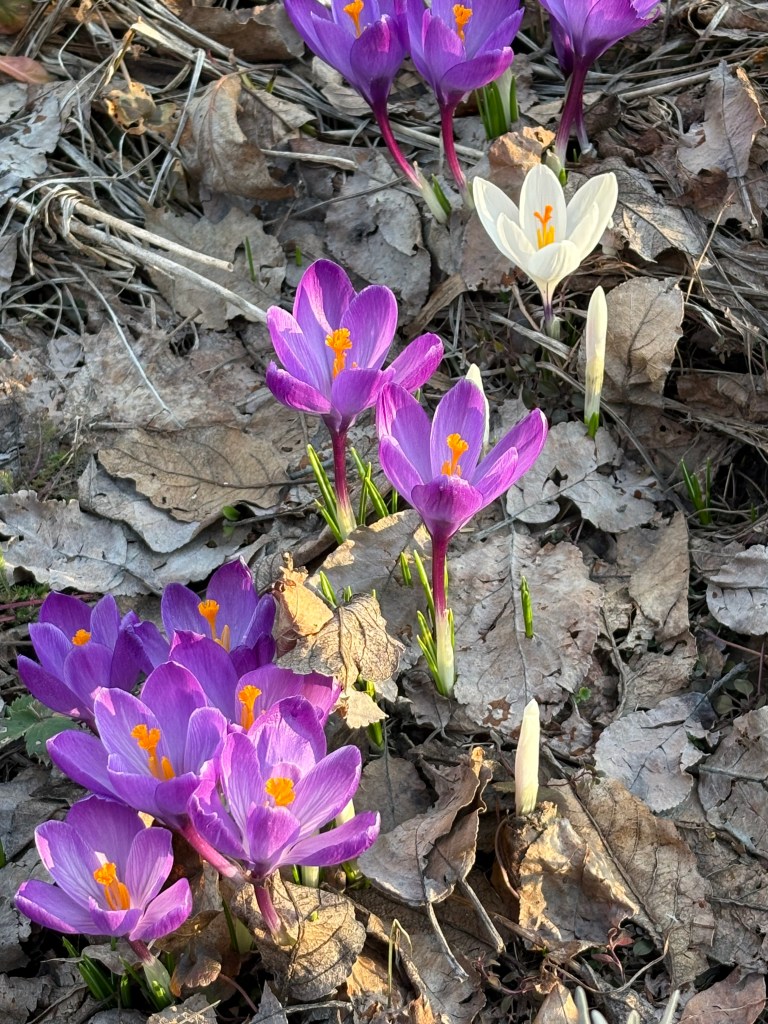
Finally… here is what happened on Good Friday in my garden…
National Dandelion Day
When the dandelions bloom,
time to plant potatoes.
  — Old Farmer's Almanac
The Old Farmer’s Almanac claims that April 5th is Dandelion Day. I’m fairly certain this is not a thing, but it should be. Dandelions are pleasurable in so many ways. Just imagine an early summer lawn dotted with bee-covered smiling suns! And when you need calm, there is nothing better than sitting in the dandelions. In my opinion, dandelions are one of only three good reasons to grow turf.
(The other two are clover honey and baseball.)
With their long tap-root, dandelions bring nutrients up from the subsoil. They are feeding all the surrounding plants. Plant them in the greens bed for extra healthy salads. They are magnificent bee plants, absolutely loaded with pollen. Brush them to your face and you’ll be adorned with golden kisses. They are also loaded with nutrients, and all parts of the plant are edible. Steam the roots and eat them with a cheesy sauce. Eat young greens fresh from the garden with a balsamic dressing and maybe a bit of toasted walnut, or sauté the older ones and eat them like collard greens. Make tea from the leaves and flowers for a refreshing spring tonic. The flowers can be eaten raw, though they’re bitter; the best way to enjoy these nutrient-dense natural snacks is in beer-batter fritters. (You must guard these from ravaging teenagers if you want to eat them yourself.) The second best way — and one that takes more planning — is to make dandelion wine. There’s a recipe below if you have flowers already.

dandelion break
poor maligned dandelion
who dots fields in delight,
such rancor we harbor for him.
deemed weedy and vulgar,
if he but shows his face
we give the whole yard a trim.
his exuberance
eludes all command.
there’s no reining in his joy.
and for purloined freedom
we grant no reprieve.
it’s heads off for this bad boy!

but when you find
that your heart’s in a bind
and your soul is craving renewal,
you can not do better
than head for the meadows
and seek out this fair golden jewel.
plop down in the sun
drop all your cares
stop all your endless mind churnings
and if you’ve a wish
then tell it to him
for this dandy will quell all your yearnings.

Dandelion Wine
I’m going to begin this recipe with a disclaimer: if you’ve never made wine, dandelion wine takes a long time. It takes months to ferment and then is best after it has aged for another year. So this is not a wine you’ll be drinking soon.
That said, dandelion wine is worth the wait. Especially since you’ll rarely find it for sale. It tastes like a cross between a dry white wine and mead, but with floral notes like nothing else in the fermentation cosmos. It also seems to be lighter on the alcohol than most other wines.
The hardest thing about this recipe is finding enough dandelion heads. It takes 2 quarts of flowers to brew this wine. Really, this is a project better begun in May or June, but somebody decided that April 5th was Dandelion Day… So here it is.
Ingredients
2 quarts dandelion flowers
1 gallon filtered or boiled water
juice and zest from two lemons
1 lime, thinly sliced
1.5 lbs sugar
1 package wine yeast (comes in 1/5oz or 5g packages)
     (can also use baking yeast, a rounded 1/2tsp)
4Tbs cornmeal
Instructions
Gather the dandelion flowers. Pick them after dew has dried but maybe not in the heat of the day since they wilt quickly. Wilting means the flower is losing liquid, meaning there will be less juice to flavor the wine. Be careful to avoid picking flowers where poisons are sprayed or where road chemicals will coat the plants. You’ll need somewhere around 50 large flower heads to make 2qts.
Remove all the green parts from the flowers. Compost the stems and the calyxes (the green part at the base of the flower). If some green bits get into the mix, that’s not a catastrophe, but keep in mind that the more green there is, the more the wine will taste bitter.
Carefully wash the flowers to remove any dirt. Use a light stream of cold water so you don’t wash away the flower’s essential oils — or the petals, which will try to get away as you rinse them.
While you are cleaning the flowers, bring the gallon of water to a boil.
When cleaned and trimmed, put the flowers in a large, heat-safe, non-reactive container, and pour the boiling water over the flowers. Lightly cover the container with a towel, and let this mixture steep for 2 hours.
Place a mesh sieve or a colander lined with several layers of cheesecloth in a large pot. Pour the water and flowers through the sieve, squeezing the flowers to release as much juice as possible. Then discard the flowers in the compost. (Or just toss them into the garden where they will rot quickly.)
Bring the dandelion tea to a low boil.
Add the sugar and the fruit juice, zest and slices. Let the sugar dissolve and then remove from the heat. To cool off the pot quicker, partially fill your sink with cold water and place the pot in the cold water.
When the water is around skin temperature, add the yeast and whatever you are using for nutrient. If you are serious about wine-making, then get a supply of wine yeast and use that; but baking yeast will ferment just fine. I’ve used cornmeal in this recipe, but it matters not at all what you use as nutrient. I’ve seen recipes that suggest simply floating a small piece of yeast-slathered toast on the liquid. You are just kick-starting microbial growth.
Tightly cover the pot and let it stand at room temperature for ten days. You need to gently stir up the mixture each morning and each evening. So leave the pot somewhere accessible. If this is your first go at wine-making, I recommend leaving it where you will see it so you don’t forget. The stirring makes sure that no anaerobic fermentation starts happening at the bottom of the pot. You don’t want that to start until after you’ve removed the fruit or very bad smells will result…
Strain the liquid into a sanitized 1 gallon jug, removing all the fruit and any remaining nutrient.
Seal the jug with a fermentation lock. These are available wherever canning supplies or wine-making supplies are sold. Ball even makes lids for their jars that are fitted with the lock on top. You can also make an airlock out of a balloon. Poke a pin through the end and fit the mouth of the balloon over the jug, securing it tightly with a rubberband. While I am loathe to make trash, this method does let you see when fermentation has nearly stopped — the balloon goes limp. Store the jug in a warm, dark, dry place.
You’ll need to continue to shake up the liquid periodically. At this stage, I think 3-4 times a week is fine, but some people shake it up every day. Again, you are keeping the liquid aerated and keeping unwanted microbes out.
At 4 weeks, siphon or gently pour the liquid into another sterilized gallon jug, leaving behind the sediment. (As much as possible…)
Seal with an airlock (or balloon) and leave in a warm, dry place. Do not stir this liquid. When the liquid is no longer cloudy, wait for 14 days, then siphon or gently pour the liquid into another sterilized jug, leaving behind the sediment.
Repeat the last step every 12 weeks for a total of 9 months. It is done when there is no more sediment forming at the bottom of the jug. (Or the balloon goes limp.)
Before bottling, if there is more than two inches between the top of the liquid and the rim of the jug, top off the liquid with sugar syrup (equal parts sugar and water simmered until the combined starting volume is reduced by half).
Use a funnel to pour the liquid into sterilized wine jars. Cork and set in a cool, dark, dry place to age. It is recommended that wine be aged with the bottle on its side. This keeps the cork from drying out and shrinking, breaking the seal. (You’re also supposed to turn the bottles over periodically, but I don’t bother with this because I don’t live in a place where cork is going to desiccate within the year or two that wine stays in its bottle.)
This wine is best bottle-aged for another year after fermentation.
This is an unexpectedly dry wine, so it goes with just about everything.
One note: there are ways to ferment this recipe more quickly. This Old Farmer’s Almanac recipe takes just a few weeks of fermentation and six months of aging. But it also uses raspberries (for color and flavor) which might speed up the yeast action. So before you even pick a flower, familiarize yourself with a variety of recipes to see what feels right to you.
A very Happy Dandelion Day to you! May it bring you peace!
©Elizabeth Anker 2026

 By My Solitary Hearth
A happy and peaceful Easter Sunday to you! This post has been a delight to read and I enjoyed listening to the music and watching the video. How good it is to read a positive view of dandelions too. The crocuses in your garden must be a very welcome sign of spring.
LikeLike