

I’m having a delightful autumn… Can you hear the sarcasm? Should I have employed scare quotes? Because it is sort of scary…
I am learning what happens when one contracts the lettuce bug and lets it run its course without seeking medical attention. Back in July, I had the runs, just like seemingly everyone else in the country. It started on a Sunday night and lasted a few days. As it began on the weekend when my doctor’s office was closed, and as I was fairly confident of what it was, having had lettuce of unknown provenance at a company luncheon, I did not go to urgent care, certainly not the emergency room — where I would have been charged several thousand dollars for some harried and dubiously qualified medical professional to tell me it was the lettuce bug… which I already knew… Instead, I rested, drank plenty of fluids, and worked from home to be near my own bathroom. I was fine, I thought, by the end of the week.
But things never did completely equilibrate. I’m guessing the bug just went dormant, as it is known to do. By the middle of August, I started having weird pains in the lower left side of my back. It hurt the worst to sit. Actually, it hurt the worst to stand up after sitting. This kept getting worse until, by the end of August, the pain upon standing up had become crippling. I was holding on to something, pulling myself up by my arms, and pressing on my back to get upright. With many expletives. It would have been funny if it wasn’t so excruciating. Watch the old lady try to stand up…
At first, I thought it was kidney stuff. Or maybe a pulled muscle. I did all the things I usually do to calm those common issues down. I even put myself on an all-liquid diet the last weekend in August. But nothing worked. So, last Tuesday I went the doctor. She threw out scary words like Crohn’s disease and diverticulitis and said we needed to do more testing, by which she meant blood work, a CT scan, and a colonoscopy. (I am not fond of any of those…) But then later that afternoon, blood started coming out. Quite a lot. So I called the office to report this new development and they sent me to the ER. Do not pass go; do not collect… anything…
The doctor at the ER seemed a little agitated at the CT scan, which showed a gut full of inflammation, some of which was obviously ruptured. Of course, that made me even more stressed. But they filled up my veins with strong antibiotics and gave me a healthy dose of pain relievers. I was instructed to stay mostly on that clear liquid diet until “we can figure out what this is”. The diagnosis was sort of vague, but it was not the sort of thing that sounds like long-term digestive illness. Actute proctosis. Which seems to mean “inflamed intestines”. One of those names that lends an air of archaic officiality to the presenting symptoms without delving into causes… not unlike pneumonia (meaning “inflamed lungs”) and meningitis (meaning “inflamed membrane”).
By Wednesday afternoon, the bleeding had slowed to a trickle of sludge, but it has not stopped… Even now. Meanwhile, the antibiotic pills that I was instructed to take have turned my stomach into a roiling cauldron of hot acid (or thereabouts). Still, I’m duly taking the drugs, and there are improvements. I can get up without screaming now. (Low bar, I know…) But I think the treatment is making me feel worse than the disease. There was pain in my back before. Now there is pain everywhere in my gut… And nausea and dizziness for about an hour after taking each pill. Meanwhile, I’m not sure that my daily thyroid pills are making it out of the cauldron of acid, so I’m starting to feel that. I have been on a mostly liquid diet for over a week which has left me hollowed out and set my arrhythmia into full syncopation mode. Which means I’m not sleeping well. I have the worst taste in my mouth, and smells are more irritating than normal. And I can’t concentrate, though I have managed to read a few books, mostly not very challenging books, fluffy fantasies that I really don’t need to be reading, except that’s just what I need right now. Today, I am trying to be back at work for the first time since last week, so I can process all the early month rent checks, but I don’t doubt that I’ll be working all day anytime soon.
Meanwhile, being off work and unable to focus, I’ve had a week to ruminate. Yesterday, I talked about the inability to rest in this era of intense wage work. But I think we should also add to the tab of late capitalism, and modernity generally, a complete inability to fully recover from anything. From grief to childbirth to cancer, we are expected to jump back into the fray as soon as we are marginally vertical. And many of us do not get paid while we are horizontal, so we comply… Moreover, being an aging body in an age of increased loss, toxicity and contagion, means that few of us are able to remain healthy in either body or mind. We are constantly being exposed to new stresses. So it is a never-ending cycle of debilitation and partial recovery that keeps stair-stepping downwards, never getting back to the former baseline, continually piling on the accumulated damages… I’m pretty sure this is why we have lower average life-spans than every other industrialized country in the world — and most of those we, in the US, patronizingly label “developing”.
And then there are the treatments! Antibiotics work by literally killing all the microbes in your body, including all those our bodies depend upon. The reason most of us feel queasy after taking them is because we’re stripping our ability to process food and energy. Also, many of these drugs are corrosive, leaving a path of dead body tissues and flailed linings throughout the digestive tract. Of course my stomach is roiling! It’s been nearly a week of chemical corrosion every six hours. (It is so very hard to make myself swallow these pills… I’m quite sniffy as the clock rolls round to each next dosage…)
I suppose the toxically positive side is that I’m finally shedding the weight from last summer’s meningitis steroid treatment…
All of our medical treatments are like this, from hip-replacement to chemotherapy. If you survive the drugs and surgeries, you might be cured of the condition. Maybe. Not always. But there is never an attempt to foster health. In fact, our revenue-driven medical system is predicated on keeping us all sick. They don’t make money to pay for all these expensive drug trials, complicated machines, and high salaries if most of us are well. (Of course, the insurance industry wants us to be well… or well enough to not generate claims… They profess to want us healthy, but health is not their objective. Collecting your premiums and avoiding paying on your claims are what keep that industry lucrative…)
But whatever… complaining about what we all know does nothing. And I will live. Though I will probably feel that much more permanently worse off than I did before eating lettuce with a dressing of vile parasites. (Because Trump…) And the spiral will continue downwards…
Meanwhile, autumn outside my digestive tract is getting on. My son drove me down to the ER (because I won’t go to the pathologically inept hospital here in my own town and went to a hospital in my doctor’s network a few miles away). So I had time to look at the leaves. I was surprised. Here in my town, autumn is largely brown. I thought that was true everywhere, but it was not so. I suspect this is because this valley has gotten fewer of the few spotty showers to pass over the region this summer, so our trees are more stressed than elsewhere. But we also seem to be behind the schedule generally. Those trees that are not brown and blighted are still green, with barely a brush of orange and gold and red on the upper branches. This is fully a month later than normal for maples and a couple weeks past when the birches start to yellow.
Other parts of state are closer to being on schedule… All the way down to the hospital, there were mountains and valleys awash with color. However, it’s not just my valley that is behind. There were still far more green leaves than is normal for this deep into autumn, and very few trees showed much defoliation, when usually all the limbs are bare not long after the equinox. The Falling Leaves Moon is new this Friday, and so far the only leaves that are falling are the brown, diseased things.
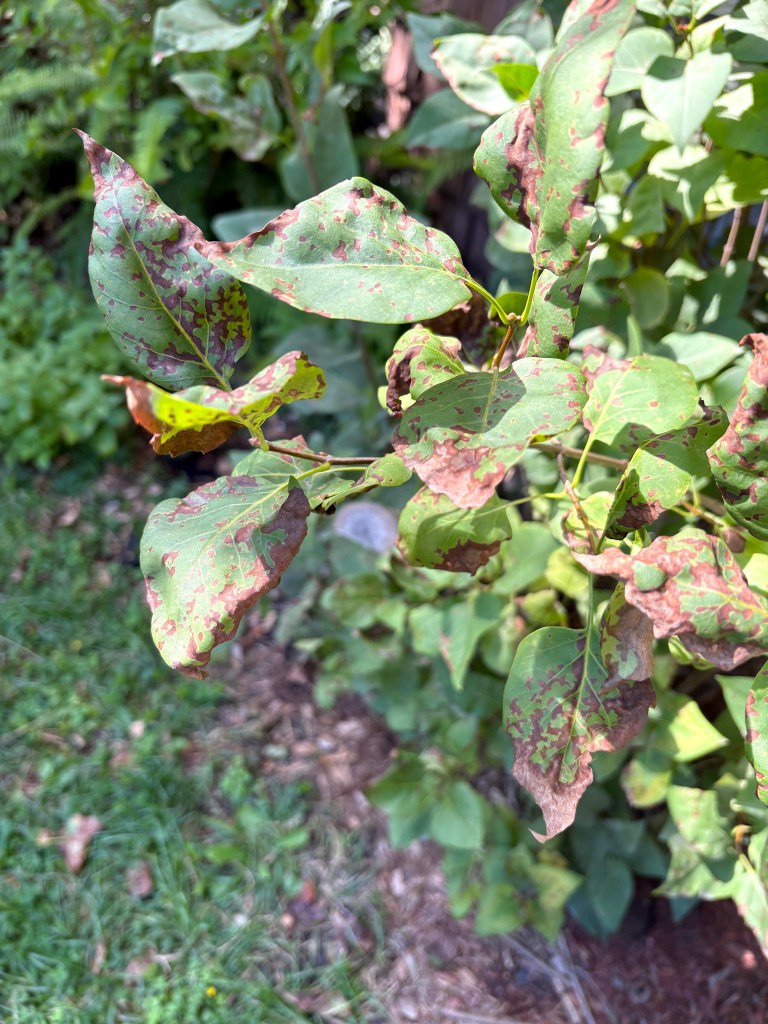
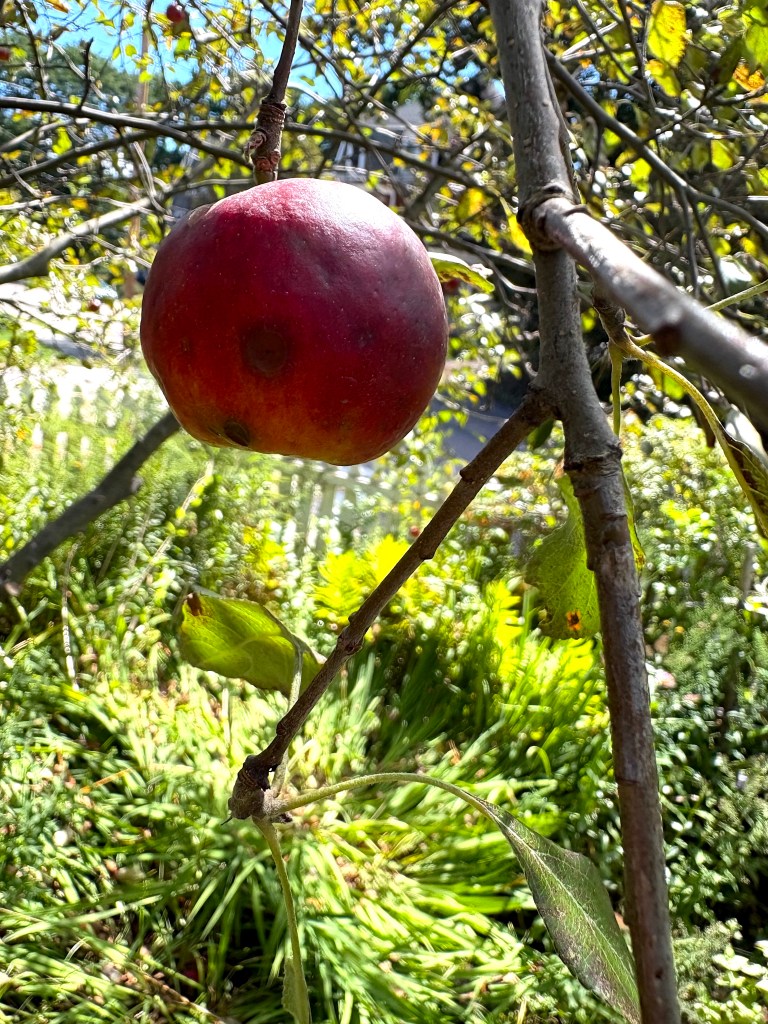
Because, of course, it’s not just humans who are dealing with increased debilitation. Every body is. There are the big things like insect population crashes and ash trees hurtling to extinction. But there are also the little things. In my garden, I have lilac leaf blight which, by late summer, turns the shrubs into deformed claws with ragged skeleton leaves. The fungus does not kill the plant, but it reduces flowering and makes for a sorry looking specimen all summer. There is also frog-eye leaf spot on the more mature apple trees on this property. This also does not kill the tree, but it dots all the leaves in ringed black spots and makes the tree more susceptible to the various fungal and insect-borne ailments that cause fruit blight. Many of my apples have brown spots that look like bruising — and rot just as quickly — while still hanging on the tree.
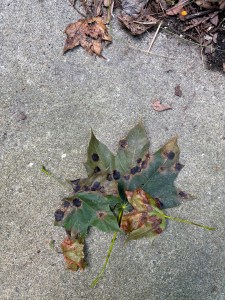
And then there’s a new thing this second autumn of drought in as many years. Norway maples, themselves an invasive nuisance planted in the early 20th century as “tough” shade trees for towns and cities, are susceptible to the tar spot fungus. This is about as pleasant as it sounds. The leaves on infected trees first develop bile-yellow spots around midsummer. As the summer progresses, the spots turn black and somewhat tacky. Some whole leaves turn brown and curled, but most stay green even as they are falling off the tree. It’s sad… I have been sweeping up infected leaves from my neighbor’s maple tree for weeks. And that’s all anyone can do to contain the infection. The fungus is not winter-killed and will live in the soil wherever the leaves land until, in spring, it spreads to new trees.
Perhaps last year the infection was not yet prominent, not affecting every leaf of most Norway maples, so I didn’t notice it. But enough infected leaves fell last year to spread the disease everywhere this year. With the trees already stressed by drought, the infection has taken over my town. Now, this fungus does not bother many other kinds of maples. Most of those in my jungle are fine, though the biggest maple, the one I had thought to tap for sugar, apparently is a Norway because it is all brown and jagged now. So no sugar from that tree… And most of the trees that line the streets of my town are also Norway maples, having been planted in the 1930s as a depression-era, make-work, beautification project, because they grow fast and cope with road salt much better than any other maple species. Back then, we didn’t know that Norway maples in this ecosystem become aggressive spreaders and will cover every space in a thick, twiggy carpet of mower-killing saplings every spring. Within a decade, one Norway maple can turn any space into a twisted tangle of a nightmare forest.
But there is a bright spot to the tar spot… Infected trees do not seem to be setting seeds this year. Maybe this is nature thinning out the aggressor… like intestinal parasites and novel viruses in humans?…
Still, it’s depressing to have gnarled green leaves falling on your garden walk and see brown shrouds on trees that should be vibrant with autumnal color. Moreover the weather has mostly reflected the somber tone. We have had very few lovely, crisp blue days, though we also have had very little rain… Foggy and miserable in the morning, with flat white skies in the afternoon. Humid and sticky all day long, with long afternoons of uncomfortable drizzle that doesn’t even dampen the garden soil. It is cooling off as the days shorten, but it’s not yet cool enough for sweaters and pumpkin spice. All in all, it does not feel like fall, and all the plants are manifestly stressed… (Though my beans are drying quite nicely on the vine for a change…)
But Saturday broke a long dry-spell. It’s funny, but rain has been in the extended forecast nearly every week, nearly every day, since the middle of July. But almost nothing has fallen out of these grey skies.
Even with the torrential flood on July 9th, July finished off with barely above-average precipitation. Furthermore, it all fell in a very few downpours. If I compare what was in my gauge at the end of July’s storm, a bit over 4″, with what the Burlington National Weather Service’s weather station says fell in all of July, 4.02″, then all of the rain over my garden fell in that one storm. Now, the Burlington weather station did not experience the storm like my town did, and that’s true of the whole summer. Some places have gotten more rain than others, some less. Over August, Burlington got a bit over 3″ at that weather station. My own records show 3.16″ fell on my garden by August 11th, again, nearly all falling in a couple large storms. But nothing measurable had fallen for nearly a month — until Saturday’s 1.25 inches that fell in two violent bursts that each lasted less than thirty minutes.
This type of precipitation does very little to recharge soil moisture, especially on the steep slopes all through Vermont. Torrents do not soak into the ground. Instead, the water surges down to the river, swelling it to flood stage and overwhelming all the storm drains at river level. Then the river sends it downstream as quickly as it is able, with almost nothing left behind. My raised beds, which do a good job of containing what rain that falls (much like a cistern), were all still damp on Sunday, but the front bank was already back to baked clay. I suspect little rain even made it to the understory of what is left of my jungle. Not only is the foliage still too thick to admit a brief downpour, but my whole neighborhood is steeply sloped and flow mostly runs on the road around my property. I watched a river form and rush down the pavement, none of it breaching the grasses that line the street. (Though a fair amount did make it into my garage… as usual…)
Still, it was a bit of much-needed rain, and the storm seems to have cleared whatever pressure system has been brooding over my valley for weeks. The breeze picked up on Sunday, blowing cooler air from the north (thankfully, smoke-free…). The high temperature of 68°F was about 10° lower than earlier in the week. And the humidity has dropped substantially, so it felt much cooler. Sunday’s low was 45°, and there are forecasts saying that we could be flirting with 30s by the weekend. Though it also says there will be more rain… so, so much for forecasts…
Perhaps the lower temperatures will at least spur the birches to turn colors, though they seem to be even more drought-stressed than the maples. Many trees are just turning brown, though that is a bit better than green with black spots…
Still, it is autumn. The Blueberry Moon goes dark on Thursday; the Harvest Moon is new on Friday. The days are losing fistfuls of time to darkness with each sunrise and sunset. Believe it or not, the equinox, our Harvest Home, is just two weeks from today. And the Harvest Moon will be full a few days later on September 26th. Because of the equinoctial effect on moonrise, it will still appear round and full as it rises over Michaelmas on the 29th, which should be lovely.
I do hope this gut infection is cleared up by then. I feel like I need a good Harvest Home celebration this year… Also… I’d just like to be able to eat solid food…
For the interim, I am enjoying the flowers in my autumn garden. Most of the asters have not yet opened, but the woodland asters are making the shady beds white as snow. The goldenrods, ironweeds, swamp milkweeds and joe-pye weeds are all glorious (and typing that really underscores how many “weeds” I have as garden plants…). White climbing hydrangeas and autumn clematis are flowing down the front bank. The New Mexico sunflowers are just starting to open their golden blossoms, while the snowy flowers of tall phlox are just starting to fade. I have a few potted mums in rust and burgundy and will probably get a few more as soon as I am able. Have to take a trip north to pick Zestar apples anyway…
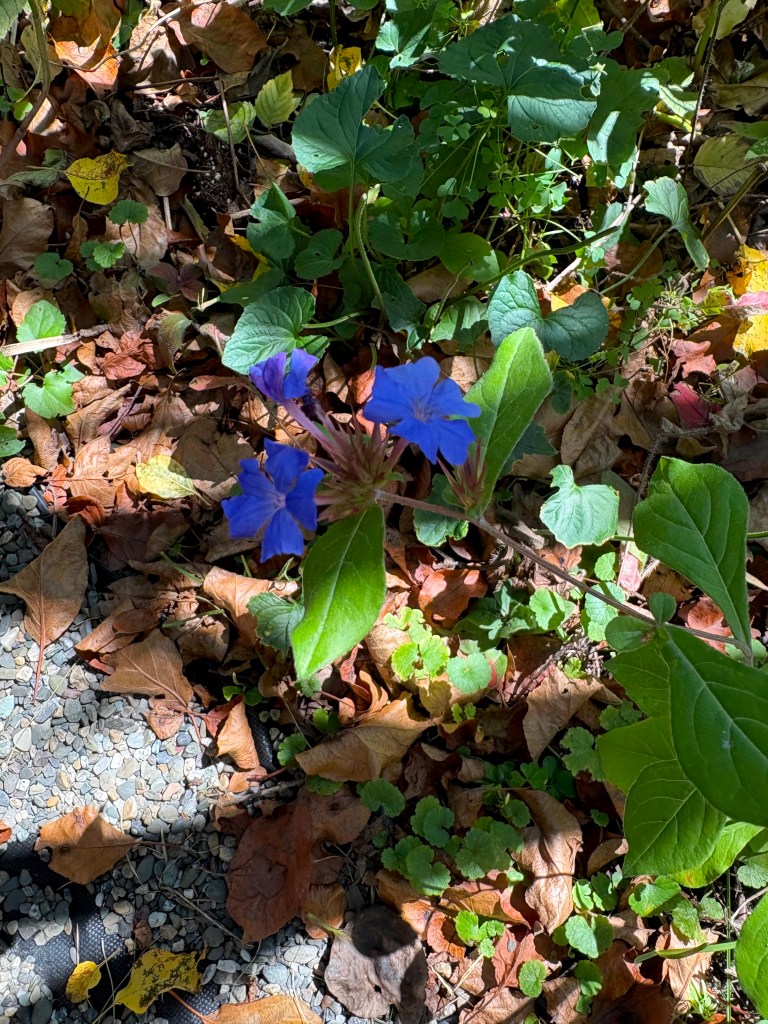
But two of my favorite flowers are rather unassuming, easy to miss if I’m not paying close attention. Plumbago blooms are tiny florets on diminutive plants, but they are one of the few true blue flowers in my garden. Moreover, after the blooms fade the seed pods are bright red sparklers on rusty plants.
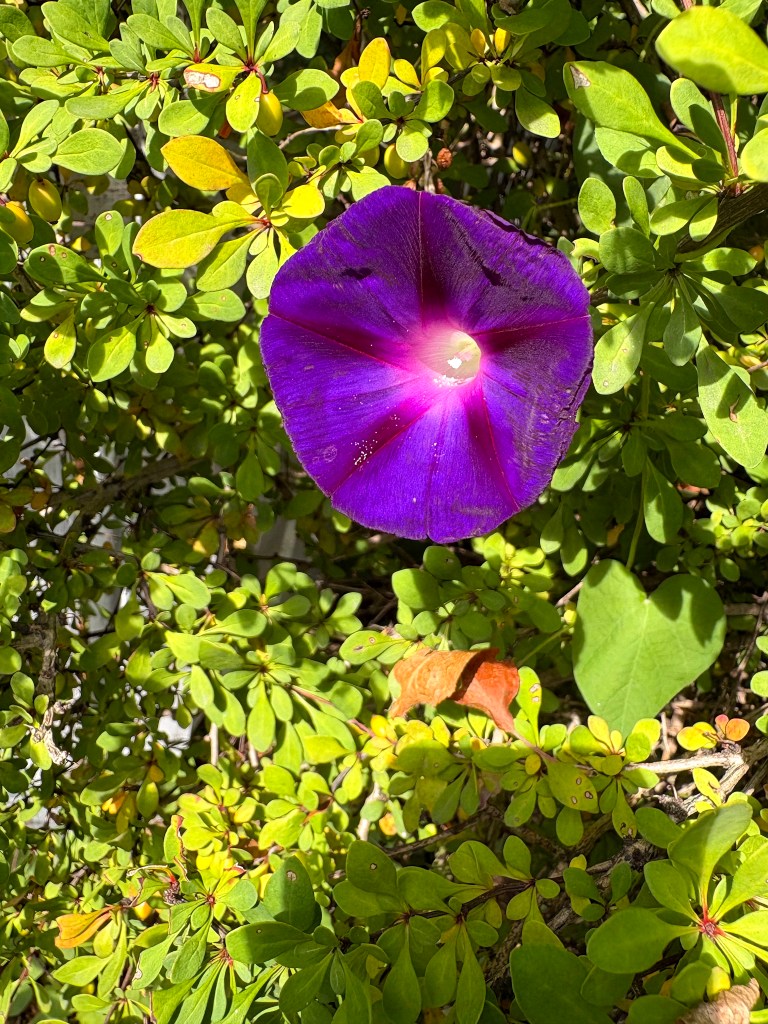
And then there are morning glories… They open out in large gorgeous purple trumpets… if you can catch them blooming for the few hours they are open.
But catch them both I did.
So, here are a couple pictures to spread the joy…
©Elizabeth Anker 2026


I can only wish you well and hope the weather shifts into the correct gear in your part of the world. Here, we are enjoying spring and the rain that has come with it. Today already feels summery!
LikeLiked by 1 person
I hope you feel better soon!
LikeLike