

Participatory Democracy
Today is Town Meeting day in Vermont. For the uninitiated, this is the day when Vermonters pack themselves into school gyms and various meeting halls to vote on town governance for the upcoming year. Officials are elected. Laws are debated and passed. Budgets are assigned. If there are complaints or disturbances, these are given voice and discussed. Resolutions are adopted. This is the primary assembly of town governors, the town citizenry.
In a world that extols the virtues of democracy, Vermont remains one of a very few governing bodies that is, in fact, democratic — that is there is a ruling body, a kratos, composed of the people, the demos. Vermont does have representational democracy. We have a governor and we elect representatives to both state and federal legislatures. But the main business of running each town — deciding how funds are allocated, deciding what laws will be implemented, deciding who will be responsible for implementation and how that will be done — this is largely accomplished through direct participation at Town Meeting.
These meetings can be contentious. It is not unusual for them to go on for the whole day and late into the evening. But most are surprisingly efficient, wrapping up before lunch. To begin with, townspeople are “warned” on the business to be discussed. Town warnings must be publicly posted a month in advance of the meeting. It is the civic duty of the people to read and familiarize themselves with meeting business before Town Meeting. Procedures at Town Meeting are designed to focus each item of business. Few words are necessary to conduct the vote, and everyone knows the rules. They’ve been the same for hundreds of years.
Town Meeting predates the representational democracy this country adopted. This is how New England colonists arranged their lives. This direct form of governance flows from the ideas of community and commons that saturated New England life. From the beginning this region governed itself.
This is not always a good thing. Outsiders have a very difficult time even today. And there are few protections for minority ideas or people. But it is much more difficult to manipulate or corrupt this system than in representational democracy because no one person holds sway. Local needs are better addressed as well precisely because it’s difficult for outsiders to have much influence. So there are trade-offs. But if you live in a direct democracy, then generally you have more of a voice in how your locality is run than if you merely vote for someone to be your voice. For one thing, you aren’t going to turn your back on yourself — but politicians will turn on you.
I believe that we need more local politics. We need to govern ourselves. I can’t say I know how to make it so that minorities have a voice in majority rule. This has been a problem for thousands of years and I’m probably not going to solve it. (I suspect that it’s unsolvable, actually.) But I also think that small regions operating under majority rule have a better chance of making sure needs are generally met than under any other system. I might even go one step beyond Vermont and do away with elections altogether. Make a system wherein officials are chosen by lot or mandatory public service. This might have the advantage of smoothing over minority issues by giving everyone a chance to be somewhat above the majority vote. But in any case, I think Town Meeting is a good system to adopt for the daily operation of a small community.
If you need a good introduction to real democracy, there’s no better than Vermont history — because plebeian rule can be highly amusing. “The laws of the hills are different from the laws of the valleys”, a long line of plucky underdog victories and, shall we call it, independent thinking makes for splendid theatre.
Vermont will be voting on raising our taxes to cover increasing education costs. In my town, we’re also electing nearly all the members of the unified district school board. I think two of the nine seats are fixed. The rest, including the board chairman, are all up for election. A few, also including the board chairman, are running for reelection, but many of the seats will be filled with brand new bodies.
This school system has been rather difficult to run since 2018 when several small and disparate systems were merged. This new school has a bigger student body, larger geographical footprint, and therefore far more costs. But it’s also a merger of several communities that don’t necessarily see eye to eye on what constitutes a proper education and who should pay for that experience. My town is like most in this country in that property taxes constitute most school revenues. But when many communities are feeding into the system, it can feel like X-town is paying for Y-town’s schooling. If X is largely an older community with lots of fixed incomes, owned homes, and few kids, you can see how it would get contentious when property taxes are raised specifically for education.
I am not one of the people who bemoans education expenses. I believe taxes are how we pool money to take care of each other. I prefer a system like Vermont where I have some vote in what “care” means — more schooling and public housing, zero military expenditures. But I don’t even begrudge federal taxes… too much. Still, I do understand the worry about rising property taxes. Social Security is not going to cover double digit increases in taxes (or in any other expense, actually), and we’re looking at a 17% increase — at a time when inflation is pushing increases in every household expense, from food to heating to transportation. In fact, that inflation is why education costs are rising so precipitously. Bussing, lunches, building maintenance, which included flood renovations for nearly every school in central Vermont — everything costs more every year. (Every month, every day… I’ve lost track.)
So we have some things to work out, and they will not all be worked out today. In fact, at the eleventh hour some crucial votes on budget increases were put on hold. I don’t actually know what I will be voting on today. But I will be voting! And I am very interested in both the process and the outcome.
On the other hand…
Not-so-participatory Democracy
I am not at all invested in the other election going on today. There will be presidential primary voting today also, though you wouldn’t know it from the local news coverage and public gossip. There is a marked lack of interest in this election, and it’s not just me. In fact, not even the national newsies are squawking all that much.
For one thing these primaries are pretty much decided. Trump is clearly going to win the Republican nomination. Biden is unopposed. There doesn’t seem much point to even casting a ballot.
Except for on a personal level… Because for the first time in my life, I could actually vote in a presidential primary. As a Green Party member, I’ve never been allowed to vote in a major party primary — and the Green Party never has much of a primary. However, Vermont doesn’t restrict primary voting. You have to stick to one party; you can’t vote in multiple primaries. But you can choose any party regardless of membership… so I could vote against Trump… which would be tempting if the others weren’t just as toxic… and so pathetically resigned to losing. (I mean, really! Why bother running if you want the other guy to win?)
But thumbing down Trump wouldn’t bring me out to vote if I wasn’t already planning on being at the Town Meeting. Because my primary vote, my presidential election vote — those don’t count. Vermont doesn’t count. We have three electoral college votes. Whatever Vermont decides when we go to the polls in November will have approximately no effect on the election. Now, I do have more voting power in Vermont’s decision. As a percentage of Vermonters, and especially as a percentage of my local town voting, I count a good deal. Because this is a small pool of voters, every vote in Town Meeting can sway the result, locally and statewide. It is not unheard of for one old geezer living on some mountaintop in the Northeast Kingdom to come down off the hill and upset a referendum. And that is exactly the point of Vermont’s participatory democracy. We all count. Every vote counts. But nationally, I am non-existent.
However, that doesn’t fully explain the lack of interest. This isn’t just me; it isn’t just Vermont; it seems to be nationwide.
Part of the apathy is that we’ve done this before, this exact thing. The last time we were voting on major party presidential candidates, the story was approximately the same. Trump was the incumbent and so more or less unchallenged. Biden was crowned by his party very early. We voted Trump out of office and Biden in, but… it didn’t work out all that well. It should be said that there wasn’t much of a change. This may be because Trump had already happened. His peculiar strain of virulent self-glorification was unleashed on the world, and there are permanent changes to the populace now. This was compounded by pandemic isolation. There is a whole new generation that has not been socialized by their peers. And given the deplorable state of parenting since the 60s, they haven’t had much socialization from their parents either. So we are a fractured nation of mostly self-absorbed assholes now. Who leads is immaterial because nobody is following.
National election coverage might also be muted because people are just tired. Sick. Too concerned with problems that are clearly not solvable, never mind solved by a particular President or perhaps any governing body in this system. Also there is a general walk out. Younger people know in their bones that this system will not benefit them in any terms, that it won’t even last until their middle age, that it is already crumbling. And they know that this is probably for the best if we want to avoid human extinction. So they are turning away from all the institutions in this system. They are making new ways of being. And the leader of this crumbling system is entirely irrelevant in every sense of the word.
But I think the lack of news coverage is mostly related to a lack of a story. There is no great struggle. No underdog overcoming obstacles to lead us all to a bright shiny future. Even the reporters, whose jobs depend upon manufacturing a compelling narrative, are approaching the election of the next President of the United States rather passively. The message so far has amounted to “Here’s what happened in that primary that does not concern most of the people who will elect that next President.” It is blasé reporting so far. And I might point out that we’ve already had Michigan and three other states — plus the New Hampshire primary vote that hasn’t actually happened but is already decided. Somehow. (No, I don’t understand that either… dark magic…) And this week we’ll see seventeen more races decided, though there are a few states that do the parties separately. One might think that there would be some loud squawking and prognosticating ahead of the week when one-third of the country decides who they will send to the national election. But the election coverage is decidedly crickets… because the winners are already determined. Biden unopposed; Trump’s race to lose. Perhaps if those seventeen don’t fall in line, then maybe we’ll hear something.
But I don’t know. In the past, even with largely predetermined nominees — because when has that not been the case, really? — there usually is much more discussion of what the current primary activity means for what might happen in November. Even when there is little activity, there is manufactured drama to sell the stories. Stories are the lifeblood of the media. If they’re not shaping up the narrative now, then they’re writing off this story in favor of… what? Disaster? Illness? Voter apathy and social fractionation?
Maybe this is also a mark of media fractionation. There is no one message, so all the messages are turned into white noise. And it’s very hard to filter out any information. I think many people have just given up. I confess that I have largely stopped paying attention to many national media sources because I just don’t have access to them anymore. I don’t watch screen media and never have, but it’s also increasingly difficult to get news from the national print media (which is also mostly screen-based these days). I maintain what subscriptions I can afford. However, I don’t get delivery up here in the boonies, and it is incumbent on me to go find information. Which is not a priority in my life… Food, sleep, flooded garage, sugar season… these things kinda take precedence for the few hours my attention is not absorbed in wage work.
And this inability to keep up with the outside world goes beyond the non-story of the 2024 election. I completely missed the Super Bowl. That it was happening passed quite under my radar this year until after it was over. And, again, it wasn’t just me. I don’t even know if the local papers said anything about it. (We’re rather absorbed in hockey this time of the year.) At work the following Monday, there was a bit of a discussion of the Super Bowl broadcast, but it did not include who was playing or who won. Truly, it was mostly grousing over the people who made our Monday morning that much more difficult by calling out of work after too much beer. But even the talk of the ads and the half-time show sounded disappointing, so I doubt I missed anything. Which reinforces not making much future effort to watch it.
Similarly, I think the Oscars are coming up soon, right? I have no idea who is nominated for what. I have probably seen none of the movies — because watching movies also takes way too much effort in these fractionated days. Where can I rent it? When can I rent it? Do I have access to that streaming service or channel? If it’s new, do I want to brave a theatre of sick people to watch it? Is it even coming to a theatre near me? Is it possible that, if the existence of a movie miraculously penetrates into my fragmented attention, I’m just going to forget about it entirely before it makes it to some venue that I can access? Probably. Movies used to be entertainment. Now, it’s another task list. And it is too often the case that the work is unrewarded. Which is probably emblematic of our whole culture. And also reinforces not making much future effort.
Some of this distraction is the continued disruption to normal patterns and activities after COVID (which is not really over), after flood (same), after all the daily disasters that put schedules on hold and make planning impossible (again, ongoing, never over). It’s not just that I missed the Super Bowl — because I’ve never engaged with the infantile travesty that is football — but these days, I have a hard time remembering that some formerly regularly scheduled things still happen. So much that I would like to depend upon does not happen these days. Something makes it through the fog and I get excited about this thing that is theoretically coming up — sometime… maybe — and then… It evanesces. Keeping up with schedules that aren’t really schedules is just too much effort when there is bound to be frequent disappointment. Why bother… There’s all this that is happening right here in front of me that needs my attention right now.
But what is happening right here in front of me, and apparently in front of the local news peddlers, is just that – local, right here in front of me, not national, barely even statewide. After another state’s primary, the local paper runs a brief article near the Op Ed page, with bland headlines and bland treatments (especially given the extravagance of opportunity for hyperbole wherever Trump is involved). And that’s it. No dissection. No prognostication. No wringing of hands over the greater meaning. Just, “Here this thing that happened; it’s done now”. There was more talk of the theatrics that is “New Hampshire trying to be first” than there was of what actually happened in the… whatever it was they did. And that talk was nearly all editorial cartoons. So… not much talking.
The interesting thing about this disinterested coverage of the election of the next President of the United States is that these reports are AP generated. They might be edited, and usually if an article has local interest that is exactly what happens. But these don’t seem to have been touched since coming down the wire. There are stylistic differences between Associated Press articles and local writing and editing. These terse descriptions are rather generically AP, which makes me think that the locals are not even interested enough in this subject to tailor the writing to the local market.
Now in most subjects, the AP does tend to avoid hyperbole, producing dry reporting, the better to be tailored to the market. However, stories that touch on the whole country or on one or two of the more significant markets like New York, and that are emotionally charged no matter the market, tend to be more colorful than typical AP style. And yet… this reporting is just as adjective-free as a report on corn futures. Maybe even more dry, given recent emotions over rising food prices. So the locals deem it unworthy of editing effort, which as this is Vermont might be sort of understandable. But even the AP doesn’t seem to think that this election process is worth much reporting or writing effort, which is not understandable at all. Elections are the bread and butter for the Associated Press. If the election isn’t newsworthy, they have to make it so. They have to enlarge the story – and repeat it so much that it feels like a strobe light in our eyes – until it is all that we can think about.
And that isn’t happening…
So what is happening?
Are we seeing the tacit acknowledgement that the system is dead? That it doesn’t matter who is elected? That this lumbering beast of a government is at a standstill, and the person perched in the saddle can do nothing to make it move?
Maybe. Most of the people I know have been looking for this to happen. This collapse has been expected. But I doubt anyone would have predicted the acquiescence of the media, the profound disinterest of the public, and the complete lack of sound and fury associated with its ending. I keep waiting for the anger, for the refusal, for the gunshots and terror and fear. And maybe that will still come… on, say, 6 January 2025. Or maybe it won’t. Maybe we’re all too tired to care. Maybe the presidency is, in fact, irrelevant. Maybe this is the last.
Probably not… I’m sure that this government will carry on in a zombie state long after it is a husk. The Roman Empire existed as a hollow shell well after it had lost the power to govern its territories — or even reliably feed its citizens and soldiers. (Which is a self-reinforcing problem for empire…) Still, the habit of being Rome persisted. I wonder how long the habit of being America will carry on. It was never as impressive as being Rome. I rather think we’ll shake it off in less than the centuries of Roman emperors who governed nothing.
But decades is sorta likely…
And in that case, with presidential elections happening but once every four years, there won’t be much more of this. Of course, Trump could just preempt the whole collapse and declare himself a dictator. But dictator of what? Who would be following his dictates? Who will be the enforcers? And how does he pay for that?
I suspect tax revenues will be rather meagre when nobody has any say in how the money is spent. State and local jurisdictions might just look the other way when federal taxes are unpaid. Better to save what resources we have to tend to our own issues than to allow a madman to suck up whatever is left. Better to vote on what is most pressing. Better to rule ourselves.
In which case, Vermont will be leading the way!
In the meantime, here are the sorts of things that do hold my attention…
The Navigation of Isis

In Apuleius’, The Golden Ass, we find a description of another marker of spring. The Navigium Isidis fell on what is now 5 March. This was an ancient festival even in Roman times. It formally began the Spring and opened the Mediterranean sea trading season. Apuleius describes a procession with children, priests, flowers and statuary that wound down to the docks where a specially prepared boat was blessed and “offered to the sea”. From the narrative this boat may have been a carved model; it seems to have been smaller than the priests. But it’s likely that other peoples would have offered a true ship by sending it out to sea — either to sail alone until it sank beneath the waves or to make the first successful journey of the year.
Apuleius tells us that the goddess of the sea in the 2nd century CE was Isis, even in places like Corinth where there were many native sea deities. This is odd, but it’s not likely to be an author’s liberties because there is plenty of corroborating evidence in contemporary literature and inscriptions. Though she was not associated with sailing in her native Egypt — which seems to have not had any sea gods — by the early current era, Isis seems to have subsumed the aspects of many deities all around the Mediterranean, among them sailing and sea trade. And where most sea gods tended toward indifference to humans — if not outright malevolence — Isis was a loving protector.
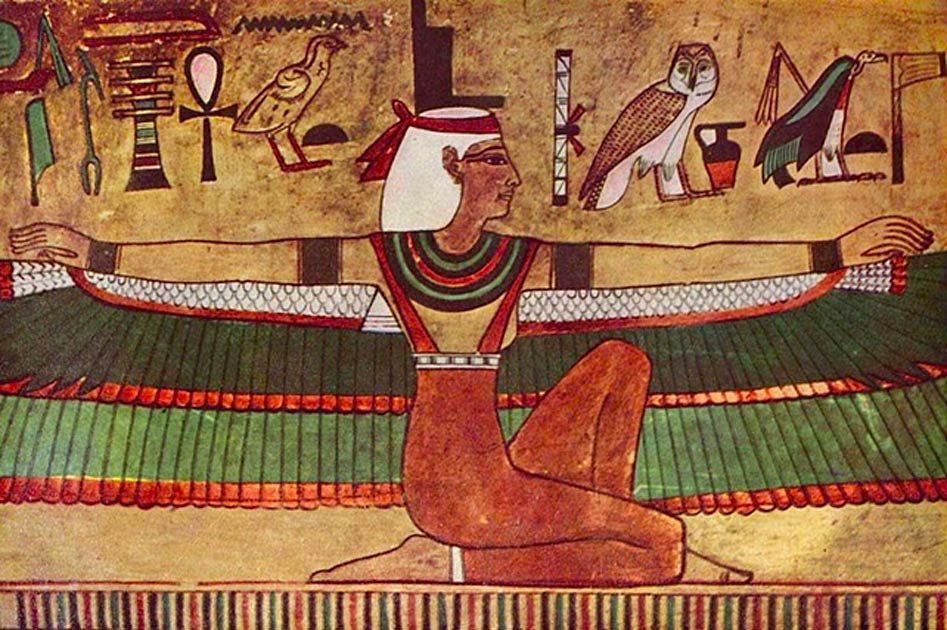
I suppose there is a certain sense in this. Isis is not particularly watery. She is not represented as living beneath the waves even in this late incarnation. She is a sky god, complete with feathers and stars. Seen this way, she becomes the breath of the wind that billows out the sails and the map of the skies which safely guides ships across the trackless seas. And she was a fierce mother who defended her children. She protected trade, which is always a fraught adventure. Isis smoothed the tensions between the normally belligerent Mediterranean peoples. She was the commonality that allowed commerce. She was also, from the very first, associated with bringing the changes in weather that engendered growth. She was the Spring and she created the Harvest — and the harvest is many things, successful trade dealings among them.
Perhaps the oldest celebrations of opening the seas for the year honored local deities. I can’t imagine the proud Mycenaeans choosing to worship a foreigner. But then they also weren’t much into trade. They tended more toward plunder and piracy. So I suppose their adversarial relationship with the sea mirrored their adversarial relationship with just about everything else. Still, the industrious Phoenicians seem to have honored a sea bird goddess, much like the Isis of Roman times. So there were probably others.
In any case, today our ancestors opened the Spring and welcomed Growth. So despite the frozen soil in my garden beds, I will set my ship a’sailing and put my trust in a horizon of verdant benevolence.
St Piran’s Day
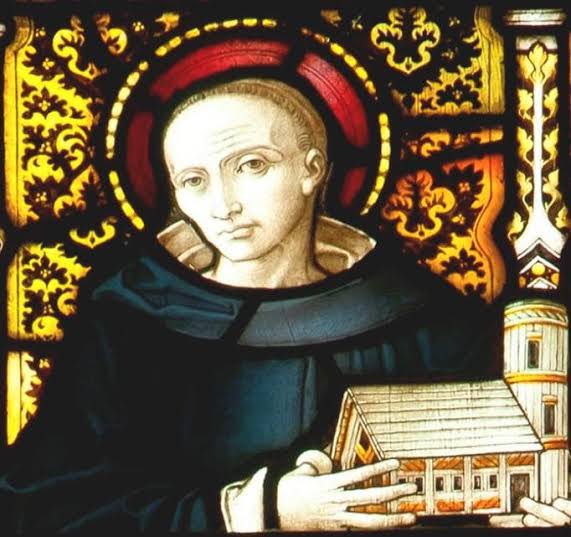
St Piran was a contemporary of St David and likely another student of St Illtud, the creator of Celtic monasticism. Piran is often conflated with St Ciarán of Saigir; and because the Brythonic languages rendered the Gaelic “c” into “p”, “Piran” may simply be “Ciarán”. The facts of both lives are similar enough. Both are Irish natives born in the 5th century. Both spent time in Wales before returning to Ireland to preach to a fairly unreceptive audience. Both were summarily expelled, dumped into the Irish Sea with a rock tied to their feet, and then miraculously washed up on the shores of Cornwall where they found a kinder welcome. However, Ciarán does not become the patron saint of Cornwall; Piran does (though St Michael and St Petroc also have some claim to that). And because Cornwall’s history is centered on tin mining, Piran is also patron of tin miners.
Cornwall’s tin mines made this peninsula on the southwest of Great Britain a focus of trade that has lasted since at least the Bronze Age. Essential to making bronze, which is an alloy of copper and tin, sea merchants traveled thousands of miles to carry this ore back to the large urban centers around the Mediterranean — maybe as far east as Persia. Certainly Cornish tin has been found in Israel. This sea trade created two industries that have lasted for millennia — mining, of course, but also piracy. (Think the musical…)
The rocky and deceptively dangerous coastline of Cornwall was deeply associated with a form of piracy called wrecking — which was pretty much as it sounds, though the image of a peg-legged guy in an outsized hat is far from the reality. Men, women, rich, poor and all in between were involved in this trade, known euphemistically as “harvesting” what came from the sea. Boats were lured into rocky coves where they capsized and sent their cargoes bobbing to the shore. Women and children were sent out to retrieve the goods under cover of darkness. The goods were quickly repackaged and sold to other merchant sailors— sometimes more than once. It was a highly lucrative method of squeezing extra wealth out of trade, not unlike the modern practice of “flipping” houses (which lacks the panache of boats, of course).
Piran is not the patron of pirates — that would be St Nicholas — but his story is bound up with perilous sea travel. He first sailed to Wales as a young idealist to train as a teacher of the new religion (which it must be said also has deep ties to boats…). He returned with a new haircut and a fiery message which the Irish simply refused. (Ciarán/Piran is a contemporary of Patrick, who made all these sea voyages in reverse — and with much greater success.) The punishment meted out to the unpopular messenger was drowning. In classic Irish-mafia style, they tied a huge millstone to his feet and dumped him over a cliff into the sea. But that rock was miraculously turned into a boat of stone which carried him all the way to Cornwall, where he set about building a chapel near the coast from which to continue his evangelizing. He remained in Cornwall until his death on the 5th day of March in about the year 480CE.
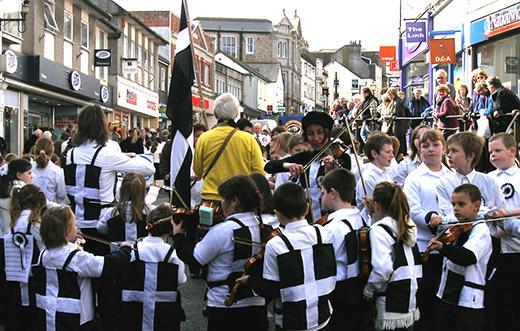
Today, March 5th is the national day of Cornwall. There are parades and concerts. St Piran’s flag, a white cross on a field of black, is emblazoned on every surface. There is also a good deal of feasting and drinking over the entire first five days of March, which are called Perrantide. Tinners have a tradition claiming that many of the secrets of their trade were given to them by Piran, so on his day they leave the mines and let the saint do the work. They head off to the pub where so much alcohol is consumed that March 6th is known as “Mazey Day” and “drunk as a Perraner” was a label used throughout Cornwall in the 19th century to describe anyone who had gone well beyond the bounds of propriety. This, in a land known for its pirates…
Piran’s body is buried in Perranzabuloe, just south of Perranporth. Perranporth Beach is likely where he crawled out of the Atlantic to set up shop. Today, it is a popular parkland with flat sandy beaches and rock pools, and another type of watery adventurer can be found here. It is a favorite haunt of surfers. Those same underwater rocks that capsize boats so efficiently also push ocean waves up into rolling breakers that are fantastic surf without the dangers of strong tides and fierce weather. There are sharks… but relatively fewer pirates!
©Elizabeth Anker 2024

 By My Solitary Hearth
As Emma Goldman so astutely observed, “If voting changed anything, they’d make it illegal.” Voting for the corporate lackey, oligarchic stooge or bankster shill to rule for and over you may be representative but it is not democracy. Yes Eliza, sometimes a good “man” is elected to represent us. But, the system is so corrupt that they are quickly co-opted or reduced to irrelevance. I call our system of governance “shamocracy.” Shamocracy: something that is not what it purports to be; a spurious imitation, fraud or hoax; pretended, counterfeit; feigned; to assume the appearance of in order to deceive.
LikeLiked by 3 people
From my very far away perspective, I cannot help wondering why a country as large as the United States cannot field younger, more vigorous and dynamic presidential candidates. Surely there are more competent, younger, men and women out there. Then, I do not understand the intricacies of the American voting system, so there may be a valid reason. Our general election is to be held at the end of May: that is not an exciting prospect either. The current party in power has achieved little but corruption and mayhem over the past decades, yet the alternatives are basically too small to achieve a majority vote and some are too awful to even contemplate. There is not much in the news here either about it – other than wishful thinking on the part of some commentators and lies and more lies from others. Time will tell.
LikeLiked by 1 person