

It is Good Friday for those who observe the Christian calendar. There are a multitude of traditions associated with this day, some of which can not be traced to any story in the New Testament. Baking hot cross buns on Good Friday is one of those odd but firmly established rituals.

Though there are many conflicting and confounding stories about hot cross buns in the spring, I’ve never found a satisfactory explanation for why these are associated with the middle of spring and specifically with Good Friday. Yes, I know there’s the whole “holy rood” thing — except the tradition of baking these buns in spring seems to be older than the cross part. The icing cross was added in the 18th century — when sugar became cheaply available — to a recipe that was associated with the spring as early as Roman times.
Hot cross buns are airy breads baked into small round loaves. Most modern recipes incorporate eggs, but the early buns were probably more like scones or biscuits flavored with dried fruit and spices. Like pancakes, these little buns were ubiquitous in spring celebrations. Some claim the shape represents the sun, particularly when carved with an equal-armed cross on the top and glowing golden with saffron. However, saffron is more commonly associated with autumn breads (because that’s when saffron is harvested) and especially with Santa Lucia buns in December. I think hot cross buns are just another cheap way to produce tasty calories during the spring fasts. And, indeed, even on Good Friday, there are no specific prohibitions on bread, no matter how sweet, nor is it hard to come by the ingredients, even in this time of spring dearth.
Still, there may be something to the association with the sun, or at least good fortune and growth. There are many traditions around these breads that have nothing to do with eating. They are hung in kitchens and byres to bring luck and protection, often protection from fire specifically. They are placed within walls and under floors as offerings or blessings, conferring strength and durability on the home. They are crumbled and sown with spring-planted grain to ensure a good harvest. They are even used as talismans against disease or in curing rituals. At least one Backwoods cure for spring chilblains is to rub the affected area with a hot cross bun.
But at any rate, hot cross buns happen in spring. Even my grandmother, who did not much like baking, made these the week before Easter. She skipped the icing because she didn’t have a sweet tooth, so that’s how I learned to make them. I still prefer them without icing — just hot buns, I guess, maybe with a cross cut into the surface. (That does produce some nice edge effects in baking.) Sometimes Grandma baked them with dried fruit. Quite often she’d use an egg and orange glaze. One thing she never skipped, though, was the saffron. So I grew up thinking that saffron was the entire point of these tasty spring treats. Far more than the cross anyway. And that is how I bake them still.
I am not making buns today. There’s this stupid job thing that gets in the way of living these days. So here is the recipe I made a few years ago. It is how I normally make them — when freed from stupid job things, that is… For those who want to do vegan buns, I think you could easily skip the eggs, or do whatever you normally do for egg-breads. The dairy is more difficult, but almond milk is probably good. If you like such things, coconut milk would probably be very good. Veg shortening would probably suffice as a butter substitute, but I’m sure you have your own favorite butter work-arounds in baking.

Ingredients
Buns
1 cup milk					3 cups bread flour
1/4 cup brown sugar		        1 tsp cinnamon
8 Tbs butter					1/2 tsp nutmeg
1/2 tsp salt					1/4 tsp powdered ginger
2 eggs 					        1/4 tsp powdered mace
1Tbs yeast                                      8-12 threads saffron
1/4 tsp almond extract	                1 cup dried fruit of your choice (optional)

Glaze
1 egg white
1/2 cup orange juice, pulp free and warmed slightly
1 tsp powdered sugar (or to desired taste & texture)

Icing
2 cups powdered sugar
2 Tbs melted butter
2 cups orange juice (pulp is fine, fresh squeezed is good)
Instructions
Warm the milk, brown sugar, butter and salt over low heat until the butter is melted. Let cool to about skin temperature. If unsure, measure it with a thermometer. It should be under 130°; 95° is perfect.
Beat the eggs well and add them to the milk mixture.
Add the yeast and let it sit for 10 minutes. The mixture should get frothy.
Add the almond extract just before combining with the dry ingredients.
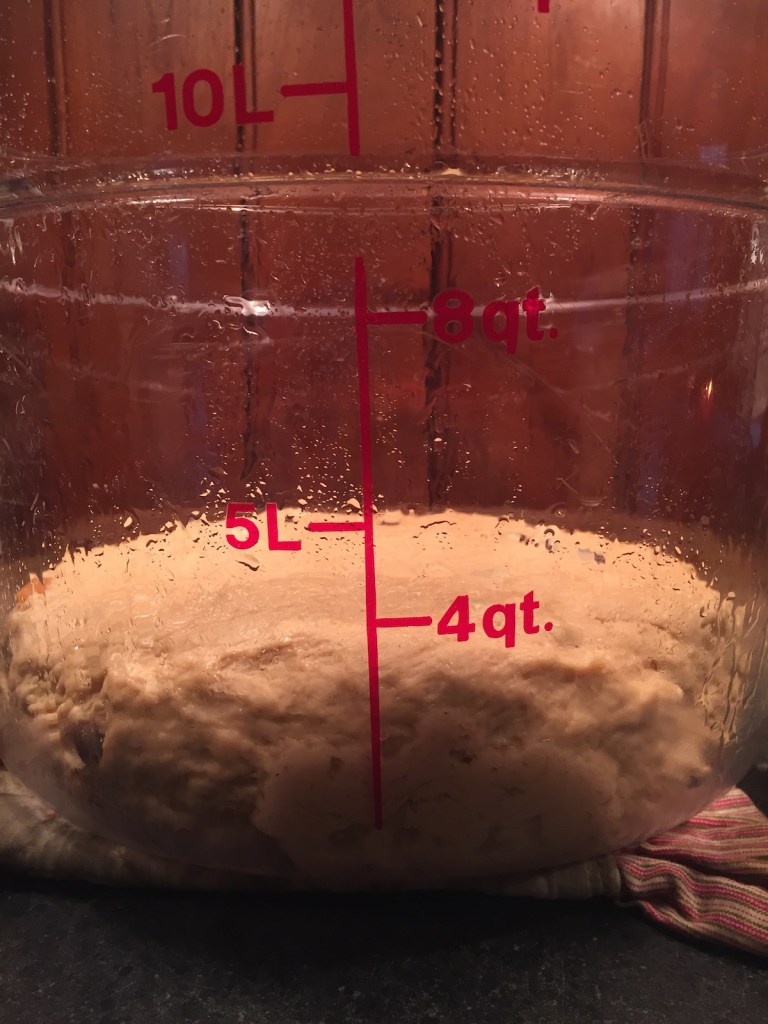
Dough before proofing

Dough after proofing
In a large bowl, stir together the flour and powdered spices. Grind the saffron with your fingers and mix that into the dry ingredients. Hands work best for this, so you get all the saffron into the dough.
If you have a sourdough culture and would like a more complex flavor to the buns, substitute 1-2 cups of firm starter for flour. Or just double the recipe and use half flour, half firm starter. (This is what I usually do.)
Add the milk mixture to the dry ingredients and mix well. Adjust flour to make a smooth, elastic dough.
Use your hands to mix in the dried fruit if wanted.
Cover the bowl, set in a warm place, and let the dough rise until doubled (or more). Probably 2 hours.

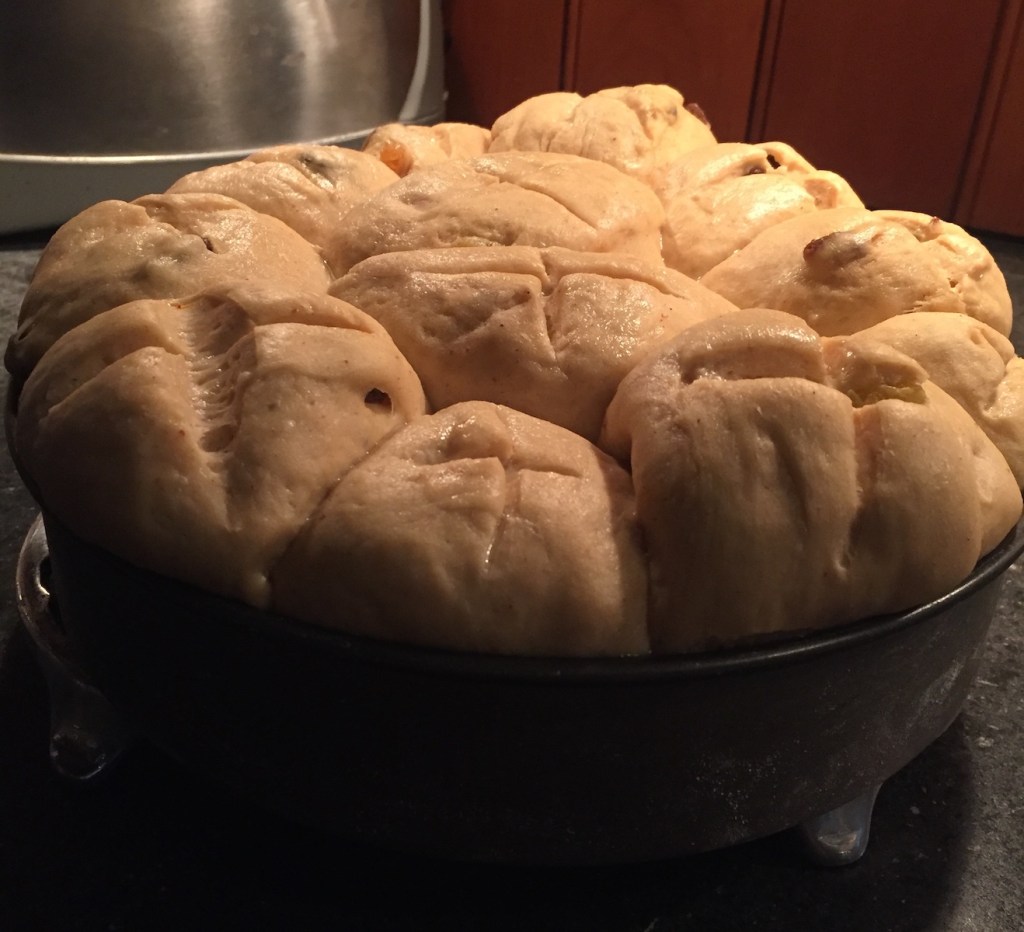
Carefully place the dough on a floured surface and cut into 10-12 equal pieces, trying not to de-gas the dough very much. Form these pieces into balls and set them, close together, in a lightly greased and floured baking pan.
Let these rise in a warm spot for 30-45 minutes, until about doubled again.
Preheat the oven to 400°F.
If you are using the glaze, separate the egg white and beat it well.
Add the sugar and orange juice and beat together. It should be somewhat syrupy.
When the buns are ready to go into the oven brush the glaze over the top.
If desired cut an X into each bun with a sharp knife or baking razor (a lame).
Bake for 40 minutes in a 400°F oven until buns are golden.
To make icing (and there’s no reason why you can’t have both glaze and icing!), combine all the ingredients and beat them until you have a smooth paste. Adjust sugar as necessary.
Put the icing in a small baggie with one lower corner cut away. Or a pastry sack if you’re fancy.
When the buns are cooked and cooled, draw an icing X on the top of each bun. (If you’ve cut into the buns before baking, simply fill the cuts with icing.)
This recipe makes 10-12 buns.
If you have leftovers (how?), store the buns in the fridge.
©Elizabeth Anker 2024

 By My Solitary Hearth