

Crom Dubh Sunday
In many northern communities, July is a hungry month. The spring flush of greens and quick-growing roots like radishes and beets may still be trickling out of the garden, but most have bolted and run to seed. However, those that remain are long on fiber and short on calories, and little of the spring harvest is amenable to preservation — if there are means of preservation at hand in the July damp heat. Most traditional methods of keeping the harvest require cool temperatures or dry air.
There is milk, and this used to be the main source of nutrition and calories in the middle of the growing season, each family or small community from farm to city having at least one dairy cow to turn all this rampant grass into a stream of nutrition that humans can ingest. But in the last couple centuries dairying has been concentrated into a few intensive production farms that mainly serve urbanites — the privileged get the cream, the laboring classes get the watery whey with additives.
The same goes for eggs. Whereas every family used to keep some kind of domestic fowl to turn food scraps and pestilential bugs into delicious eggs which would quell the hunger in the lean summer weeks, now eggs are produced in horrifying factory conditions mostly for consumption by the wealthy because eggs produced in this manner and shipped long distances are costly — and there now needs to be profit in each egg rather than nutrition. Moreover the chickens are now fed a diet that is not complimentary but in competition with human nutrition, grains and legumes. Worst of all, these factory farms concentrate disease. So when bird flu finds its way in, hundreds of hens must be killed to contain the contagion. This is one of several reasons why eggs are so dear right now.
Grains and legumes are not quite ready in the summer. Early on, there may be garden peas, but these are grace notes on the diet, not bulk calories and protein. Under the Hay Moon, the more cold-tolerant grains like oats, barley and rye are harvested. However even in mechanized farming, the process of turning the seed-heads of grass into edible food takes a quite a bit of time and labor. It may be mechanized labor, but it is still necessary work that must be done before eating. Grain is never edible right off the plant, quaint tales of baking bread from the first or last sheave notwithstanding. Also the cold-season grasses produce seeds that are relatively high in plant proteins and fiber, but they aren’t the calorie-dense foods that empty bellies are craving in this season of hard work. Those energy-rich seeds mostly come from spring-planted wheats like durum and hard red — that which gets made into most of our pastas and high-gluten doughs like white breads, pizza crust and bagels — and these grains are not ready for harvest until late in summer and not available to fill bellies for many weeks after the harvest begins.
However, there is one cold-tolerant, calorie-packing crop that is ready to eat in late July — the potato. Like the family cow and flock, small communities and homesteads have cultivated a potato patch since the Andes were invaded and this highly engineered ball of easily stored energy was shipped off to northern climes. Potatoes grown as local food are extremely energy efficient. It doesn’t take much to plant or nurture a bed of potatoes. It actually takes more work to keep them from taking over in limited spaces. Harvest is a bit time-consuming, but it is not particularly hard work if the soil is kept hilled-up, light and loose — the way potatoes prefer it. Storing potatoes can be as complex as the Andean methods of freeze-drying the tubers into virtual rocks that can be kept for years, or as simple as dumping the spuds in a bin of sand and placing the bin in a cool, damp place. In climates that don’t get so cold that the soil freezes hard, potatoes can even be left in the ground and dug up as needed.
It is not romanticizing to say that Ireland fell in love with the potato. Grown as food, the potato nourished all classes. The potato harvest became a central pillar of Irish culture, with its own mythos and traditions and wisdom tales — and recipes! Combined with cabbage and various alliums, the potato makes nutritious ballast for the belly. Paired with fish or roasting meats or all sorts of dairy products, potatoes provide the caloric boost necessary to digest the proteins, as well as a perfectly balanced blend of flavors. Potatoes are even eaten alone, as fried chips or simply roasted whole in the fire, as fluffy and rich as a warm loaf of bread — with much less effort.
In Ireland, there was a tradition of fair season, Lughnasadh, the wake games of the harvested land. This complex of holidays was centered on the third cross-quarter day in the Irish calendar, August 1st or 2nd. Lughnasadh predates the potato in Ireland, probably by millennia, but once the spud showed up, the jubilation of the potato harvest took center stage in late July and early August. Most of the traditions associated with Lughnasadh are related to the potato — from the first harvest pot of colcannon to be shared out with all and sundry to the anxieties over a late or failed harvest that might spread to other fields. This was combatted by making sure everybody got to eat the first harvest, even if some fields were not ready.
We remember the Famine and some blame the potato for failing the Irish people, but this could not be further from the truth. There was blight and it did decimate the harvest for several years running in the 1840s. But the main cause of the hunger was the same as the cause of hunger today — crops were being grown for profits that accrued to distant owners. Potatoes were commodified. The best land was enclosed and taken out of local food production, turned into acres of wealth extraction for English owners. The former variety of potato cultivars was cut to just one or two strains, which made crop failure nearly inevitable once pests and disease-causing microbes adapted to the introduced plant. And rents on land and housing were simultaneously ratcheted upwards, so that the Irish people could barely afford either food or shelter — but not both — while all the traditional community support networks were undermined and destroyed.
This is the same familiar story we see the world over when capitalism comes to the community. Homes and families are ripped apart, and local food-ways are trampled into the dead dirt. Those who used to thrive on nutrition and calories produced for themselves become wretched and hungry when wages and long transport lines come between the soil and the belly. Crops raised for wealth extraction gut the land in a race to the bottom possible cost per yield. And eventually the weakened soil and plant communities will falter and die, leaving long-term scars on the land and failed harvests of all kinds. The Famine was not potato blight; it was theft.
But there was this tradition of July of the Cabbages, the Hungry Month, the lag time between the promise of planting and the bounty of harvest. A time heavy in labor and light on reward. So as the Irish people recovered from the rape of their land, the potato took pride of place in the celebration of the first fruits — because it ended the season of hunger, filling all the bellies like the August storms filled all the lakes and streams.
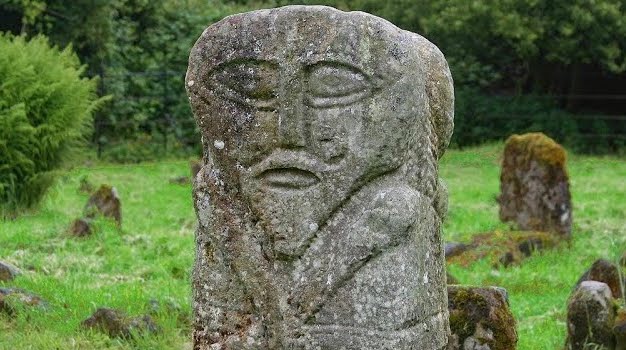
This became Crom Dubh Sunday, or Reek Sunday, or Bilberry Sunday. In the old traditions, people spent the day in pilgrimage to the high places to give thanks for the quenching of the summer heat and hunger. In the newer traditions, farm-wives cooked vats of potato mash flavored with new bacon to share out with their neighbors, especially those whose fields languished, the “wind farmers”. Offerings of flowers and milk and honey were left for the Fair Folk; and Crom Dubh, the “dark bent one”, was thanked and honored for allowing the people to take the harvest from the land. Children gathered the wild blueberries known variously as bilberries, fraughans, whortleberries or heatherberries from the hedges and hills — and young women and grandmothers baked that bounty into delicious cakes to sweeten the potato feast. Contests and games were held for the sheer pleasure of using the body and mind again after summer lethargy was shaken off.

For this is the beginning of the fair season, the revels of the harvest, the gathering of the people for feasting and communion and good-natured competition in which there are rarely any losers and everyone wins the prize of a delightful day. It is Lughnasadh, the “games of Lugh”, inaugurated by the god of the tribe to honor the sacrifice of his step-mother, Tailtiu, when she labored to clear the fields so the people would be sustained.
Crom Dubh was a Christian invention, a local devil to set against the new hero, St Patrick. In the Christian tales, he is the very incarnation of evil. But if you pay attention to the stories the monks told, you can hear an echo of the old man of the mountain, the “dark bent one” of Irish folklore. This being has much in common with the Egyptian Bes or the earliest versions of Roman Saturn. These are jolly old men, often portrayed with bug-eyes and bulging bellies and sly humor. Saturn rules regeneration and shows us how to bring in the harvest. Bes is the protector of families and children, the defender of “all that is good”. Crom Dubh has no mythos, but there are elements of the ancient dark old man who gently guides the lost home, who magically produces food for empty bellies, and who protects the weak from the predations of the strong. Crom Dubh puts out the blazing eye of Balor and ushers in the harvest. On Crom Dubh Sunday, the tribes thanked the old man for quenching the heat of the late summer sun so that work could be done in the fields.
In my part of the world, the harvest is going rather well. The veg may be a bit late, but it is abundant. Many gardeners I know have too much kale, tomato plants that are taking over, and apple trees weighted down with ripening fruit. There were two cuttings of hay at the farm across the street from where I work, and the orchard I like to visit had such a bounty of sour cherries that they marked down the price only a week or two into the season. And blueberries are ripening right on time. Friday’s newspaper carried a front page picture of pick-your-own berries at a nearby farm. I will be going next weekend.
But not today… even though this is Bilberry Sunday. Because this weekend is my town’s birthday party. There are food trucks, one selling nothing but curly fries slathered in hot buffalo sauce and melted cheese. There are performances in every venue and music playing in the parks. We’ve had fireworks and a parade. The library is holding its huge annual book sale. There was a strawberry shortcake social on Friday and an ice cream social today. There are demonstrations and craft classes on everything from sheep shearing to glass blowing to carving granite. There was even a coloring book party for those of us who are not up to full-body-contact crafting. From Thursday afternoon to sundown today, there has not been one hour without something interesting to do. However, I have not got to enjoy much of it (except the fireworks from my bedroom window and the strawberry shortcake which was indoors at the Grange). We had a visitation from Canada on Friday evening… The smoke was so bad on Saturday that the early morning fog was brown, and when that burned off it left tannish-grey skies and yellow air at ground level. I can mask my lungs, but not my eyes which do NOT like smoke…
So… I stayed indoors yesterday. And today I am getting in all the food trucks and outdoor music I can. Berry picking will have to wait. I think Crom Dubh would understand. In fact, I’m pretty sure he would be first in line at the Sisters of Anarchy ice cream stand today. Gathering is what this time is all about, after all. And games. And fun. And not a little goofiness.
So enjoy today! Take some time to use your body and fill your belly. Play games. Climb to the heights. Gather the late summer flowers and the early autumn fruits. Make cornucopias to grace your table. Cook a first fruits feast. And give heartfelt thanks to the gods of your place for allowing you and your people to take a little, your own needs, from the land’s vast bounty.
©Elizabeth Anker 2025

 By My Solitary Hearth
I have absorbed all of this with great interest. Enjoy the food stalls and the fun today!
LikeLike