

May the 4th be with you!
Hawthorn Day
May 4th is Hawthorn Day. This is the traditional day to tie clooties on hawthorn boughs over magical springs. It’s one of the days when villages compete to make the most astonishingly elaborate display of greenery and white flowers. It’s the Feast of Bona Dea when we re-member the Earth’s bounty and give thanks to the Producers. This is the first day of National Wildflower Week, and Friday is National Public Gardens Day (and, yes, I am still sad about the destruction of the White House Rose Garden). We’re in the waning of the Greening Moon, but not near the Dark Moon yet. And Sunday is Mother’s Day. Altogether, this is a great time to plant a garden.
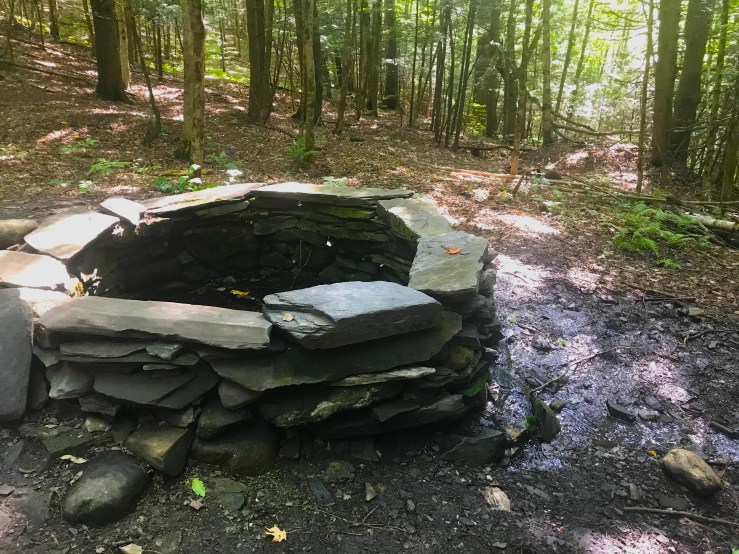
The dandelions are blooming, so over the weekend I planted all the potatoes. This year, they are going in the big bed at the back of the garden where they have plenty of room to ramble. I have Adirondack Blue, Elba, a New England russet, and a winter-keeping potato that was bred in Vermont — but this is the last year that Fedco will be selling it. So… I need to grow seed stock for next year.
I dug the potato trenches and filled them with spud pieces. Then I planted a couple kinds of red onion between the potato rows. These will deter potato bugs, so they say. But really, I’m just using space efficiently.
I covered the whole bed with a few inches of fresh compost and then several inches of straw. There will be plenty of vertical space for the potatoes to make tubers. Later in the summer, when the onions are tall, I’ll probably add on another few inches of straw for a few fingerling potatoes at the top. Blue potatoes make delicious fingerlings. Just wash them, toss them in a covered dish, drizzle with olive oil and fresh rosemary, and roast them for about 45 minutes. This makes a satisfying meal for me, especially with a bit of yoghurt on the side.

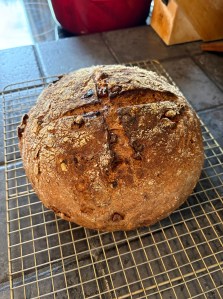
I did not garden on Sunday. It was windy, spitting rain — and snow at the higher elevations — and the temperature stubbornly remained at about 40°F. Which is not warm enough for my joints. But I had enough to do. Laundry and cleaning and so on. But I also decided to make lentil-rice stew and a superb walnut-onion bread. This is not exactly spring fare, but then, it’s not exactly spring weather here. In any case, I’m the cook and that’s what I wanted.
Well-Dressing
March winds make April showers,
and April rains bring May flowers.

Dry March, wet May
fills the barn with corn and hay.
These are the snippets of lore we English-speakers learn as children. I suppose they don’t apply to much of the English-speaking world anymore. Leaving aside the whole Southern Hemisphere — for which the annual calendar associations are all wrong — even in the North a “dry March” or “wet May” are unusual. Usually it is the opposite; and in some quarters, May is decidedly leaning toward drought. March may be windy, but it’s also wet; most spring precipitation falls in March. And while April may have showers, it may mostly fall to the ground as snow in my part of the world. What is constant is the warming of the sun and the melting, creeping flow all around us.
Water may fall from the sky, though it falls less and less as the Greening Moon waxes and wanes; but most of the flow of water in North American Spring comes from melting. It may be mountain snow running in streams to the sea. It may be flatland snow mounds sinking into the earth. But Vermont Spring deals in Winter’s precipitation. And everywhere there are perennial roots, the water is captured. So after a summer and autumn of drought, as we had last year in most of the Northern Hemisphere, much of the spring thaw of winter will be sucked right up into the woods. Perhaps in your part of the world this year, the Greening Moon streams are silent because the waters are feeding the trees. But even so, meltwater is making its way further downwards. Permeable layers of sandstone and shale let water flow in rock-bound rivers. Cracks and crevices deep underground become dark pools — and wells are filling. So this is the season of well-dressing, honoring the cold, clean water that flows from the earth.
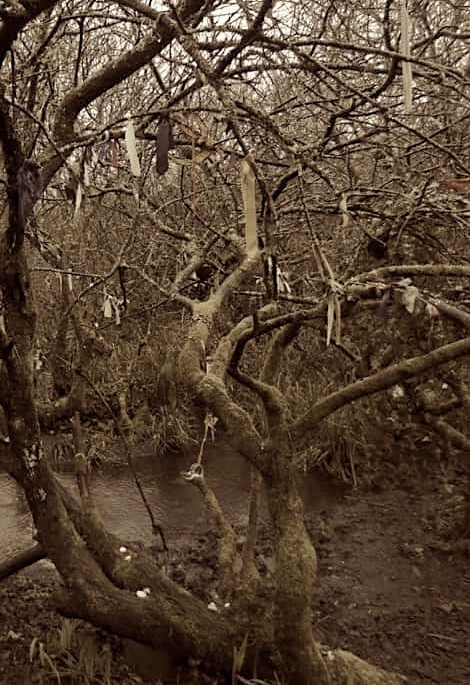
Although the English well-dressing festivals happen later in the summer when there are abundant flowers to make elaborate displays, the custom of decorating a well or leaving votive offerings in spring-water is more commonly associated with the season of beginning growth, not harvest. On May Day, it was customary to make pilgrimage to holy wells, seeking both cures and curses; and spring rites from Imbolg to Beltaine include hanging strips of wishing cloth — called “clooties” in Scotland — on the small trees that overhang a well, usually alder, hazel or, most auspiciously, hawthorn. These strips of cloth originally were torn from the clothing of petitioners so the spirit of the well would know who sought their aid. Over time, the torn rags changed to bright ribbons and streamers of lace. A clootie tree, one decked in colorful bunting, is a merry sight — though I’m sure there are still curses cast into the waters with the coins and silver pins and many of the wishes likely flow from sadness…
Still, a wish made is a sign of living hope.
there is a sacred spring
	down the lane
yea, truly, though abandoned by utility
	desecrated by profanity
there is a tiny bit of the elysian
	just down the lane
a spring bedight
	in candles, coins, rags, riches
	scraps of superstition
	supplication
	alms and oblation
just down the lane
and surreptitiously they come
	seeking lucidity
	seeking succor
	seeking salvation
yea, truly, they are drawn down the lane
	by the aroma of fecundity
just down the lane
and so, to the spring they come
	where life is swelling and essence is streaming
	maidens are laughing and lambs are bleating
	sparrows are singing and spirits are speaking
	and white blossoms ever are teeming
or so they say
	just down the lane
		is a sacred spring
Here is a story I wrote about the custom of sending wishes to the well-spirits. It is not set in spring, but in autumn because I felt that its plague atmosphere was a bit too bleak. In reality, most wishes were just as dire as the one in this tale, yet were commonly made in Springtime. Our ideas about benevolent Spring may be colored by the continual abundance we find in modern supermarkets. Not too long ago, and very likely not too far into the future, spring was and will be a time of perilous dearth, a time when hunger allowed illness to run rampant. So this story is probably more coldly vernal than luxuriantly autumnal.
The Clootie Tree
She crept down the lane, keeping to the shadows which danced in the afternoon wind. Leaves circled her like hunting cats, taking her scent, then passed on, no doubt intent on getting caught up in the thatch in the lee-sides of the village chimneys. Tears sprang to her eyes as she realized her brother would never again be up his ladder, cleaning out the damp rot before it spread through the roof. Liam was the fifth to fall this month and the youngest claimed by the plague so far.
Maeve stopped and leaned against an oak bole. When would it stop surprising her, this sudden sharp pain? When would the wounds in her heart begin to scab over? When would she be able to breathe again? Mother dead, father dead, her sister, and both of her towheaded nephews. Now her brother. She and her sister’s husband moved through the desolate house, avoiding the wide emptiness in each other’s eyes. So much loss in each glance, one look into those depths could cripple.
She didn’t understand why she was still alive. She felt both abandoned by her mounting dead and ashamed by her continuing good health. Why were they gone and she here? Why couldn’t she follow? She’d sat by enough deathbeds; surely Death had her name and number by now. Yet he did not come for her with his bloody cough, florid rash, and blue, bloodless lips — a cold kiss of no awakening. The graveyard was full, yet she still walked the waking world. For how much longer? How much longer?
She walked on.
As she neared the spring, she fingered the slip of ribbon in her pocket. Nine months ago she’d torn off this bit of binding from her mother’s pale blue nightgown. Her mother had died first — before the village was aware of the monster that had crept into their midst. Her mother had died of a flu virus; by the time her father died a fortnight later, it was The Plague. Maeve had taken the ribbon and kept it in her pocket, waiting for something she could not name.
She turned off the lane, following a well-worn footpath into the woods. The path threaded its way through tall boulders that looked like so many drunken trolls caught by the rising sun. The leaves were still green here and mosses furred every surface. Woodland asters nodded in grave assent as she passed. Her sense of unease grew with every step.
This was dangerous ground, sacred ground. What warrant had she to tread this path with her petition? She was inconsequential, just a motherless child lost in the woods. What right had she to ask for aid? She almost turned back. But then suddenly, a whirling torrent of leaves leapt up around her, and the wind carried the sharp scent of snow in distant pinewoods.
Maeve froze.
But in the blink of an eye, the leaves swirled away leaving nothing behind but a hint of disquiet. She hesitated for a bit longer. Should she go home? Or now that she’d come this far, should she just go on with it? She could not read the leaves. And false steps were deadly. At that thought, she realized that there was no hold on her. She had nothing to lose. Death already stalked her world. What worse thing could happen? She did not care if he came for her now. It might be a relief. She went on.
Not many more steps and she came upon the standing stones that marked the spring. Rowan berries and oak leaves blazed russet and copper. A spreading hawthorn stood sentinel over the pool, glowing gold and vermillion in contrast with the emerald mosses and sedges that limned the water in verdant summer. Bright-hued ribbons fluttered in the autumn wind, remnants of past supplicants, delicate embodiments of grief and want, falsely cheery in their pageantry of color.
Maeve pulled the pale blue ribbon from her pocket. Even now fear made her body heavy. She moved as though resisted by deep water flowing in fast currents. She treaded the marshy banks carefully, making her way to the Clootie Tree. A silver coin for the pool and a ribbon for the silver branch. She dropped the coin into the waters and watched it sink into the depths. It vanished into the mud with nary a glint remaining. She then reached up with the ribbon and tied it to the hawthorn.
Another gust of wind swirled leaves and ribbons and set the light dancing around her, but this time it took the fear from her limbs. She stepped back and bowed her head, whispering her heartfelt prayer. She felt a presence, an awareness, terrible but compassionate, turning her supplication over in slow regard. She felt her words heard and accepted. She felt a great weight lifted from her shoulders. She saw water droplets rippling the surface of the spring at her feet and realized these were her tears, mingling with the spring water.
She bent and dipped her hands into the pool, brought the water to her lips, and drank. Grief and supplication in those waters. And relief. Gratitude swelled in her heart.
She rose and turned away. Her prayer was answered. She need not linger.
©Elizabeth Anker 2026

 By My Solitary Hearth
Very interesting – as always. The bread looks so delicious too!
LikeLike