

I wrote in my garden calendar that today is the day to plant out the nightshades and sow the summer cucurbits and beans. If the weather holds, then as you read this I will be out in the veg garden covered in dirt — and indescribably happy! Not least because that means the guest bedroom will be free of plants.
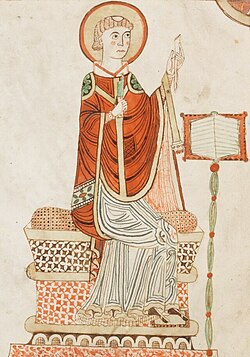
Today is St Bede’s Day. Bede was a late 7th century Anglo author and historian who served at the monasteries of St Peter and St Paul, both in the Kingdom of Northumbria. His writings are extensive, including the magisterial Ecclesiastical History of the English People, an exhaustive history of the Christian religion in Britain. He was the theological authority of his time, writing tracts, books and commentaries. His chronologies and explanations are still regularly quoted — with caveats. In his time, there was none of this obsession with separating the objective from the subjective, and the Venerable Bede liberally salted his works with his own exalted opinions and fancies. Still, he lived about a century after the great Irish Church father, Colmcille, and about a century before the Carolingian renaissance, so his writings shed light on a time that is otherwise nearly opaque. He also wrote some of the earliest accounts of what would later become the Arthurian tales — though, being a patriotic Anglo-Saxon, Bede completely omitted Arthur’s name from his writings, calling the victorious commander at the Battle of Mount Badon, for example, simply the British legionnaire.
Friday the 29th is Oak Apple Day, or Garland Day. On this day, the Garland King rides through Castleton in Derbyshire draped in a voluminous floral garland. The King leads a procession through the village to St. Edmund’s Church where the garland is raised to the top of the bell-tower to crown the spire. The day commemorates the 1660 Restoration of the Monarchy on the 30th birthday of King Charles II. Great Britain is currently ruled by King Charles III.
Saturday, 30 May, is the traditional date of the battle between King Arthur and his nephew (or son, likely foster sister-son), Mordred, the day King Arthur died. If the Battle of Mount Badon began his illustrious quest to unite the warring tribes of Britain, the Battle of Camlann was his ignoble end. Though it was not the end of his story. Tradition has it that Arthur was spirited away under the care of his sister, Morgaine, to an island in the West — perhaps Avalon, perhaps Glastonbury, or maybe Emhain Ablach, the Otherworld island of undying apples, land of Manannan. Wherever he may rest, it is said that when Britain’s need is great, Arthur will return once again.
On Sunday the 31st the Flower Moon is full at 4:45am. This is the second full moon in May and therefore a blue moon.
Garden Advice for May 25th: Plant thyme near cabbage to deter cabbageworms, which are the larvae of cabbage white butterflies. Plant summer savory near beans to drive off bean flies and blackfly infestations, which latter are actually aphids.
Ancient Rome celebrated the festival of Rosalia, also called Rosaria, on one or more days from early May to the middle of July. The Oxford Book of Days claims the Rosalia fell on 23 May, so that’s what I recorded in my calendar. But I think the idea of the festival better matches Memorial Day. Not as we celebrate it, but the meaning behind the day. This is ostensibly a time set aside to honor the dead — particularly the martial dead — with blood red flowers.
Now, it is unusual to see a rose blooming in May in either Oxford’s England or my New England. I rarely had rose blossoms before June even in New Mexico. Yet though Rome is far north of Albuquerque and much closer to the latitude of my current home in central Vermont, the Mediterranean Sea surrounding the Italian peninsula moderates the climate to such an extent that it is likely roses were blooming in abundance by late May in Roman villas.
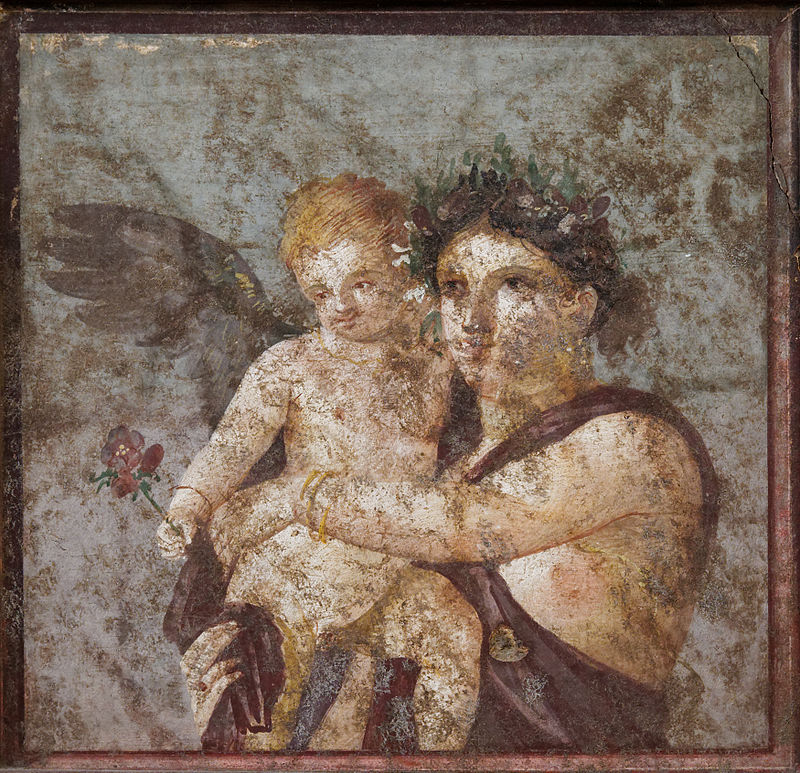
The Rosalia was a day of the dead, a dies rosationis, a day of rose-adornment, a commemorative festival that goes back to the earliest Greek cultures. The day of adornment could also be celebrated with violets, both flowers being erotically scented and colored the rich, warm hue of blood. Violets, in particular, were associated with the blood of gods and deified mortals. Adonis, beloved of Venus, was gored by a wild bore. The blood that dripped from his wounds sprang up from the ground as blooming violets. Similarly, in the much older story of Attis and Cybele, blood flowing from the mortal injury of Attis became a garland of violets which Cybele draped on the sacred evergreen fir-tree in memory of her lost lover. This winter tree decked in bright flowers is one of many origins of the Christmas tree.
Roses, too, were closely associated with the dead, and especially those who were mortally wounded. After Achilles abused the corpse of Hector in the gruesome tantrum that followed the death of Achilles’ lover Patroclus, Aphrodite bathed the desecrated body in roses, restoring it before Hector’s grieving family came out to retrieve his corpse. Bright roses were thought to bloom eternally in the dim Elysian Fields of the dead, and being pricked with a rose thorn was a common euphemism for deep wounding — sometimes with the bronze and iron of the battlefield, sometimes with the darts of love. The Latin purpureus was applied to the bloody color range of roses and violets, marking them as flowers of death. Etymologically, purpureus is akin to Greek porphyreos, which described the coloring of skin by bruising or wounding. Warriors dying in battle were often poetically associated with blown roses in deep shades of red. Sacrifice to the dead frequently included garlands of roses and violets or libations of red wine in lieu of blood, and graves were decked in these bloody flowers at many times throughout the year. Hothouse flowers were a major Roman industry, with most going to adorn graves.
Maybe because of this eternal life-in-death association, the rose, in particular, also became associated with royalty, feasting, erotic love and passion. The rose was a symbol of goddesses from Astarte to Venus and continued its association with the Divine Feminine right into the Christian age. The Virgin of Guadalupe, the native Mexican avatar of the Virgin Mary, revealed herself through a bouquet of wine-dark roses blooming in December. Roses represented both sides of the English succession wars — white York and red Lancaster — and the Tudors used the two flowers combined into one to metaphorically proclaim the hard-won unity of the new royal line.
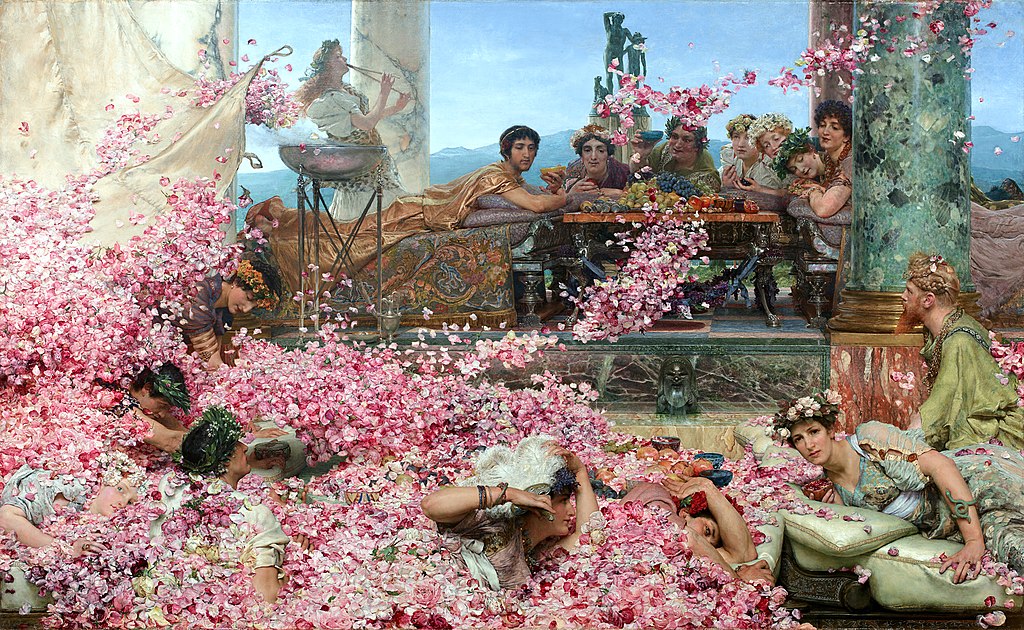
Roses have long been given to sweethearts on Valentine’s Day and have been worn by brides and bridegrooms since ancient times. In fact, in Rome it was more common for the groom, the embodiment of the family bloodline, to wear a crown of roses than for the bride to be so bedight. Similarly, when the Emperor went abroad in the city, he wore a rose and laurel crown and his route was garlanded with rose-laden vines. The probably apocryphal Emperor Heliogabalus (his name is a fusion of the names of the Greek sun deity, Helios, and the Syrian sun god, Elagabalus) once buried and asphyxiated an entire hall of banquet guests in an avalanche of rose petals. It is thought that this grotesque story was derived from the tradition of showering victorious athletes and newly wedded couples with leaves and petals — a custom called phylloboliain Greece — but Victorians reputedly became quite enthralled by the concept of suffocation by roses.
Though there was a deep association between deity and the rose in ancient times, the flower was not explicitly tied to any one pagan god. So the rose’s favored status continued through the Christian era to today. Catholics still count prayers with beads named for the Roman funereal garland of roses, the rosarium, what is now called the rosary. Some rosaries include beads made from pressed rose petals or porous beads that are infused with attar of roses. Globally today, the rose accounts for over a third of the cut flowers sold in any given year, and, as in Rome, hothouse flowers are still a major industry; the perennial demand for roses extends well beyond the growing season. Roses and lilies are still the principle flowers in bouquets and garlands for both wedding celebrations and funerals. And we give roses to our mothers in May while naming many of our infant daughters Rose.
We used to garland the graves of fallen soldiers in roses on Memorial Day, but we do not celebrate the rose-adornment as enthusiastically as our ancestors once did. We do not honor our ancestors as they honored their dead. We are too afraid of the transformations of time and the un-making of the self to fix our gaze on those who have gone before us. Death and the dead are hidden away in forgotten corners and cold crypts. Funerals mark the end of relationship with those who have died. We still give roses to sweethearts and we make lavish arrangements of flowers to surround caskets, but we forget that the rose is the symbol of sacrificed life-blood, the death-in-life and life-in-death, the end of one cycle so that life can carry on to the next.
Still, there are many stories of the duplicitous nature of the rose even in our culture. Snow White originally had a sister, Rose Red, in the much Grimm-er version of the story; and the pathos of Perrault’s “Beauty and the Beast” begins with a plucked rose. Roses are equally symbolic of horror — what vampire does not wear the damask rose? — and benign comfort — fairy roses ramble over every cozy cottage in our folktales. A yellow rose is the sign of eternal friendship, white is purity, pink is innocence, but red is power, passion, lust and death as well as perdurable love. In the folklore of the rose, even in its most Disney-fied princessy pink, there is a grave undercurrent, a whiff of putrescence in the heavenly scent, the hint of spilled blood in a dewdrop falling from rosy thorns. Even as death-averse as we are, we see death in the rose and embrace it. Maybe the rose is our scapegoat, the embodiment and repository of our promise to the future, our tacit acknowledgement that death is both necessary and beautiful, though terrifying and as odious as a rotting flower left too long in the vase. I see shadows of sacrifice in the rose, the ephemeral nature of all life — and particularly of beauty — and the agreement to abide by the limits of individual existence — so that existence may continue without limits.
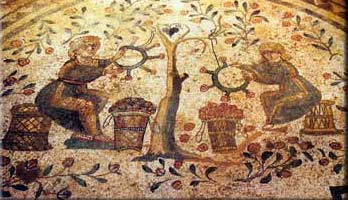
Maybe that’s too poetical for the analytical Greek and the practical Roman, but there was undoubtedly weighty magic behind the rose even in Mediterranean cultures. As we are the heirs to those cultures, it’s not inconceivable that we find subliminal traces of that magic in the stories we tell ourselves. I think that even in our death-denying culture, we see our death and the continuance of life in the fragile allure of the claret rose. And in spite of its thorns and its finicky culture, the rose still grows ubiquitously in our gardens and we still give its blooms to those we love best.
So today, take your roses and weave garlands of hope and remembrance. And if a few drops of blood fall on the flowers, take that as a symbol of the life you will gladly lay down so that you may be ancestral to the future.
©Elizabeth Anker 2026


I find it very interesting that in St. Bede’s time, “there was none of this obsession with separating the objective from the subjective.” Bede lived in a time when written language was displacing the oral tradition of the poets and bards. It marked not just the end of the bards but the beginning of the Greek language problem that transformed a society intimately interconnected with nature into one of degrees of separation. I wrote this poem for last Wednesday’s word, but it is really about the changes that writers like Bede imposed on their – and our – world.
The Crisis of Reality
********
The crisis of reality
was the culmination
of all that subjectivity,
all those little white lies
and biases given free reign.
Of course we have the right
to see reality however we see fit.
It could be no other way
this culmination of the Greek language problem.
The one degree of separation
That made all the difference.
All this I, me, mine reality
and the worst part is not caring
any more about a common reality
that others saw too.
But only what is left after
we all see things our way.
Reality fractured into a thousand pieces,
our souls in two, ego and id.
Of course, there still was a common reality
but it had become so commodified.
Substance instead of relationship,
everything money or cost
value indistinguishable from price.
Shadow ghosts of the real use,
numbers floating in a space
that no longer seemed real.
LikeLike