

Lion and Lamb
March is upon us once again. An Old English name for March was Hlyda, meaning “loud”, presumably referring to the roaring March winds. This name survived as Lide in the West countries.
Eat leeks in Lide and ramsons in May,
And all the year after physicians may play.
— proverb from western England

The month that comes in good goes out bad.
— 1 March in the Old Farmer's Almanac calendar

Ducks wan't lay till they've drink'd lide water.
— Cornish proverb*
*Probably long after they’ve “drink’d lide water”. Ducks don’t lay eggs until there are 14-16 hours of sunlight in a day, and Cornwall doesn’t see 14-hour days until the end of April.
In Devon the first three days of March were called blind days, so unlucky that no farmer would sow seed until the 4th. In Greece, the first three days of March are known as sharp days. If you wash clothes, they’ll wear out; chop wood and it will rot; bathe and your hair will fall out. Traditionally a March-thread is left out overnight on a rosebush then worn on the wrist for protection until Easter. This custom is sufficiently ancient that St Chrysostom complained of the ubiquitous red threads “draped on children” to protect them, and woolen threads to ward off evil were worn by the initiates of the Eleusinian Mysteries at Athens.
Paradoxically, Greeks also regard 1 March as the first day of fine weather. In the Dodecanese, children go round with an effigy of a swallow, singing songs in honor of the bird and the fine weather it brings, begging for food at each house. This was also a custom in ancient Rhodes.
March has a long association with beginnings and new year celebrations. March 1st was originally the first day of the Roman year. Though the official new year was moved to January 1st in the 2nd century BCE, March 1st remained the de facto new year throughout classical times. It was marked by tending the sacred fire of the goddess Vesta and hanging fresh laurels on various important buildings in Rome. The Leaping Priests, or Salii, performed a procession in honor of Mars, chanting archaic hymns, which had devolved to nonsense even in classical times, and carrying figure-of-eight shields called ancilia, thought to have been the type of shield carried by King Numa, the second king of Rome.
March 1st was also the beginning of the official year for Venice. It was the Russian new year until the 14th century. March was reckoned the first month of the financial year in the Ottoman empire. The ancient Franks counted their year from March 1 until the 8th century. Sumerian new year festivals were held when barley was sown around the vernal equinox. Babylon continued this tradition, dedicating the first month of the year to their patron deity, Marduk, a rather martial god. Persians still celebrate Nowruz, “new year”, on the vernal equinox in March.
March 1st was also the feast of Juno Lucina, the goddess of childbirth. Called Matronalia, it was the married women’s festival on which they received presents and special attentions from their husbands. Of course, spring is still associated with birth even in our times — birds, bees and whatnot. The March Hare is mad not at the raving weather, as is sometimes supposed, but because March is the beginning of the breeding season for rabbits and hares — and many other adorably cranky beasties. For example, the Old Farmer’s Almanac claims that skunks begin to breed this week. Which explains the smell coming from under my porch, no doubt…
March is named for the Roman god of war, Mars, who sired the founding twins of Rome, Romulus and Remus, and is therefore the patron deity of Rome. The season of beginnings and new life begins with the month of war; indeed, Roman war campaigns began in March. But Mars has an older association, one that may predate Rome. He was originally a god of agriculture — and spring is firmly associated with planting season. (Though planting has no true season and grain planting actually happened in late fall in Rome.) So there is a strange contradiction embodied in Mars and in spring. On the one hand there is a focus on new life and growth; on the other the time of Mars brings war and death.
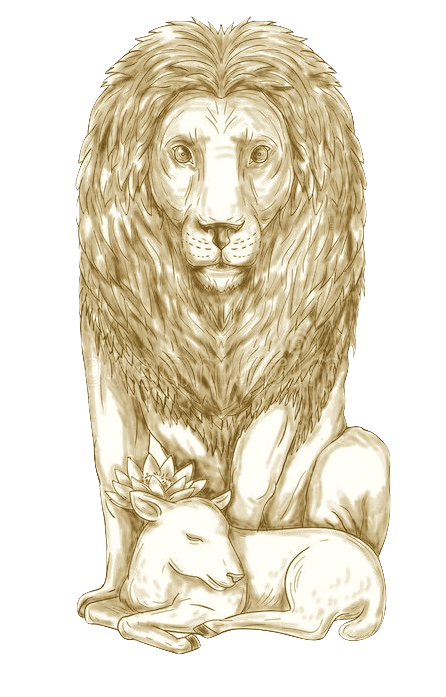
To add one more complication, the Roman deity Mars is cognate with the Greek deity Ares. Ares was a true jerk of a deity, being solely focused on war as a force of destruction and chaos. War under Mars, on the other hand, was seen as a stabilizing force — the threat of war brought peace. Now, Ares lends his name to the first zodiac constellation, Aries, which time period begins near the end of March and the symbol of which is… a sheep. The lamb.
March is like that. It is the season of new buds and sap, eggs and lambs. But it can also be the time of the Snow Moon and Frost Giants. Warm green life and cold white death braided together in these marching days. Winter is broken, but summer is still distant. It’s time to garden, but I sure don’t want to go out there in this petrifying weather.
Best wait on the lamb. Whenever he shows up…

St David’s Day

Dewi, whose name was Christianized into David, is the patron saint of Wales. He was one of many students of the 5th century “good magician”, Saint Illtud, the reputed cousin of King Arthur who created the blending of Celtic mysticism and Oriental asceticism that would become the Celtic monastic tradition. Interestingly, David was one of the early proponents of vegetarianism, and his devotees largely followed suit.
David’s monastery at Mynyw, which took on his name, St David’s in Pembrokeshire, was and remains central to Christianity in Wales. This bishopric developed into the focus of Welsh autonomy in the late Middle Ages, as Anglo-Norman influence began to spread out of Canterbury. Thus St David became the rallying figure and patron of his people. March 1st is both his feast day and a day of national celebration of Welsh history and culture. Though it is not a national holiday, as St Patrick’s Day is to Ireland (because Wales is still colonized), this day is celebrated with parades, concerts and poetry competitions (or eisteddfodau) throughout Wales, particularly in schools.
Today is also the day to “wear the leek” to drive the evil spirits of winter away — and to show your support of Welsh language, culture and history. Most of the Matter of Britain has roots in Welsh soil and rock. The Mabinogion, Merlin, Arthurian legend, the resistance movements of Caradoc and Buddug, the famous college of druids on the Isle of Anglesey — all these are from the land now called Wales, though its more proper name is Cymru.
Welsh has an unkind etymology. Its oldest roots are in Caesar’s name for a Gaulish tribe in what is now the south of France, the Volcæ. This name was incorporated into Germanic languages and first was applied to the Gauls generally. Then it was carried north and applied specifically to the peoples of Britain, who were only similar to Gauls in that they spoke related, though mutually unintelligible, languages. As the appellation migrated north it was mangled until it came to mean “not Anglo-Saxon”, “foreigner”, even “servile” or “not free”. Mind you, these were the native inhabitants of nearly the entire island of Britain — many were urbane Roman citizens! — and those who were giving them this name were the actual intruding foreigners. But that’s English for you.
So call them their ancient name — the Cymri. This is very likely what Dewi, Rhiannon, Arthur and all the rest might have called themselves. It means something like “compatriot”, not unlike the words that Indigenous cultures around the world use to name themselves — We, the People.
St David’s Day also commemorates a battle between the Cymri and the colonizing Saxons. Around 630CE on 1 March, King Edwin of Northumbria led his forces against King Cadwallon, leader of the North Britons. To confuse his adversaries, Edwin dressed his army in the same red jerkins that the Britons favored. But the Britons got wind of this before the battle and hit on a clever plan. They gathered the wild leeks that grew along streambeds in the West Country and wore these bright green leaves to distinguish friend from foe. The Northumbrian ruse was thwarted and Cadwallon led his army to victory. Edwin was killed in the battle and the Northumbrians were routed. To this day, the “wearing of the leek” is synonymous with Welsh nationalism, though through time another early spring bulb has replaced the wild onion, one that probably smells much better — the daffodil.

It is too early for daffodils here in the cold North, but they might be blooming in balmy climes. If you live where there are daffodils, or “Peter’s leek”, put one in your hat and remember the victories over colonialism — or, if you prefer, the billions of victories of vibrant Spring over Winter’s constraining Frost Giants.
Dydd Gŵyl Dewi Hapus!
St David’s Day also ushers in Shrovetide this year. These are the last four days before Lent begins on Ash Wednesday, the last days before the spring fast. It is Carnival time. (Carnival, by the way, means something like “goodbye to meat”… puts an interesting spin on things, no?) Up north, Carnival is celebrated mostly with pancakes and ball games.
Pancakes are a delicious way to use up all the dairy and fats that you won’t be able to eat in Lent. They are also easy food to eat on the run — which is what the ball games are. Running. Mostly. These are not tame matches on a marked pitch with rules and referees. There may not even be an actual ball, just a roundish object that can be tossed and carried. There are many variants, from classic futbol with almost rules, to hurling with rather fewer rules, to chucking around a silvered chunk of wood with no rules at all. It is not unusual for the ball course to cover an entire village or neighborhood, nor is it abnormal for the game to last for more than a day, with players rotating in and out. Mostly to go eat pancakes and drink beer. In many towns with the spring Ba’ games, there are boards on the windows of homes and shops this weekend because it is also not unusual for these games to get rowdy. Most players will go home with some injuries, and there have been some few fatalities in the hundreds of years that this tradition has carried on. Mostly there’s just a lot of mud and a bit of blood. And then it’s off to the pub for more pancakes and beer.
Carnival is also a time for parades and fairs and mischief. The Latin Quarter New Orleans Mardi Gras parade is the gold standard, though it’s hard to pull off that much exposed flesh in most of the north this time of year. Many parades up north, instead, feature giants. Costume puppets up to 15 feet tall that can take two or more people to wield go marching down the market street today, the Saturday before Lent. Tomorrow, the Sunday before Lent, is Pancake Sunday in Brittany, though the pancakes are crepes down there. Shrove Monday is named Collop Monday, a collop being a rough hunk of meat that is either roasted and eaten before Wednesday or is salted to last until after Lent. Shrove Monday is also known as Peasen Monday, and it is traditional to eat pea soup, for much the same reasons that people eat black-eyed peas on New Year’s Day.
Shrove Monday usually sees the beginning of mischief. It is Nicky Nan Night in Cornwall, among other places. This is a sort of trick-or-treating for pancakes. If you give the little blighters a pancake, they are supposed to take their pranks elsewhere. I suspect this rule breaks down from time to time. At some point on Shrove Monday or Tuesday, it will also be barring out time. Kids will lock the school door, barring out their teachers and yelling “Bear, bear, give us a holly” which means roughly “We’re not unlocking the door until you give us an extra holiday”. Which, of course, the teachers grant them. (Because it’s not just the little blighters that get the holiday… I do wonder sometimes why the teachers even bother trying to get in… “Oh dear, it’s locked… Well, off to the pub!”)
On Tuesday, in Catholic countries, and even some Protestant places, the Pancake Bell rings around midday. People go confess their sins — or, get shriven, hence Shrove Tuesday — then they gather for a pancake supper. When the bell rings, shops are obliged to close for the day and not reopen until Thursday. This is when most barring out happens. Then the kids go door to door, caroling for pancakes and sweets. In Scotland, Shrove Tuesday is a popular time for divination. It is Bannock Night, where little trinkets that each carry significance for the future are baked into an oatcake. Whatever you bite down on marks the coming year.
And then it’s Ash Wednesday. However strict (or not) your Lenten fast may be, this beginning of Lent is usually observed with a full fast and total abstinence. Parishioners go to Mass, carrying a bit of palm from last year’s Palm Sunday. This is burned and then used to mark the forehead, reminding us of our temporality. Today all utensils and pots for preparing and eating meat are washed and put away.
This year, Ash Wednesday falls on St Piran’s Day, which is anything but a solemn observance and Cornwall’s “national” day. (If they had such things…) I do wonder which impulse is going to win out. Maybe both. Start drinking on Tuesday… then roll out of bed at 5pm on Wednesday for ashes and abstinence… because you can’t ingest anything else anyway.
The Sap Moon was new yesterday. Tonight, about a half hour after sunset, go out and look to the west. The crescent Moon will be smiling well above the horizon alongside brilliant Venus. But a few degrees down from the pair, you’ll find another bright “star” descending into the west. This will be Mercury. At magnitude -1, Mercury is as bright as it gets. For the first two weeks of March, the two innermost planets will be hugging the sun, though going opposite directions. Venus is in retrograde and will continue to move closer to the sun, westwards across the sky each night until April 12th. It will pass the sun and become a morning star on the 22nd. Still bright though! Mercury is moving eastwards until the middle of March, when it too will shift to retrograde motion.
The Sap Moon is full on Pi Day, Friday, March 14th, at 2:55am. In my part of the world this full moon will be in full eclipse. Totality will be visible from much of North America, though you will lose sleep for this one. The penumbral phase begins around midnight here on the Eastern seaboard. Partiality begins around 1am, and totality begins around 2:25am with peak at 2:55am. Totality ends around 3:30am, and the whole show is over about an hour before sunrise, which happens at 7am on the 14th.
And then we should get to have pie all day on 3.14 2025… except it’s a Friday in Lent. So you might as well just go back to bed.
The vernal equinox takes place under the Sap Moon this year. In my part of the world, the true equinox, the day when day and night are equal, is St Patrick’s Day, March 17th. This falls on a Monday this year, so I will probably put off my annual trek to watch the migrating shore birds on Lake Champlain until the weekend. On the other hand, if the weather is amenable, I will plant my peas on the equinox. That doesn’t take too long, and after the time change on the 9th, there will be plenty of light in the evening. I’m just hoping that this snow melts by then. I may be shoveling it into the ravine just to be able to plant.
Bran, the British sun deity, regains his power when the sun, in its apparent northward journey along the horizon, passes the ecliptic on the 20th at 5:01am… about two hours before sunrise in my part of the world. (Again, time change… means plunging the mornings back into darkness…) When people talk about the equinox, they are usually talking about this moment in the sun’s journey. Or that’s the day they are talking about anyway. However, day length is changing so rapidly at this time of the year that in just three days between the 17th and the 20th, the day has already gained over ten minutes. Look up when you see a 12-hour day, and then compare that to day length on the 20th. It is always amazing to note how fast the days are lengthening!
This year the Sap Moon enters its final quarter on World Water Day. Many traditions see the moon as a watery influence. (The moon, methinks, looks with a watery eye…) The last quarter of the moon has the darkest nights, and darkness too is associated with deep water. So let it flow on March 22nd. And then the Sap Moon goes dark on the Feast of St Mark, Saturday March 29th. This dark Moon will give us a partial solar eclipse, also visible in my part of the world. The sun will rise in eclipse and the maximum darkening will be about 20 minutes after sunrise.
And then the Greenleaf Moon is new on the 30th, which is also Mothering Sunday, or Refreshment Sunday, the time to relax the rules of Lent for a day. But that is a story for the next lunation.
©Elizabeth Anker 2025

 By My Solitary Hearth
Sigh (of contentment), this has been a joyously ‘delicious’ read!
LikeLiked by 1 person
Any celebration with pancakes is alright by me!
LikeLiked by 1 person