


We don’t like mothers very much in this country. Yes, today is Mother’s Day, but how do you feel about that? Obligated to make a phone call, a Zoom meeting? Did you slap your head, remembering that you forgot to get a card? Did you then remember that cards aren’t really a thing anymore in the era of enshittification, and what do you do now for easy greetings? Maybe you could send flowers? Or sponsor a tree planting in her name? Or just pretend like you never saw this and forgot? Because we forget much in these days of flux.
You have affectionate feelings for your mother, I’m sure, no matter how complicated by overlying tensions they might be. You love your mother, probably love the idea of motherhood in some fashion. But do you like your mother? Do you like the idea of mothers? Have you ever considered these questions?
Very likely not. Mother is a concept that we do not question. But I will answer it for you. In all probability, you don’t like mothers very much.
I am not talking about personal resentment or personality clashes, though those feed into the dislike. This is a cultural problem. In this country we have mawkish caricatures in pink and soft light. We have baby showers and sentimental portraits. We put Mother on a pedestal — the better to keep her out of the way.
We do not listen to her. We do not give her what she needs. We do not care what she wants. We do not truly love her. And we are continually embarrassed by her existence. Because it reminds us of what we owe to others, of our dependence, of our utter lack of self-sufficiency, of our aging body and the sagging, befuddled future that awaits it. We can’t be self-made folks when we account for our mothers. We can’t be eternally youthful but mature in body, perennially strong in intellect, and unchangingly powerful in relationship when we are confronted with the physical fact of our mothers. We can’t tolerate that there is one person in the world who knew us and knows us at our weakest and stupidest. We don’t want to be in debt that can never be repaid, can not even be properly acknowledged with the tools we set aside for that — cards, flowers, Mother’s Day.
What would a real day for mothers look like? For one thing, it would be every day because that’s how much we owe. For another, there would be less pink and far more practical.
Mothers in this country are in a constant state of conflict. Mothers are supposed to do it all, preferably in silence and self-sacrifice. Supposed to feed, clothe, nurse, teach, protect. Love unconditionally. Supposed to inculcate values and societal norms. Supposed to be there for every need. And yet also supposed to be household providers and thus employed somewhere else many hours of the day. Or night. Mothers are also supposed to be individuals who have full lives that are not tied to their children. Supposed to have careers, not merely jobs. Supposed to cultivate interests and be interesting. Supposed to be independent — so that we do not feel the burden of her attachment and our dependence.
Mothers are supposed to laud our every accomplishment but refrain from offering advice, much less criticism. Mothers are supposed to watch our every step but from a distance, preferably from behind. Mothers are supposed to keep us out of trouble but stay out of our way when the troublesome things we do are what we desire. Mothers are never supposed to point out that the trouble we cause hurts us as much as it hurts everything else, including our mothers.
In this country, we put mothers in fetters. Mothers can not be what we want because what we want is not possible. It is not possible to provide food for the table through wage-work and be at home to prepare that food for dinner. It is not possible to love fiercely and yet remain aloof and unconcerned. It is not possible to be a mother on a pedestal, one that graciously accepts our belated cards and insufficient gratitude with no expectations or wishes of her own. It is not possible to care and not be cared for.
We do not recognize mothers because we do not like to care. We want to be cared for only when we want that care. We do not want the obligation to care for others. Motherhood is the embodiment of care work, and we do not like care work at all.
So back to the question: what would Mother’s Day look like if we loved our mothers?
Let’s start with the basics. Bodily sovereignty and equality — in responsibility and in reward. The total freedom to decide whether or not to be a mother. The divorce of femaleness and motherhood. The assignment of duties to no gender and the expectation that all people will do what needs to be done — including emotional doings. The assignment of equal value to all work and to equal reward to all equally valued work. The assignment of roles to nobody and the total fulfillment of roles by everybody. Of course, there are biological limitations; these should be treated as insufficiency on the male side, not as female handicaps. But in these very few cases where females must do the necessary work, males must assist in every possible way, and as assistants, not leaders or experts. Men do not know how to be pregnant and can offer zero advice on the subject, but they absolutely must offer help to women — all women, not merely the ones they impregnate — when women’s bodies are doing this difficult and energy-consuming reproductive labor for our species.
Those are the basics. What other things might be in a real Mother’s Day? What is Mother’s Day? It is the day we express our gratitude and love for the people who made us.
This is the point where I will bring the rest of the world into the discussion. We can be loving, caring and grateful to the singular women who gave birth to each of us and still not be doing enough for our mothers. Because our mothers are not the only people who made us. Yes, there are fathers and grandparents and other human ancestors. But more importantly there is the whole world, all of it contributing to your existence and well-being. You would not exist if there were not stars, bacteria, rivers, jellyfish, soil, ruminants, rain, grass, fire, fresh air, and all the infinity that came before you, that feeds you, that made your body and keeps it alive. You are utterly dependent on more than the woman who gave birth to you — and for your entire life, not merely childhood.
A true Mother’s Day would acknowledge this interdependence and would celebrate it. We would love the rocks and trees and birds because they are part of us and we are part of them. This whole world is our mother and we are mother as well. We are cared for by every thing, and we owe a debt of care to every thing.
What would a real Mother’s Day look like? There would be an end to war, to oppression, to waste. There would be an end to destruction, an end to carelessness, an end to private gain at the expense of any other thing. There would be reciprocity, responsibility, respect for all of our Mother and all of our mothers. There would be love freely given and overflowing to our Mother and every one of our mothers. There would be gratitude. There would be community.
I do not think this Mother’s Day will come to pass in my lifetime, but I also do not think it beyond human capacity. In fact, every indication points to this being the ground state for humans, our natural ways of being, the way we lived for most of our existence. There are large pockets of this true humanity even now, when everything in the dominant culture wants to suppress it and every tool of that culture is bent on its annihilation. If true love for our mothers has survived the last few centuries, then it must be a very strong tendency. It will return.
So for now, I wish you all a happy mother’s day. And keep dreaming of the day when that will be truly possible.
My Grandmother’s Hands
My grandmother was born over a century ago in Ireland. We don’t know where. She would never say. She and her twin sister were adopted by the Daleys of Chicago. She changed from foundling to heiress as she crossed the Atlantic. Her name and her ancestors were abandoned on the quay — and she was quite insistent on this. Her adopted family was her only family.
She had many stories. She lived in a house with a ballroom. She had a coming-out celebration that included people in high school history books. She was not-quite-engaged to a nephew of Al Capone for a time. Her wedding to my grandfather was a lavish spread in the Daily News. The softly faded clippings lived in a shadow box with diamond pins, silk ribbons and other obscure bits and bobs. She was the most magical being I have ever known.
She had these stories, but her true magic was in her hands. She is still the inspiration for all that I do. She embodied what I believe is the good life. She did start from a position of privilege, and my grandfather added to that. But they used their wealth unlike other wealthy folk. They adopted my grandmother’s sister’s four children, raising a family of seven all together in a nice, but not lavish, Chicago home. They were not flashy, though my grandma loved her bright colors. They smoked and drank like the rest of their generation, but not to excess that I remember. And I was an irritatingly observant child, according to many of my older relatives.
They traveled, I think, but they didn’t have vacation homes. Cars were not an obvious point of pride in their life; my grandmother never did learn to drive. In old age, they didn’t have much in the way of property at all, in truth. They lived the last years of my grandfather’s life in a converted motel on the beach in Biloxi, Mississippi — a sort of commune for a hodge-podge of odd old Midwesterners escaping the cold. There was a pool; everybody had their own suite of rooms; there was a community hall with movie nights and ballroom dancing, pool tables and perpetually occupied checker-boards. There was Dixieland jazz and Creole story-telling and dubious art classes. Behind the motel, my grandpa raised tomatoes, peppers, basil, eggplant and okra, sometimes corn, sometimes sunflowers. I learned about fire ants in this garden.
When grandpa died of brain cancer, my grandmother moved in with us for a while. Eventually she moved into her own small condominium. It was here that I was apprenticed to her magical arts. My grandmother was the best cook I have ever known. She could improvise in any cuisine, harmonize any flavors. She made symphonies in the kitchen. Her favorites were the Italian-American recipes of her Chicago childhood, but she was equally fearsome with Cajun spices and German stews and French sauces. She did not like baking much, but then she didn’t like eating bread all that much either. She did make muffins and soda bread and scones for Sunday brunches, and she baked cookies for holidays. But she also made her own noodles and pizza crust — both of which were simply astonishing to a teenager.
In that kitchen, I learned to pickle anything and make fruit into jams and chutneys and preserves. I learned how to make simple ricotta and turn that into lasagne. I learned the distinctions between various thymes and oreganos. I learned how to make ice cream and butter, though she most often bought the latter. I learned what tomatoes make the best sauce and what peppers will melt into sweetness when sautéed in olive oil. I learned the subtle stages of roux-making and the difference between sautéed and caramelized onions. I learned the entire alphabet of herbs and spices and which companies sold the best of each. And I learned to savor food, to savor the whole process of food, from producing it to ingesting it.
If not for that kitchen, I would not be the person I am today. But it didn’t stop there. Grandma made magic in many ways. Her hands embroidered fancy napkins and table-covers. She crocheted and knitted all manner of things, from clothing to small toys and dolls. She made intricate lace with fine knot-work I can no longer even see. She tailored her own clothes and could alter anything bought off the rack into something divine. She made baptismal dresses for all her grandchildren. She did not live long enough to make prom dresses for us, but I suspect that would have happened had she survived.
Cancer took her too when I was in high school. I took care of her at the end, cooking food that she could no longer taste, ironing sheets and table linens for no reason other than it was the done thing in her world. I read to her and listened to her stories. I brushed her peach-fuzz hair until it was gone and washed her favorite satin pajamas — eye-watering lime green and fuchsia. I calmed all the nervous worries spawned by chemo and morphine — there were bears on the ceiling with alarming regularity.
But I never was brave enough to ask about Ireland. I regret this now. There were Irish echoes in much of her personality. She was Irish Catholic and all that implies about a rather extensive pantheon and annual calendar. She had rituals and habits that I now recognize as Irish, little tics that did not come from a Chicago debutante’s milieu. She always touched wood and tossed spilled salt over her shoulder. She would not stir a pot counter-clockwise. She drank whiskey by the pint and sang wordlessly when working. She loved laughter and had a wicked sense of humor. She did not always stick to mundane reality and mere actuality. She fervently believed in spirits of the land and hearth and had active relationships with many of them — even before morphine. I would have liked to learn how these things came to be in her. Because they seem to be genetic. Well, except the whiskey. Can’t stand the stuff…
I can’t say that I miss her. I don’t think she ever left me. I still get prompting in the kitchen and inspiration when looking at a pile of wool. I hear her cackle of approval when things are going right and her sharp admonishments when I am less than I can be. I think she likes what I’m doing now. I think she is in these words. I think her hands are still shaping mine and helping me tell these stories to the world. She is still showing me how to hand-craft the good life. This is her gift to the future as much as my own. And it is a magical gift indeed!
Rogation Sunday
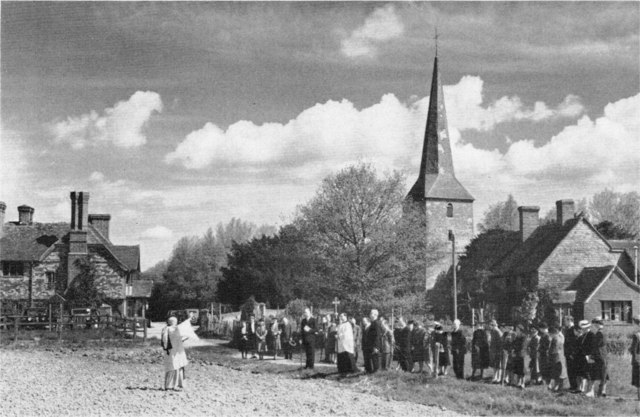
Today is also the day that Christians celebrate Rogation. As it is preserved in modern times, it is a Protestant holiday, though its roots go nearly back to the founding of the Church. In modern times, Rogation Days are woven throughout the Roman Catholic liturgical year, but none are much observed in practice. However, the Anglicans and the Lutherans kept the festival alive pretty much intact.
Protestants mark the sixth Sunday after Easter as Rogation Sunday. The name comes from the Latin rogare, meaning “to ask”. This is the day that the peasantry asks deity to grant them a good harvest. It is marked with processions and blessings on the plowed fields and potluck dinners and the sort of ambulatory begging that accompanied all the holy days in Northern Europe.
In the 16th century upheavals, the Protestants scrubbed all the Catholic imagery out of the observance, claiming that it was entirely too pagan. But for whatever reason they kept the day itself — which is nothing but a pagan appeal to the local land spirits, with not even an attempt at disguise — proving that peasants will stubbornly cling to the path of whatever works, which usually means keeping faith with the old gods.
I find all this immensely amusing.
©Elizabeth Anker 2026


